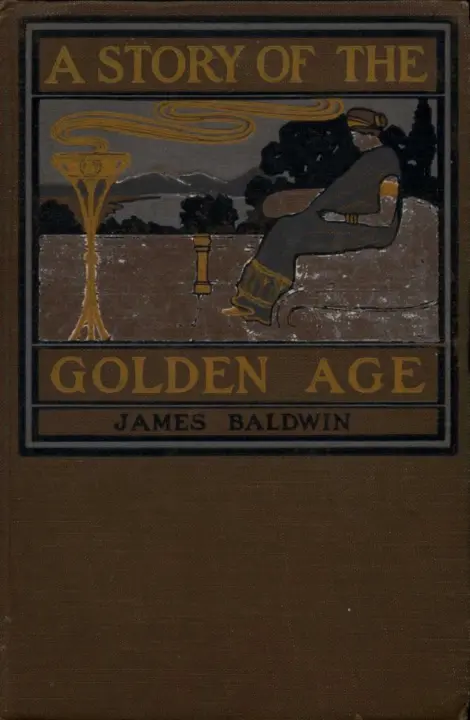
A Story of the Golden Age
James Baldwin
THE CLASSIC COLLECTION · 1892
"Six Centuries of English Poetry: Tennyson to Chaucer" by James Baldwin is a comprehensive anthology of Classic English poetry spanning from the 14th to the 19th century. Written in the late 19th century, this work is part of a series aimed at education, designed for students and teachers to explore notable English literary pieces alongside critical annotations and historical context. The book features selections from renowned poets like Tennyson, Wordsworth, and Chaucer, offering readers an insight into the evolution of English poetic expression through various eras. At the start of the anthology, Baldwin introduces the reader to the historical development of English poetry, suggesting that its roots trace back hundreds of years before Chaucer. He elaborates on the influence of earlier poets and the transition of language, connecting these historical elements to the richness found in later works. Baldwin points out the significance of understanding poetry not just as a literary form but as a reflection of cultural and historical shifts, emphasizing the importance of familiarizing oneself with poetic creations to appreciate their beauty fully. The opening sets a scholarly tone while making an engaging argument for the study of poetry as a vital component of English literature.
Introduction adapted from the source catalogue; source summaries may be automatically generated.
Free to read · English · 75,364 words · No account needed
MAKE TIME FOR A GOOD BOOK
On by default. Untick to stop anonymous reading totals. Each page counts after 10 seconds in view. How this works.
Anonymous counting is on unless you have switched it off.
"The influence of the poetry of the past lasted; new elements were added to poetry, and new forms of it took shape. The study of the Greek and Latin classics revived, and with it a more artistic poetry. Not only correct form, for which Pope sought, but beautiful form was sought after. Men like Thomas Gray and William Collins strove to pour into their work that simplicity of beauty which the Greek poets and Italians like Petrarca had reached as the last result of genius restrained by art. . . . Two things had been learned. First, that artistic rules were necessary, and, secondly, that natural feeling was necessary in order that poetry should have a style fitted to express nobly the emotions and thoughts of man. The way was therefore now made ready for a style in which the Art should itself be Nature, and it sprang at once into being in the work of the poets of this time. The style of Gray is polished to the finest point, and yet it is instinct with natural feeling. Goldsmith is natural even to simplicity, and yet his verse is even more accurate than Pope's. Cowper's style, in such poems as the 'Lines to my Mother's Picture,' arises out of the simplest pathos, and yet it is as pure in expression as Greek poetry."--STOPFORD BROOKE.
"At last there started up an unfortunate Scotch peasant (Burns), rebelling against the world, and in love, with the yearnings, lusts, greatness, and irrationality of modern genius. Now and then behind his plough, he lighted on genuine verses, verses such as Heine and Alfred de Musset have written in our own days. In those few words, combined after a new fashion, there was a revolution."--TAINE.
Poets of the Eighteenth Century.
=Alexander Pope= (1688-1744). See biographical note, page 155.
=Thomas Parnell= (1679-1718). "The Hermit"; short poems.
=Edward Young= (1684-1765), "Night Thoughts"; "The Last Day";
"Resignation."
=Allan Ramsay= (1686-1758). "The Gentle Shepherd": "Scots Songs"; "Fables
and Tales."
=John Gay= (1688-1732). "The Beggar's Opera"; "The Shepherd's Week"; "Trivia"; "Rural Sports"; fables, and other short poems.
=Matthew Green= (1696-1737). "The Grotto"; "The Spleen."
=John Dyer= (1698-1758). "Grongar Hill"; "The Fleece."
=Robert Blair= (1699-1746). "The Grave."
=James Thomson= (1700-1748). "The Seasons"; "The Castle of Indolence."
=Samuel Johnson= (1709-1784), "The Vanity of Human Wishes"; "London."
=Richard Glover= (1712-1785). "Leonidas"; "Admiral Hosier's Ghost"; "The
Athenaid."
=William Shenstone= (1714-1763). "The Schoolmistress"; "Pastoral Ballads."
=Thomas Gray= (1716-1771). See biographical note, page 139.
=William Collins= (1721-1759). Odes and other short poems.
=Mark Akenside= (1721-1770). "The Pleasures of the Imagination."
=Oliver Goldsmith= (1728-1774). See biographical note, page 128.
=Thomas Warton= (1728-1790). "The Pleasures of Melancholy"; "The Triumph
of Isis"; short poems.
=William Cowper= (1731-1800). See biographical note, page 122.
Your reading position is saved on this browser. Take it to another device with a library code. Reading pages adapt to text, rather than matching a printed edition.
James Baldwin
James Baldwin
James Baldwin
James Baldwin
BEHIND THE BOOK
This eBook is for the use of anyone anywhere in the United States and most other parts of the world at no cost and with almost no restrictions whatsoever. You may copy it, give it away or re-use it under the terms of the Project Gutenberg License included with this eBook or online at www.gutenberg.org. If you are not located in the United States, you will have to check the laws of the country where you are located before using this eBook. Read the source licence.
The original source file, including credits and licence, is retained by this library. Request an original-format copy at no charge. Please include the book title and Project Gutenberg identifier #30235.
KEEP YOUR CURIOSITY GOING

Eric Mackay
Edmund Gosse
Sophia Margaretta Hensley
Gilbert Parker
George MacDonald

Elizabeth Bibesco