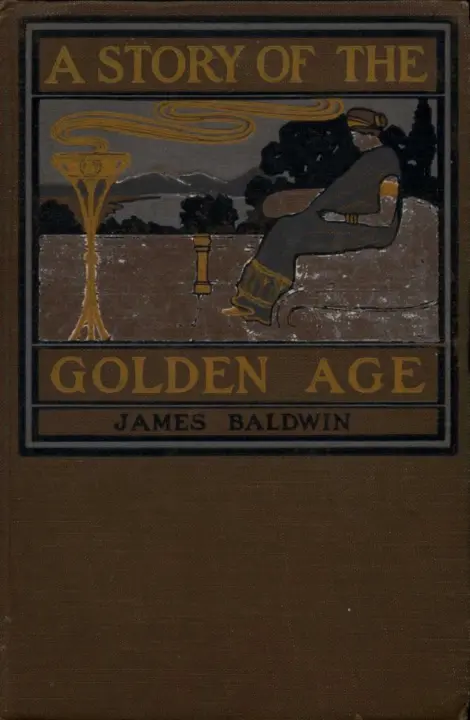
A Story of the Golden Age
James Baldwin
THE CLASSIC COLLECTION · 1892
"Six Centuries of English Poetry: Tennyson to Chaucer" by James Baldwin is a comprehensive anthology of Classic English poetry spanning from the 14th to the 19th century. Written in the late 19th century, this work is part of a series aimed at education, designed for students and teachers to explore notable English literary pieces alongside critical annotations and historical context. The book features selections from renowned poets like Tennyson, Wordsworth, and Chaucer, offering readers an insight into the evolution of English poetic expression through various eras. At the start of the anthology, Baldwin introduces the reader to the historical development of English poetry, suggesting that its roots trace back hundreds of years before Chaucer. He elaborates on the influence of earlier poets and the transition of language, connecting these historical elements to the richness found in later works. Baldwin points out the significance of understanding poetry not just as a literary form but as a reflection of cultural and historical shifts, emphasizing the importance of familiarizing oneself with poetic creations to appreciate their beauty fully. The opening sets a scholarly tone while making an engaging argument for the study of poetry as a vital component of English literature.
Introduction adapted from the source catalogue; source summaries may be automatically generated.
Free to read · English · 75,364 words · No account needed
MAKE TIME FOR A GOOD BOOK
On by default. Untick to stop anonymous reading totals. Each page counts after 10 seconds in view. How this works.
Anonymous counting is on unless you have switched it off.
13. "=Tirra lirra.=" French tire lire. Probably intended to imitate the
note of the lark.
[23:A] Malory's King Arthur, Part III.
[24:A] Tennyson's Elaine.
I come from haunts of coot{1} and hern,{2}
I make a sudden sally,
And sparkle out among the fern,
To bicker{3} down a valley.
By thirty hills I hurry down,
Or slip between the ridges,
By twenty thorps,{4} a little town,
And half a hundred bridges.
Till last by Philip's farm I flow
To join the brimming river,
For men may come and men may go,
But I go on forever.
I chatter over stony ways,
In little sharps and trebles,
I bubble into eddying bays,
I babble on the pebbles.
With many a curve my banks I fret
By many a field and fallow,
And many a fairy foreland{5} set
With willow-weed and mallow.
I chatter, chatter, as I flow
To join the brimming river,
For men may come and men may go,
But I go on forever.
I wind about, and in and out,
With here a blossom sailing,
And here and there a lusty trout,
And here and there a grayling,
And here and there a foamy flake
Upon me, as I travel,
With many a silvery waterbreak
Above the golden gravel,
And draw them all along, and flow
To join the brimming river,
For men may come and men may go,
But I go on forever.
I steal by lawns and grassy plots,
I slide by hazel{6} covers;
I move the sweet forget-me-nots
That grow for happy lovers.
I slip, I slide, I gloom,{7} I glance,
Among my skimming swallows;
I make the netted sunbeams dance
Against my shady shallows.
I murmur under moon and stars
In brambly wildernesses;
I linger by my shingly{8} bars;
I loiter round my cresses;
And out again I curve and flow
To join the brimming river,
For men may come and men may go,
But I go on forever.
This little lyric forms a part of "an idyl" of the same title, published in 1855. The poet introduces it in the following manner:
"Here, by this brook, we parted; I to the East And he to Italy--too late--too late: . . . . . . . . . Yet the brook he loved . . . . . . . seems, as I re-listen to it, Prattling the primrose fancies of the boy, To me that loved him; for, 'O brook,' he says, 'O babbling brook,' says Edmund in his rhyme, 'Whence come you?' and the brook, why not? replies: 'I come from haunts of coot and hern,'" etc.
In reading this poem, observe how strikingly the sound is made to
correspond to the sense.
Your reading position is saved on this browser. Take it to another device with a library code. Reading pages adapt to text, rather than matching a printed edition.
James Baldwin
James Baldwin
James Baldwin
James Baldwin
BEHIND THE BOOK
This eBook is for the use of anyone anywhere in the United States and most other parts of the world at no cost and with almost no restrictions whatsoever. You may copy it, give it away or re-use it under the terms of the Project Gutenberg License included with this eBook or online at www.gutenberg.org. If you are not located in the United States, you will have to check the laws of the country where you are located before using this eBook. Read the source licence.
The original source file, including credits and licence, is retained by this library. Request an original-format copy at no charge. Please include the book title and Project Gutenberg identifier #30235.
KEEP YOUR CURIOSITY GOING

Eric Mackay
Edmund Gosse
Sophia Margaretta Hensley
Gilbert Parker
George MacDonald

Elizabeth Bibesco