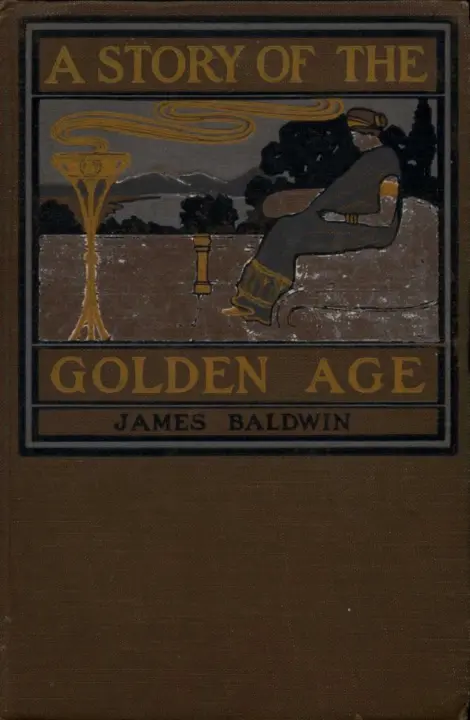
A Story of the Golden Age
James Baldwin
THE CLASSIC COLLECTION · 1892
"Six Centuries of English Poetry: Tennyson to Chaucer" by James Baldwin is a comprehensive anthology of Classic English poetry spanning from the 14th to the 19th century. Written in the late 19th century, this work is part of a series aimed at education, designed for students and teachers to explore notable English literary pieces alongside critical annotations and historical context. The book features selections from renowned poets like Tennyson, Wordsworth, and Chaucer, offering readers an insight into the evolution of English poetic expression through various eras. At the start of the anthology, Baldwin introduces the reader to the historical development of English poetry, suggesting that its roots trace back hundreds of years before Chaucer. He elaborates on the influence of earlier poets and the transition of language, connecting these historical elements to the richness found in later works. Baldwin points out the significance of understanding poetry not just as a literary form but as a reflection of cultural and historical shifts, emphasizing the importance of familiarizing oneself with poetic creations to appreciate their beauty fully. The opening sets a scholarly tone while making an engaging argument for the study of poetry as a vital component of English literature.
Introduction adapted from the source catalogue; source summaries may be automatically generated.
Free to read · English · 75,364 words · No account needed
MAKE TIME FOR A GOOD BOOK
On by default. Untick to stop anonymous reading totals. Each page counts after 10 seconds in view. How this works.
Anonymous counting is on unless you have switched it off.
Forlorn! the very word is like a bell
To toll me back from thee to my sole self!
Adieu! the fancy cannot cheat so well
As she is famed to do, deceiving elf.
Adieu! adieu! thy plaintive anthem fades
Past the near meadows, over the still stream,
Up the hill-side; and now 'tis buried deep
In the next valley-glades:
Was it a vision, or a waking dream?
Fled is that music:--do I wake or sleep?
"This poem," says Leigh Hunt, "was written in a house at the foot of Highgate Hill, on the border of the fields looking towards Hampstead. The poet had then his mortal illness upon him, and knew it; never was the voice of death sweeter."
1. =Lethe-wards.= That is, towards Lethe. Lethe was one of the rivers of Hell. Its name means "forgetfulness." Milton describes it thus:
"A slow and silent stream,
Lethe, the river of oblivion, rolls
Her watery labyrinth, whereof who drinks
Forthwith his former state and being forgets--
Forgets both joy and grief, pleasure and pain."
--Paradise Lost, ii, 583.
2. =Dryad.= A wood-nymph. From Gr. drus, an oak tree. The life of the Dryad was supposed to be bound up with that of her tree.
"The quickening power of the soul, like Martha, is 'busy about many things,' or, like a Dryad, living in a tree."--Sir John Davis.
3. =Provençal song.= Song of the troubadours, a school of lyric poets that flourished in Provence, in the south of France, from the eleventh to the thirteenth century. A love song.
4. =Hippocrene.= The "Fountain of the Horse" (Fons Caballinus). A fountain on Mount Helicon, Boeotia, sacred to the Muses. It was said to have been produced by the horse Pegasus striking the ground with his feet. Its waters were supposed to be a source of poetical inspiration.
Longfellow, in "The Goblet of Life," says:
"No purple flowers--no garlands green,
Conceal the goblet's shade or sheen,
Nor maddening draughts of Hippocrene,
Like gleams of sunshine, flash between
Thick leaves of mistletoe."
5. =Bacchus and his pards.= Bacchus was frequently represented as riding on the back of a leopard, a tiger, or a lion, or in a chariot drawn by panthers.
=pards.= Spotted beasts.
See Dryden's "Alexander's Feast," third stanza, page 160.
6. Compare with Shakespeare's "A Midsummer Night's Dream," Act ii, sc.
i:
"I know a bank where the wild thyme blows,
Where oxlips and the nodding violet grows,
Quite over-canopied with luscious woodbine,
With sweet musk-roses and with eglantine."
Your reading position is saved on this browser. Take it to another device with a library code. Reading pages adapt to text, rather than matching a printed edition.
James Baldwin
James Baldwin
James Baldwin
James Baldwin
BEHIND THE BOOK
This eBook is for the use of anyone anywhere in the United States and most other parts of the world at no cost and with almost no restrictions whatsoever. You may copy it, give it away or re-use it under the terms of the Project Gutenberg License included with this eBook or online at www.gutenberg.org. If you are not located in the United States, you will have to check the laws of the country where you are located before using this eBook. Read the source licence.
The original source file, including credits and licence, is retained by this library. Request an original-format copy at no charge. Please include the book title and Project Gutenberg identifier #30235.
KEEP YOUR CURIOSITY GOING

Eric Mackay
Edmund Gosse
Sophia Margaretta Hensley
Gilbert Parker
George MacDonald

Elizabeth Bibesco