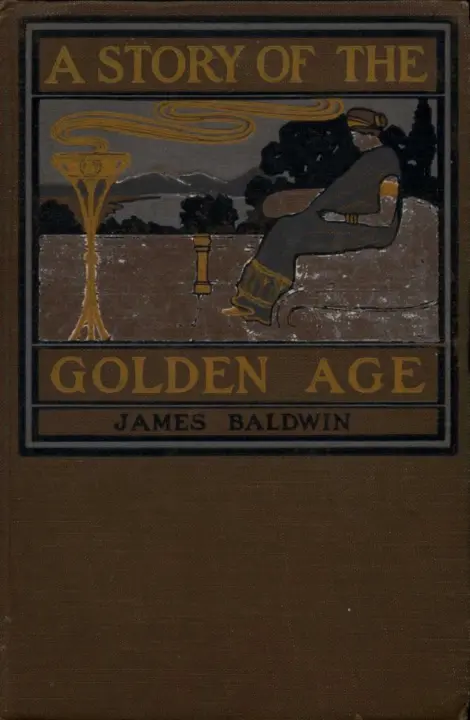
A Story of the Golden Age
James Baldwin
THE CLASSIC COLLECTION · 1892
"Six Centuries of English Poetry: Tennyson to Chaucer" by James Baldwin is a comprehensive anthology of Classic English poetry spanning from the 14th to the 19th century. Written in the late 19th century, this work is part of a series aimed at education, designed for students and teachers to explore notable English literary pieces alongside critical annotations and historical context. The book features selections from renowned poets like Tennyson, Wordsworth, and Chaucer, offering readers an insight into the evolution of English poetic expression through various eras. At the start of the anthology, Baldwin introduces the reader to the historical development of English poetry, suggesting that its roots trace back hundreds of years before Chaucer. He elaborates on the influence of earlier poets and the transition of language, connecting these historical elements to the richness found in later works. Baldwin points out the significance of understanding poetry not just as a literary form but as a reflection of cultural and historical shifts, emphasizing the importance of familiarizing oneself with poetic creations to appreciate their beauty fully. The opening sets a scholarly tone while making an engaging argument for the study of poetry as a vital component of English literature.
Introduction adapted from the source catalogue; source summaries may be automatically generated.
Free to read · English · 75,364 words · No account needed
MAKE TIME FOR A GOOD BOOK
On by default. Untick to stop anonymous reading totals. Each page counts after 10 seconds in view. How this works.
Anonymous counting is on unless you have switched it off.
25. William Wallace (1270-1305), the Scotch national hero was, like
Burns, a native of Ayrshire.
=aft=, often.
=amaist=, almost.
=amang=, among.
=ance=, once.
=auld=, old.
=belyve=, by and by.
=blate=, bashful.
=blinkin=, gleaming.
=blythe=, happy.
=braw=, brave, fine.
=cannie=, easy.
=carking=, fretting.
=certes=, certain.
=chows=, chews.
=claes=, clothes.
=convoy=, accompany.
=cracks=, talks.
=craws=, crows.
=drapping=, dropping.
=eydent=, diligent.
=fell=, tasty.
=flichterin=, fluttering.
=frae=, from.
=gang=, go.
=gars=, makes.
=guid=, good.
=hae=, have.
=haffets=, temples.
=hafflins=, half.
=halesome=, wholesome.
=hallan=, partition wall.
=hameward=, homeward.
=ingle=, fire.
=jauk=, trifle.
=kebbuck=, cheese.
=kens=, understands.
=lathefu'=, shy.
=lave=, the rest.
=lyart=, gray.
=miry=, muddy, dusty.
=moil=, labor.
=nae=, no.
=parritch=, porridge.
=pleugh=, plough.
=rin=, run.
=sair-won=, hard-earned.
=sowpe=, milk.
=spiers=, inquires.
=stacher=, stagger.
=strappin'=, strapping, stout.
=tentie=, attentively.
=towmond=, twelvemonth.
=uncos=, unknown things, new.
=wales=, chooses.
=wee bit=, little.
=weel=, well.
=wee things=, little folks.
=weel-hained=, well-kept.
=wiles=, knowledge.
=wily=, knowing.
=youngling=, youthful.
=younkers=, youngsters, children.
='yont=, on the other side of.
Wee, modest, crimson-tippéd flow'r,
Thou's met me in an evil hour;
For I maun crush amang the stoure
Thy slender stem.
To spare thee now is past my power,
Thou bonnie gem.
Alas! it's no thy neibor sweet,
The bonnie lark, companion meet!
Bending thee 'mang the dewy weet
Wi' spreckled breast,
When upward springing, blythe to greet
The purpling east.
Cauld blew the bitter-biting north
Upon thy early humble birth;
Yet cheerfully thou glinted forth
Amid the storm,
Scarce reared above the parent earth
Thy tender form.
The flaunting flowers our gardens yield,
High sheltering woods an' wa's maun shield;
But thou, beneath the random bield
O' clod or stane,
Adorns the histie stibble-field,
Unseen, alane.
There, in thy scanty mantle clad,
Thy snawie bosom sunward spread,
Thou lifts thy unassuming head
In humble guise:
But now the share uptears thy bed,
And low thou lies!
Such is the fate of artless maid,
Sweet flow'ret of the rural shade!
By love's simplicity betrayed,
And guileless trust,
Till she, like thee, all soiled, is laid
Low i' the dust.
Such is the fate of simple bard,
On life's rough ocean luckless starred!
Unskilful he to note the card
Of prudent lore,
Till billows rage, and gales blow hard,
And whelm him o'er!
Such fate to suffering worth is given,
Who long with wants and woes has striven,
By human pride or cunning driven
To misery's brink,
Till, wrenched of every stay but Heaven,
He, ruined, sink!
Even thou who mourn'st the Daisy's fate,
That fate is thine--no distant date;
Stern Ruin's ploughshare drives, elate,
Full on thy bloom,
Till crushed beneath the furrow's weight,
Shall be thy doom.
Your reading position is saved on this browser. Take it to another device with a library code. Reading pages adapt to text, rather than matching a printed edition.
James Baldwin
James Baldwin
James Baldwin
James Baldwin
BEHIND THE BOOK
This eBook is for the use of anyone anywhere in the United States and most other parts of the world at no cost and with almost no restrictions whatsoever. You may copy it, give it away or re-use it under the terms of the Project Gutenberg License included with this eBook or online at www.gutenberg.org. If you are not located in the United States, you will have to check the laws of the country where you are located before using this eBook. Read the source licence.
The original source file, including credits and licence, is retained by this library. Request an original-format copy at no charge. Please include the book title and Project Gutenberg identifier #30235.
KEEP YOUR CURIOSITY GOING

Eric Mackay
Edmund Gosse
Sophia Margaretta Hensley
Gilbert Parker
George MacDonald

Elizabeth Bibesco