THE CLASSIC COLLECTION✦An outlaw’s diary: the CommuneCLASSIC FREE BOOKS
An outlaw’s diary: the Commune
Cécile Tormay
THE CLASSIC COLLECTION · 1911
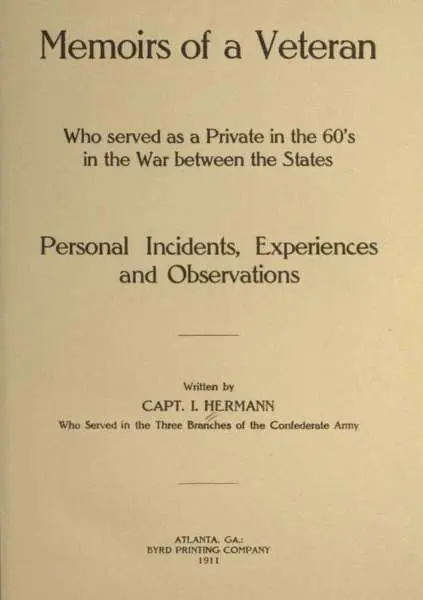
"Memoirs of a Veteran Who Served as a Private in the 60's in the War Between the States" by Capt. I. Hermann is a historical account written in the early 20th century. The book narrates the personal experiences and observations of Hermann, who enlisted in the Confederate Army during the American Civil War. Through his detailed anecdotes, the narrative explores themes of sacrifice, camaraderie, and the harsh realities of warfare from the perspective of a soldier on the front lines. The opening of the memoir introduces Capt. I. Hermann's reflections on the idealized visions of military life presented in propaganda, contrasting them with the grim realities he and his comrades faced. He recalls his enlistment in the Confederate Army in 1861 and the initial enthusiasm among fellow soldiers, driven by patriotism and duty to their homes. Hermann illustrates the early tensions that sparked the Civil War, recounting events like the defense of Fort Sumter, and shares vivid descriptions of his regiment's first encounters, including their experiences leading up to the Battle of Manassas. The early chapters set a foundation for Hermann's journey, highlighting both personal and collective struggles while providing insights into the complexities of war from an intimate viewpoint.
Introduction adapted from the source catalogue; source summaries may be automatically generated.
Free to read · English · 58,417 words · No account needed
MAKE TIME FOR A GOOD BOOK
On by default. Untick to stop anonymous reading totals. Each page counts after 10 seconds in view. How this works.
Anonymous counting is on unless you have switched it off.
In perusing your previous issue I noted Capt. Evan P. Howell's advertisement, which among others I was named as one absent without leave, and should I not report immediately to my command, he would publish me as a deserter. Now in simple justice to myself, I wish to inform Capt. Howell, as well as the public, that his statement is false, that I have a furlough granting me leave of absence and that under no consideration would I be away from my command,
Very respectfully,
I. Hermann.
At Home.
P.S.--Please forward copy of your next issue to Captain Howell
and charge expenses to me."
I returned to my friends and said, "Gentlemen, this is my reply, and when my time is up, I shall report, either to Dr. Paul Eve, or Captain Howell." Colonel Sol Newsome tapped me on the shoulder, saying, "Hurrah, Hurrah for you, Hermann." In a few days later, Sergeant W. H. Hines, and four men of my Company came to arrest me. I said to them, "You can't do it as long as I have authority to remain here," and showed them my furlough, which lacked about two weeks of having expired. They were all glad I was properly fixed and so expressed themselves. They were also glad of the opportunities they had to call upon their respective families, which they would not have had otherwise.
From Fenns Bridge I went to Macon to spend a few days with a cousin who lived there. As I walked the street one named Colson who belonged to the Provost Guard came up saying, "Ike old fellow, I have orders to arrest you." "What for, Colson?" He answered, he did not know. "Who gave you the orders?" He said "Major Roland." "Let us go up and see him." We walked up from Cherry Street to Triangular block, where Roland, who was commander of the Post, had his headquarters. The room was full of men and officers, among whom I recognized Captain Napier, who had lost a limb in Virginia; the rest were all strangers to me. Major Roland addressed himself to me "What can I do for you?" "You had me arrested." Colson was standing there; I looked at him; he said "You gave me the orders." "What is your name?" "Isaac Hermann." Roland brightened up; "You are the fellow I was after; you are reported as a deserter." I pulled my furlough, which was somewhat dilapidated from constant wear and tear; he scrutinized it closely, handing it back to me, saying, "This paper is forged; some brother countryman fixed it up for you." "You are a liar," I said. Quick as lightning he grabbed and drew his sword, which was lying on the table, exclaiming as he faced me, "I am an officer." In the meantime I executed a half about, drawing my pistol, saying: "I am a private; if you make a move I'll put daylight through you." And there we stood, facing each other for a few seconds, when one of the officers in the room approached me, saying in a whisper, "Put up your pistol, I am your friend." "Who are you?" "I am Paton Colquitt, Colonel of the 46th Ga. Reg't., stationed at Charleston, S. C., I am on my way to my command, but intend now to remain to see you out." I extended my hand and he shook it heartily. Major Roland looked very pale; the rest of the company present looked on with interest. Roland ordered a Sergeant and four men as a guard to escort me to the guard house. I said "I'll die first, right here, before I'll march through Macon, guarded like a horse thief. I have not done anything to be arrested for; I am known in Macon and will not submit to any such indignity." Colonel Colquitt stepped up to the table, saying, "Will you take me as sponsor for this gentleman, to report at any place you may designate, without a guard?" Roland could not refuse, so trembling he wrote me (a billet de logement): "To the Officer in Command at the Calaboose: Admit the Bearer. By order of Major Roland, Commanding Provost Post, Macon, Georgia." Before calling at the prison I passed to where my cousin lived. I stated what had happened, so that she would not look for me, as I was stopping at her house. She was much distressed and feared personal harm would befall me. I reassured her the best I knew how and requested her to let me have a blanket, if she could spare one, so that I could sleep on it that night. I rolled the blanket, tied the ends together with a string and drew it across my shoulder. On the way I thought of the threat Captain Howell made at Bryant County, Camp Arnold, when Sergt. Hines reported to me what he said, that he would get me yet. I was mad; I was honor bound to report at the calaboose. Col. Colquitt was my sponsor, I could not go back on him. Finally I arrived at the prison, an old building, about 25 by 40; it might have been used as a stable. I presented my ticket for admittance, the officer looked at it, read it, then looked at me and smiled, and said, "Well, this is unusual." I disengaged myself of the blanket, as he unlocked the door. The room was packed with men, among them some Yankees, or some in Federal uniforms. As the door was locked behind me one of the inmates hollowed. "There is a new comer, he must sing us a song;" I remarked, I rather felt like fighting than singing just now, when a big strapping fellow presented himself, with his coat off, saying, as he put himself in a fighting attitude, "Here is your mule;" I answered as I hit him, "Here is your rider." I struck him such an unexpected blow that it stunned him, when he said he had enough, as I was to double him. He apologized, saying he was just funning; I answered and said, "I meant it, and you believe it now; I am obliged to you for having given me this opportunity, for I have been badly treated." I need not say that I was respectfully treated by the rest of the inmates. And while room to lay down was at a premium, I had all I needed for that purpose. The following morning at the break of day, my name was called at the wicket; I answered. The door swung open and there stood Col. Colquitt, smiling. "Well, you are a free man"; "How did you do it!" "Ask me no questions and I'll tell you no lies." I said, "Let me get my blanket I borrowed on the way." He answered: "The train that will carry me to my regiment will leave in half an hour, and I have done what I intended before going; I wish I had a thousand men like you, and I would walk through Yankeedom." I thanked him heartily for what he said and did, promising never to forget it, and I never have. We walked some distance together, the atmosphere was chilly, and I proposed to him if he would accept a treat from me in the way of a drink; he said, "With great pleasure." We found a place on our way to the depot, which was not very far, as the Calaboose was situated a little back of the Brown House, and we drank a drink of as mean potato whiskey, the only kind the men had, at one dollar a dram, that was ever distilled.
Your reading position is saved on this browser. Take it to another device with a library code. Reading pages adapt to text, rather than matching a printed edition.
BEHIND THE BOOK
This eBook is for the use of anyone anywhere in the United States and most other parts of the world at no cost and with almost no restrictions whatsoever. You may copy it, give it away or re-use it under the terms of the Project Gutenberg License included with this eBook or online at www.gutenberg.org. If you are not located in the United States, you will have to check the laws of the country where you are located before using this eBook. Read the source licence.
The original source file, including credits and licence, is retained by this library. Request an original-format copy at no charge. Please include the book title and Project Gutenberg identifier #41528.
KEEP YOUR CURIOSITY GOING
Cécile Tormay

Moritz Busch
John L. Ransom
Frances Wright
Cécile Tormay

Mabel Potter Daggett