THE CLASSIC COLLECTION✦An outlaw’s diary: the CommuneCLASSIC FREE BOOKS
An outlaw’s diary: the Commune
Cécile Tormay
THE CLASSIC COLLECTION · 1904
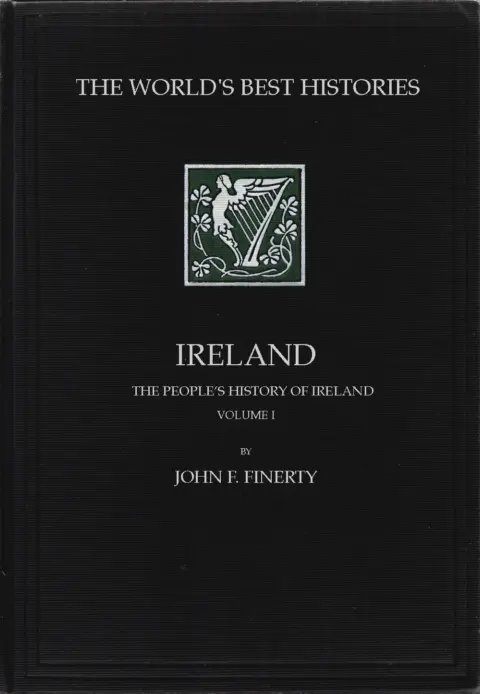
"Ireland: The People's History of Ireland, Volume 1" by John F. Finerty is a historical account written in the early 20th century. The text delves into the rich and complex history of Ireland, addressing the narrative from ancient times through significant events, such as the Reformation and invasions. It aims to provide a comprehensive understanding of the people and culture of Ireland, particularly for those unfamiliar with its past. At the start of the volume, Finerty discusses geographical and physical characteristics of Ireland, outlining its divisions into provinces and detailing the nation's fertile land and vibrant resources. The text emphasizes the importance of Ireland's history, noting the influence of its early inhabitants, the establishment of social structures, and the impact of various invasions, including the Danish and Norman incursions. Finerty aims to illuminate the contributions of the Irish people to the wider world and their enduring legacy, especially as it relates to the Irish diaspora in America.
Introduction adapted from the source catalogue; source summaries may be automatically generated.
Free to read · English · 128,763 words · No account needed
MAKE TIME FOR A GOOD BOOK
On by default. Untick to stop anonymous reading totals. Each page counts after 10 seconds in view. How this works.
Anonymous counting is on unless you have switched it off.
THE first Anglo-Irish Parliament held within a period of twenty-seven years was summoned to meet in Dublin on May 18, 1613, and, notwithstanding the Act of Uniformity, it would appear that quite a large number of Catholics, styled in the language of the times “recusants,” because of their opposition to the spiritual supremacy of the king, were elected to serve in that body. They would have had a majority but for the creation of some forty “boroughs,” each entitled to a member, under the patronage of some Protestant peer. This was the beginning of that “rotten borough” system which finally led to the abolition of the sectarian Irish Parliament of after times. Scenes of great disorder occurred in this Parliament of 1613, chiefly occasioned by the intolerant, and even violent, proceedings of the anti-Catholic party, unreasonable bigots, having an eye to the main chance in the matter of confiscated property, to whom the presence of any “Papist” in that body was as gall and wormwood. This bitter prejudice led finally to the utter exclusion of all Catholics from the Anglo-Irish Parliament, and even the few Catholic commoners previously entitled to a vote were deprived of that privilege, or rather right, until the last decade of the eighteenth century. Still, the Catholic minority in the Parliament of 1613 succeeded in preventing ultra-tyrannical legislation, and, really, made the first stand for the constitutional rights of Ireland, from the colonial standpoint. It was finally adjourned in October, 1615, and no other Parliament was called to meet in Ireland until 1635, when Charles I had already been ten years on the throne. “Government,” meanwhile, had been carried on arbitrarily, without constitutional restraint of any kind, as under the Tudor sovereigns—only with far less ability. The Tudors, at least—particularly Henry and Elizabeth—were intellectual tyrants, which their immediate successors were not. Never was so shameful a system of public spoliation carried out as in the reigns of James I, and his equally despotic, and still more unscrupulous, son Charles I. The viceroy was not responsible to any power whatever, except that of the English monarch. Chichester was succeeded by Lord Grandison, and under his régime the infamous “Commission for the Discovery of Defective Titles” was organized, of which the surveyor-general, Sir William Parsons, ancestor of the Earls of Rosse, was the head. This Commission, “aided by a horde of clerkly spies, employed under the name of Discoverers (McGee), ransacked Old Irish tenures in the archives of Dublin and London with such good effect, that in a very short time 66,000 acres in Wicklow and 385,000 acres in Leitrim, Longford, the Meaths, and Kings and Queens Counties were ‘found by inquisition to be vested in the crown.’ The means employed by the Commissioners in some cases to elicit such evidence as they required were of the most revolting description. In the Wicklow case, courts-martial were held, before which unwilling witnesses were tried on charge of treason, and some actually put to death. Archer, one of the number, had his flesh burned with red-hot iron, and was placed on a gridiron over a charcoal fire till he offered to testify anything that was necessary. Yet on evidence so obtained, whole counties and towns were declared forfeited to the crown.” (Ibid.) Is it any wonder, therefore, that a people so scourged, plundered, and degraded should cherish in their hearts fierce thoughts of reprisal when opportunity offered? These wholesale land robberies were not confined to the Celtic Irish alone, but were practiced on all Irishmen, of whatever descent, who professed the Catholic faith. Add to these the bitter memories of the murder and persecution of many bishops and innumerable priests and communicants of that faith, and the only wonder is that the Irish Catholic people of the seventeenth, and most of the succeeding, century, retained any of the milder and nobler characteristics of the human family. They were stripped of their property, education, civil rights, and, in short, of all that makes life worth living, including freedom of conscience—that dearest privilege of a people naturally idealistic and devotional. The idea of religious toleration never seems to have entered into the minds of what may be called the “professional Protestant” ascendency, except, as we have seen, for purposes of diplomacy which tended to weaken and divide Irish national opposition to foreign rule. In addition to the grievances we have enumerated, the office of Master of Wards was bestowed upon Sir William Parsons, and thus “the minor heirs of all the Catholic proprietors were placed, both as to, person and property, at the absolute disposal of one of the most intense anti-Catholic bigots that ever appeared on the scene of Irish affairs.” (McGee.) This was one of the pernicious influences that, not for conscience’ sake, but for sordid gain, changed the religion of so many of the ancient families of Ireland from the old to the new form of belief; and no English policy was more bitterly resented and vengefully remembered by the Irish Catholic masses. And because of this dishonest system of proselytizing, carried on by one process or another from the period of the Reformation to the reign of Victoria, the Irish Catholic peasant has associated “conversion” of any of his neighbors to the Protestant belief with personal degradation. The Irish Catholic peasant has no feeling but that of utter contempt and aversion for a “turn-coat” Catholic; but he is most liberal in his feelings toward all Protestants “to the manor born,” as has been frequently and emphatically manifested by his choice of Protestant leaders, from Grattan to Parnell. Whatever of religious bigotry may linger in the warm heart of the Catholic peasant may be justly charged to outrageous misgovernment, not to his natural disposition, which, in the main, is both loving and charitable. The faults we can trace in the Irish character to-day are partially those of human nature, which averages much the same in all civilized peoples, but many of them, and the gravest, can be attributed, without undue prejudice, to the odious penal laws which were sufficient to distort the characteristics of angels, not to speak of mortal men.
Your reading position is saved on this browser. Take it to another device with a library code. Reading pages adapt to text, rather than matching a printed edition.
BEHIND THE BOOK
This eBook is for the use of anyone anywhere in the United States and most other parts of the world at no cost and with almost no restrictions whatsoever. You may copy it, give it away or re-use it under the terms of the Project Gutenberg License included with this eBook or online at www.gutenberg.org. If you are not located in the United States, you will have to check the laws of the country where you are located before using this eBook. Read the source licence.
The original source file, including credits and licence, is retained by this library. Request an original-format copy at no charge. Please include the book title and Project Gutenberg identifier #67845.
KEEP YOUR CURIOSITY GOING
Cécile Tormay

Moritz Busch
John L. Ransom
Frances Wright
Cécile Tormay

Mabel Potter Daggett