THE CLASSIC COLLECTION✦An outlaw’s diary: the CommuneCLASSIC FREE BOOKS
An outlaw’s diary: the Commune
Cécile Tormay
THE CLASSIC COLLECTION · 1904
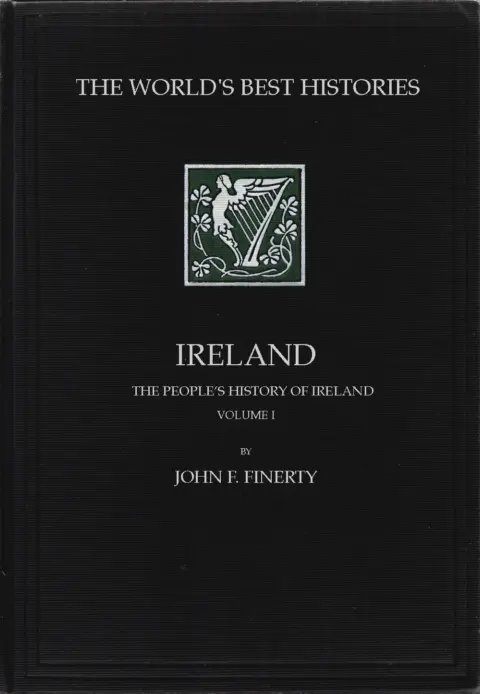
"Ireland: The People's History of Ireland, Volume 1" by John F. Finerty is a historical account written in the early 20th century. The text delves into the rich and complex history of Ireland, addressing the narrative from ancient times through significant events, such as the Reformation and invasions. It aims to provide a comprehensive understanding of the people and culture of Ireland, particularly for those unfamiliar with its past. At the start of the volume, Finerty discusses geographical and physical characteristics of Ireland, outlining its divisions into provinces and detailing the nation's fertile land and vibrant resources. The text emphasizes the importance of Ireland's history, noting the influence of its early inhabitants, the establishment of social structures, and the impact of various invasions, including the Danish and Norman incursions. Finerty aims to illuminate the contributions of the Irish people to the wider world and their enduring legacy, especially as it relates to the Irish diaspora in America.
Introduction adapted from the source catalogue; source summaries may be automatically generated.
Free to read · English · 128,763 words · No account needed
MAKE TIME FOR A GOOD BOOK
On by default. Untick to stop anonymous reading totals. Each page counts after 10 seconds in view. How this works.
Anonymous counting is on unless you have switched it off.
THE forces of the belligerents were not large, according to our more modern standards. In his comprehensive “History of Ireland,” the Rev. Abbe McGeoghegan credits Owen Roe with only 5,000 infantry and 500 horse, while he calls Monroe’s force 6,000 foot and 800 cavalry. The objective of both generals was the ancient city of Armagh, and the grand-nephew of the great Hugh O’Neill was destined to win one of Ireland’s proudest victories in the immediate neighborhood of his grand-uncle’s most famous battlefield—the Yellow Ford. Marching northward from the borders of Leinster, Owen Roe crossed the historic Blackwater and took position at a place called Benburb, in the present county of Tyrone. Monroe advanced to attack him, and ordered his younger brother, George Monroe, who commanded a strong detachment, to join forces with the main body without delay. O’Neill, apprised by his scouts of this movement, sent two regiments, under Colonels MacMahon and MacNenay, to intercept young Monroe at a pass through which he would be compelled to defile his troops in order to form a junction with his brother. The two colonels obeyed their orders so strictly that George Monroe’s force was so utterly broken and routed that it was unable to render any service to the Puritan general during the remainder of the campaign. The victors immediately rejoined O’Neill, who, in the interim, had detached Colonel Ricard O’Ferrall to obstruct the elder Monroe’s march from Kinnaird to Caledon, where he had crossed the Blackwater. The Scotchman’s cannon proved too much for O’Ferrall, who could only reply with musketry, but he retired in admirable order, although closely pressed by Monroe’s stronger vanguard. The battle of Benburb began on the morning of June 16th, new style, 1646. O’Neill’s post was near the river, his flanks protected by two small hills, and his rear by a wood—all held by chosen troops. Throughout most of the day, the Scots, who had both sun and wind at their backs, seemed to have the advantage, in so far as partial demonstrations could determine the question. O’Neill, in expectation of a reinforcement from the direction of Coleraine, “amused” the Scotch general until the sun had shifted position and no longer shone full and dazzlingly in the faces of the Irish soldiers. Almost at this propitious moment, the expected auxiliary force reached the field, and took up position in O’Neill’s line of battle. Rev. C. P. Meehan, historian of the “Confederation of Kilkenny,” who quotes Monroe’s despatch, Rinuccini’s letters, and other contemporaneous authorities, says: “It was the decisive moment. The Irish general, throwing himself into the midst of his men, and, pointing out to them that retreat must be fatal to the enemy, ordered them to charge and pursue vigorously. A far resounding cheer rose from the Irish ranks. ‘Myself,’ said he, ‘with the aid of Heaven, will lead the way. Let those who fail to follow me remember that they abandon their general.’ This address was received with one unanimous shout by the army. The Irish colonels threw themselves from their horses, to cut themselves off from every chance of retreat, and charged with incredible impetuosity.” Some musketry was used, but the victory was decided in Ireland’s favor by her ancient and favorite weapon, the deadly pike, which may be called the parent of the bayonet. Monroe’s cavalry charged boldly that bristling front of spears, but was overthrown in an instant and all but annihilated. Vain, then, became the fire of the vaunted cannon of the Scotch commander and the crashing volleys of his small arms. Vainly he himself and his chosen officers, sword in hand, set an example of courage to their men. With the shout of “Lamh Dearg Aboo!” which, fifty years before, had sounded the death-knell of Bagnal, Kildare, and De Burgh, on the banks of the same historic river, the Irish clansmen rushed upon their foes. The struggle was brief and bitter. Lord Blaney’s English regiment perished almost to the last man, fighting heroically to the end. The Scottish cavalry was utterly broken and fled pell-mell, leaving the infantry to their fate. Lord Montgomery’s regiment alone retired in good order, although with considerable loss, but Montgomery himself, fifty other officers, and some two hundred soldiers, were made prisoners. Monroe fled, without hat or wig, and tradition says he lost his sword in swimming his horse across the Blackwater. Of the Anglo-Scotch army, there died upon the field 3,243 officers and men, and many more perished during the vengeful pursuit of the victors, who do not appear to have been in a forgiving mood. O’Neill acknowledged a loss of seventy men killed and several hundred wounded. The Scottish army lost all of its baggage, tents, cannon, small arms, military chest, and, besides, thirty-two stand of battle-flags. Fifteen hundred draught horses and enough food supplies to last the Irish army for many months also fell into the hands of the vanquishers. Monroe’s army was, virtually, destroyed, and he sullied a previously honorable record by plundering and burning many villages and isolated houses to gratify his spite against the people whose soldiers had so grievously humiliated him.
Your reading position is saved on this browser. Take it to another device with a library code. Reading pages adapt to text, rather than matching a printed edition.
BEHIND THE BOOK
This eBook is for the use of anyone anywhere in the United States and most other parts of the world at no cost and with almost no restrictions whatsoever. You may copy it, give it away or re-use it under the terms of the Project Gutenberg License included with this eBook or online at www.gutenberg.org. If you are not located in the United States, you will have to check the laws of the country where you are located before using this eBook. Read the source licence.
The original source file, including credits and licence, is retained by this library. Request an original-format copy at no charge. Please include the book title and Project Gutenberg identifier #67845.
KEEP YOUR CURIOSITY GOING
Cécile Tormay

Moritz Busch
John L. Ransom
Frances Wright
Cécile Tormay

Mabel Potter Daggett