THE CLASSIC COLLECTION✦An outlaw’s diary: the CommuneCLASSIC FREE BOOKS
An outlaw’s diary: the Commune
Cécile Tormay
THE CLASSIC COLLECTION · 1904
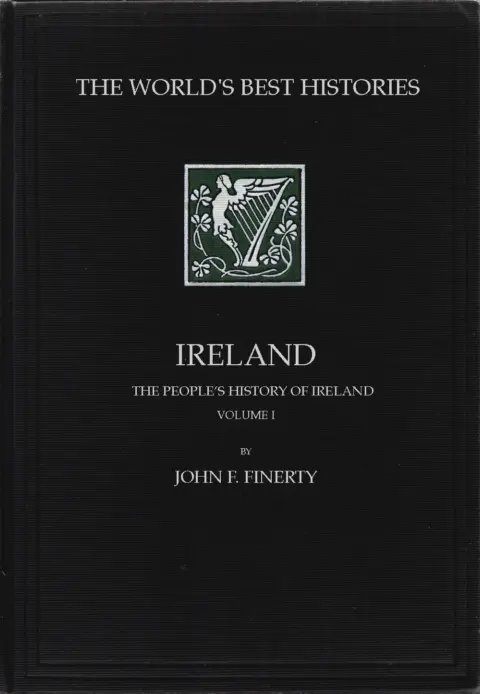
"Ireland: The People's History of Ireland, Volume 1" by John F. Finerty is a historical account written in the early 20th century. The text delves into the rich and complex history of Ireland, addressing the narrative from ancient times through significant events, such as the Reformation and invasions. It aims to provide a comprehensive understanding of the people and culture of Ireland, particularly for those unfamiliar with its past. At the start of the volume, Finerty discusses geographical and physical characteristics of Ireland, outlining its divisions into provinces and detailing the nation's fertile land and vibrant resources. The text emphasizes the importance of Ireland's history, noting the influence of its early inhabitants, the establishment of social structures, and the impact of various invasions, including the Danish and Norman incursions. Finerty aims to illuminate the contributions of the Irish people to the wider world and their enduring legacy, especially as it relates to the Irish diaspora in America.
Introduction adapted from the source catalogue; source summaries may be automatically generated.
Free to read · English · 128,763 words · No account needed
MAKE TIME FOR A GOOD BOOK
On by default. Untick to stop anonymous reading totals. Each page counts after 10 seconds in view. How this works.
Anonymous counting is on unless you have switched it off.
NOTHING could exceed the enthusiasm with which the Irish people welcomed King James. In the cities and towns, flowers were strewn in his path, corporation officials turned out in their robes of state, and speeches of welcome were delivered in English or read in Latin. The entry into Dublin was a magnificent spectacle. The whole city was in gala dress, and the different trades paraded before him. Harpers played at the triumphal arches under which he passed. Beautiful young girls, costumed in pure white, and coroneted with wreaths, danced the ancient Irish national dance, known as the Rinka, in the progress of which flowers were profusely scattered by the fair performers. The religious orders were out in force, a great cross being borne at their head. The viceroy, lord mayor, and members of the corporation, on horseback or in carriages, made up an imposing part of the procession. When he reached the Castle, the sword of state was presented to him by the Lord Lieutenant, and the Recorder handed him, according to an old custom, the keys of the city. “Te Deum” was sung in the Chapel Royal, one of the architectural creations of the Duke of Tyrconnel. From the flagstaff on the tower of the Castle itself, floated an Irish national flag, with a golden harp upon its folds; and on this broad ensign were inscribed the inspiring and sadly prophetic words, “Now or Never! Now and Forever!” Wherever the king appeared in public, he was greeted with enthusiastic shouts, in Gaelic, of “Righ Seamus!—Righ Seamus, Go Bragh”! (“King James—King James, Forever!”)
The military situation of King James’s adherents in Ireland could not be called encouraging when he took up his residence in Dublin. As usual, arms and ammunition were scarce. Some 30,000 men had volunteered to fight for Ireland, and there were not more than 20,000 stand of arms, all told, to place in their hands. And of this small supply, fully three-fourths were antiquated and worthless. While there were, nominally, fifty regiments of infantry enrolled, the only serviceable regiments of horse were those of Galmoy, Tyrconnel, and Russell. There was one regiment of dragoons, and of cannon only eight field-pieces had been collected. The two best-equipped bodies of Irish troops were the command of General Richard Hamilton, in Ulster—about 3,000 men; and that of General Justin McCarthy, Lord Mountcashel, in Munster—slightly more numerous. Derry and Inniskillen held out for William of Orange, and notwithstanding some successes of General Hamilton in the North, there seemed no immediate prospect of reducing them. The stubborn attitude of Inniskillen delayed the junction of Mountcashel’s and Hamilton’s forces, which had been ordered by the Duke of Tyrconnel, commander-in-chief of the Irish army, with General De Rosen as his second in command. The smaller places occupied by the Williamite forces were abandoned as being untenable, and the little garrisons fell back on Londonderry, which had now become the main objective of the Jacobite army. The military governor, Lundy, was suspected of being, at heart, a Stuart sympathizer, but he was soon virtually superseded, first by Governor Baker and afterward by the celebrated Rev. George Walker, rector of the living of Donoughmore, to whom history awards the glory of the long, desperate, brilliant, and successful defence of Derry against the armies of King James. It is a pity that the ability and bravery displayed by Dr. Walker have been made causes of political and religious irritation in the north of Ireland for upward of two centuries. Lundy, when his authority was defied, escaped from the city at night, in the disguise of a laborer, and cut no further figure in Irish history. Before his flight, King James’s flatterers in Dublin had persuaded him to advance against Derry in person and demand its surrender. Tyrconnel opposed the idea in vain. He well knew that Lundy was in correspondence with Hamilton and De Rosen for the surrender of the city. It is quite probable that Derry would have finally surrendered, on honorable terms, had James taken Tyrconnel’s advice; but, with his usual fatuity, the obstinate king took the advice of the shallow courtiers, and did actually present himself before the walls of Derry and demand its unconditional surrender! The reply was a cannon shot, which killed an officer at James’s side. The king retired with precipitation, and the citizens sent after him the “Prentice Boys’” shout of “No surrender!” Mortified by his rather ignominious failure, James retired to Dublin, and summoned Parliament to meet on the lines already indicated.
Your reading position is saved on this browser. Take it to another device with a library code. Reading pages adapt to text, rather than matching a printed edition.
BEHIND THE BOOK
This eBook is for the use of anyone anywhere in the United States and most other parts of the world at no cost and with almost no restrictions whatsoever. You may copy it, give it away or re-use it under the terms of the Project Gutenberg License included with this eBook or online at www.gutenberg.org. If you are not located in the United States, you will have to check the laws of the country where you are located before using this eBook. Read the source licence.
The original source file, including credits and licence, is retained by this library. Request an original-format copy at no charge. Please include the book title and Project Gutenberg identifier #67845.
KEEP YOUR CURIOSITY GOING
Cécile Tormay

Moritz Busch
John L. Ransom
Frances Wright
Cécile Tormay

Mabel Potter Daggett