THE CLASSIC COLLECTION✦An outlaw’s diary: the CommuneCLASSIC FREE BOOKS
An outlaw’s diary: the Commune
Cécile Tormay
THE CLASSIC COLLECTION · 1904
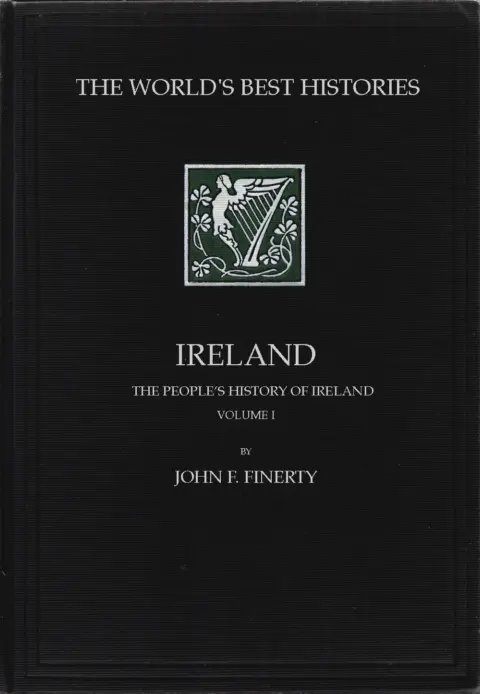
"Ireland: The People's History of Ireland, Volume 1" by John F. Finerty is a historical account written in the early 20th century. The text delves into the rich and complex history of Ireland, addressing the narrative from ancient times through significant events, such as the Reformation and invasions. It aims to provide a comprehensive understanding of the people and culture of Ireland, particularly for those unfamiliar with its past. At the start of the volume, Finerty discusses geographical and physical characteristics of Ireland, outlining its divisions into provinces and detailing the nation's fertile land and vibrant resources. The text emphasizes the importance of Ireland's history, noting the influence of its early inhabitants, the establishment of social structures, and the impact of various invasions, including the Danish and Norman incursions. Finerty aims to illuminate the contributions of the Irish people to the wider world and their enduring legacy, especially as it relates to the Irish diaspora in America.
Introduction adapted from the source catalogue; source summaries may be automatically generated.
Free to read · English · 128,763 words · No account needed
MAKE TIME FOR A GOOD BOOK
On by default. Untick to stop anonymous reading totals. Each page counts after 10 seconds in view. How this works.
Anonymous counting is on unless you have switched it off.
THE first half of the fourteenth century passed away quietly enough in Ireland, except for occasional conflicts between the Anglo-Normans and the Celtic tribes, or an odd encounter of the latter with one another. Edward III had so many quarrels with Scotland and France that he could do nothing in Ireland, even were he so inclined, and the sad experience of the Duke of Clarence in that country warned succeeding viceroys to let well enough alone. The Irish nation, Celtic, Norman, and Saxon, was gradually fusing and would soon have developed a composite strength nearly equal to that of England herself. In the wars with France, many Anglo-Irish septs fought under the orders of Edward, and, probably, some of the Celtic septs also joined his standard, rather as allies, through the bad policy of their chiefs, than as mercenaries.
By the time that Edward completed, or nearly so, the conquest of France, the English power in Ireland had so shrunken as to be almost nominal. Dublin, Drogheda, Kilkenny, and Waterford were the chief garrisons of the English. The Lacys, Burkes, Fitzgeralds, and other Norman-Irish houses and clans were scarcely to be distinguished from the Milesian families and septs. Such fighting as they indulged in between themselves was comparatively trivial. The island, blessed with partial peace, began to grow more populous and prosperous. Edward, the Black Prince, having crowned himself with glory in France, died before he could inherit the crown of England. Edward III, not so old as worn out by ceaseless warfare, died in 1377, and after him came to the English throne Richard, son of the Black Prince, a handsome boy of sixteen, who, at first, gave promise of great deeds, but who subsequently proved himself a weakling and voluptuary. In Ireland, Ulster, Connaught, and Munster remained tranquil for the most part, but, in Leinster, the royal house of MacMurrough—lineal descendants of the traitor of Strongbow’s time—showed a determination to drive the remnant of the English garrison into the sea. They were as loyal to Ireland as their accursed ancestor had been faithless. King Art I, after a long series of successes and failures, died, and was succeeded on the Leinster throne by King Art II—one of the bravest, wisest, and truest characters in Irish history. He continued the war his father had begun. Richard II, like all of his race, was vain and greedy of military glory. As the war with France had closed for a period, he thought Ireland a good field in which to distinguish himself as a general. He had heard of “MacMore,” as he called MacMurrough, and longed to measure swords with him. Accordingly, in the summer of 1394, he landed at Waterford with a large army. The historian McGee estimates it at 35,000 horse and foot, but we are inclined to think it was much less. That it was formidable, for those times, all historians who have dealt with the subject are agreed upon. He was accompanied, also, by a large retinue of nobility, among them Roger Mortimer, the young Earl of March, who, because of the childlessness of Richard, was heir to the British throne, through descent from the Duke of Clarence, in the female line. Richard did not wait long in Waterford, but proceeded on his march to Dublin, unfurling the banner of Edward the Confessor, for whom the Irish were supposed to have a deep veneration. MacMurrough, however, showed scant courtesy to the Confessor’s ensign, not because it was the banner of a saint, but because, for the time, it represented the rapacity of England. Richard was met boldly at every point. His bowmen got tangled up in the woods. His horsemen floundered in the bogs. MacMurrough’s army hovered in his front, on his flanks, and in rear. Not a single success did the English monarch gain. He summoned MacMurrough to a conference when he reached Dublin—having lost a third of his army while en route—and the Leinster king, having accepted the invitation, was ruthlessly thrown into prison. After a time, a treaty of some kind was patched up between King Richard and himself, and the Irish prince was allowed to go free. Richard then returned to England, leaving Roger Mortimer in command. Soon afterward, MacMurrough, objecting to the English encroachments in his territory, again rose in arms. He encountered Mortimer and the English army on the banks of the King’s River at Kenlis or Kells in Westmeath, and utterly routed them. England’s heir-apparent was among the slain. This circumstance had much to do with bringing about the bloody Wars of the Roses in the succeeding century.
Your reading position is saved on this browser. Take it to another device with a library code. Reading pages adapt to text, rather than matching a printed edition.
BEHIND THE BOOK
This eBook is for the use of anyone anywhere in the United States and most other parts of the world at no cost and with almost no restrictions whatsoever. You may copy it, give it away or re-use it under the terms of the Project Gutenberg License included with this eBook or online at www.gutenberg.org. If you are not located in the United States, you will have to check the laws of the country where you are located before using this eBook. Read the source licence.
The original source file, including credits and licence, is retained by this library. Request an original-format copy at no charge. Please include the book title and Project Gutenberg identifier #67845.
KEEP YOUR CURIOSITY GOING
Cécile Tormay

Moritz Busch
John L. Ransom
Frances Wright
Cécile Tormay

Mabel Potter Daggett