THE CLASSIC COLLECTION✦An outlaw’s diary: the CommuneCLASSIC FREE BOOKS
An outlaw’s diary: the Commune
Cécile Tormay
THE CLASSIC COLLECTION · 1904
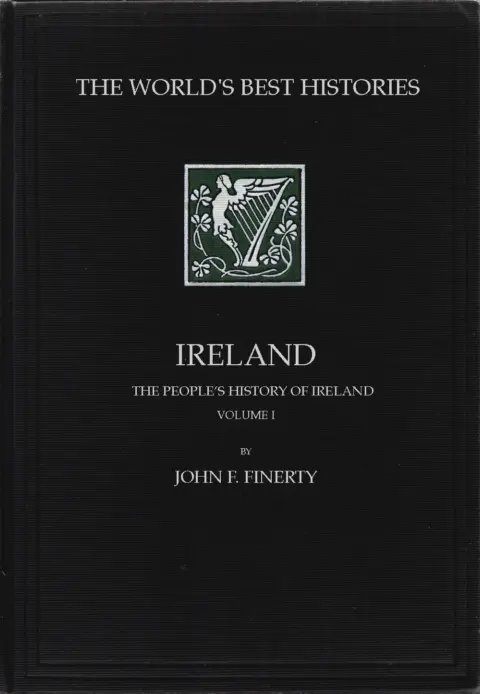
"Ireland: The People's History of Ireland, Volume 1" by John F. Finerty is a historical account written in the early 20th century. The text delves into the rich and complex history of Ireland, addressing the narrative from ancient times through significant events, such as the Reformation and invasions. It aims to provide a comprehensive understanding of the people and culture of Ireland, particularly for those unfamiliar with its past. At the start of the volume, Finerty discusses geographical and physical characteristics of Ireland, outlining its divisions into provinces and detailing the nation's fertile land and vibrant resources. The text emphasizes the importance of Ireland's history, noting the influence of its early inhabitants, the establishment of social structures, and the impact of various invasions, including the Danish and Norman incursions. Finerty aims to illuminate the contributions of the Irish people to the wider world and their enduring legacy, especially as it relates to the Irish diaspora in America.
Introduction adapted from the source catalogue; source summaries may be automatically generated.
Free to read · English · 128,763 words · No account needed
MAKE TIME FOR A GOOD BOOK
On by default. Untick to stop anonymous reading totals. Each page counts after 10 seconds in view. How this works.
Anonymous counting is on unless you have switched it off.
“Then rose the roar of battle loud, the shout, the cheer, the cry! The clank of ringing steel, the gasping groans of those who die; Yet onward still the Norman band right fearless cut their way, As move the mowers o’er the sward upon a summer’s day.
“For round them there, like shorn grass, the foe in hundreds bleed; Yet, fast as e’er they fall, each side, do hundreds more succeed; With naked breasts undaunted meet the spears of steel-clad men, And sturdily, with axe and skian, repay their blows again.
“Now crushed with odds, their phalanx broke, each Norman fights alone, And few are left throughout the field, and they are feeble grown, But high o’er all, Sir Tristram’s voice is like a trumpet heard, And still, where’er he strikes, the foemen sink beneath his sword.
“But once he raised his visor up—alas, it was to try If Hamo and his boy yet tarried on the mountain nigh, When sharp an arrow from the foe pierced right through his brain, And sank the gallant knight a corse upon the bloody plain.
“Then failed the fight, for gathering round his lifeless body there, The remnant of his gallant band fought fiercely in despair; And, one by one, they wounded fell—yet with their latest breath, Their Norman war-cry shouted bold—then sank in silent death.”
When Cathal Mor finally became King of Connaught, he caused a monastery, which he called “the Abbey of Victory,” but which has been known to the Irish of Connaught for ages as “Abbey Knockmoy,” to be erected on or near the site of the battle. Tradition, not a very reliable guide, fails to exactly define the scene of Cathal’s victory over the Normans. Knocktuagh, an inconsiderable eminence, is within a few miles of the city of Galway, whereas Knockmoy, where stands the historic abbey, is fully twelve miles east of that ancient borough, on the highroad to Athlone. Cathal of the Red Hand fought many battles and won many splendid victories, although he occasionally sustained defeats at the hands of the Normans and their traitorous native allies; his greatest victory was won over his bitter rival, albeit his nephew, Caher Carragh O’Conor, whom he encountered somewhere in the county of Galway. There was an awful slaughter on both sides, but Cathal prevailed, and, no doubt, built the abbey on the spot where Caher and his leading chieftains, Irish and Norman, fell. De Courcy was the only foreigner allied with Cathal Mor in this great battle. Abbey Knockmoy is one of the most interesting of Irish ruins, and contains friezes and frescoing most creditable to Irish art in the thirteenth century. The victory gave Cathal Mor the undisputed sway of Connaught. Adopting the policy of the invaders, for the benefit of his country, he used Norman against Norman; allied himself with Meyler FitzHenry, the last of Strongbow’s lieutenants, to punish Connaught’s inveterate foe, William de Burgo, ancestor of the Clanricardes in Limerick, and to humble the pride of the ambitious De Lacys in Leinster. In 1210, this gallant Irish monarch compelled King John of England to treat with him as an independent sovereign, and, while he lived, no Norman usurper dared to lord it over his kingdom of Connaught. Like his royal father and brother, he was a champion of the Irish Church, and was a liberal founder and endower of religious houses. Had the Connacian kings who followed been of his moral and military calibre, the Normans could never have ruled in Connaught. Nor did this great Irishman confine himself to his native kingdom alone; he also assisted the other provinces in resisting foreign encroachment. Even in his old age, when the De Lacys tried to embarrass his reign by fortifying Athleague, so as to threaten him in flank, the dauntless hero, at the head of his hereditary power, marched from his palace of Ballintober, made two crossings of the river Suck, and, by a bold manœuvre, came on the rear of the enemy, compelling them to retreat in all haste across the Shannon into Leinster. He did not fail to raze their forts at Athleague to the ground. This was the last of his countless exploits. His time was drawing nigh, and, according to the Four Masters, “signs appeared in the heavens” which foretold his death. In 1223, Cathal’s load of age and care became too heavy, and he resigned the crown of Connaught to his son, Hugh. The old king, assuming the habit of the Franciscans, retired to the Abbey of Knockmoy, and there expired, mourned by his country and respected by its enemies, A.D. 1224. Tradition still points to his tomb amid the majestic ruins of that venerable pile. His death was the signal for the rise of Norman power in Connaught, and for the final deposition by the alien De Burgos of the royal race of O’Conor.
Your reading position is saved on this browser. Take it to another device with a library code. Reading pages adapt to text, rather than matching a printed edition.
BEHIND THE BOOK
This eBook is for the use of anyone anywhere in the United States and most other parts of the world at no cost and with almost no restrictions whatsoever. You may copy it, give it away or re-use it under the terms of the Project Gutenberg License included with this eBook or online at www.gutenberg.org. If you are not located in the United States, you will have to check the laws of the country where you are located before using this eBook. Read the source licence.
The original source file, including credits and licence, is retained by this library. Request an original-format copy at no charge. Please include the book title and Project Gutenberg identifier #67845.
KEEP YOUR CURIOSITY GOING
Cécile Tormay

Moritz Busch
John L. Ransom
Frances Wright
Cécile Tormay

Mabel Potter Daggett