THE CLASSIC COLLECTION✦An outlaw’s diary: the CommuneCLASSIC FREE BOOKS
An outlaw’s diary: the Commune
Cécile Tormay
THE CLASSIC COLLECTION · 1904
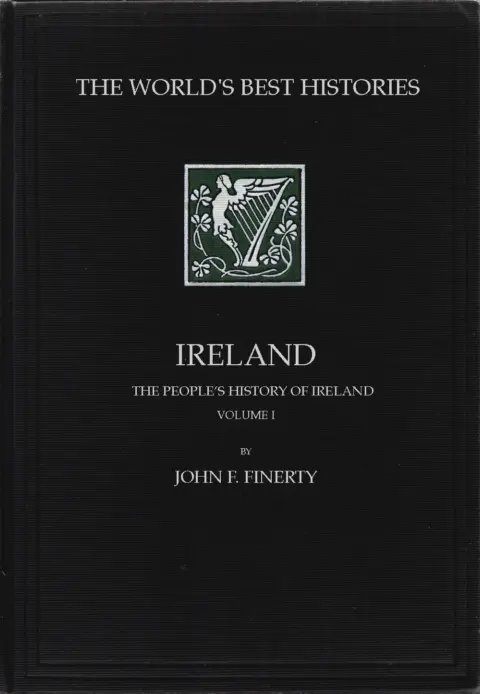
"Ireland: The People's History of Ireland, Volume 1" by John F. Finerty is a historical account written in the early 20th century. The text delves into the rich and complex history of Ireland, addressing the narrative from ancient times through significant events, such as the Reformation and invasions. It aims to provide a comprehensive understanding of the people and culture of Ireland, particularly for those unfamiliar with its past. At the start of the volume, Finerty discusses geographical and physical characteristics of Ireland, outlining its divisions into provinces and detailing the nation's fertile land and vibrant resources. The text emphasizes the importance of Ireland's history, noting the influence of its early inhabitants, the establishment of social structures, and the impact of various invasions, including the Danish and Norman incursions. Finerty aims to illuminate the contributions of the Irish people to the wider world and their enduring legacy, especially as it relates to the Irish diaspora in America.
Introduction adapted from the source catalogue; source summaries may be automatically generated.
Free to read · English · 128,763 words · No account needed
MAKE TIME FOR A GOOD BOOK
On by default. Untick to stop anonymous reading totals. Each page counts after 10 seconds in view. How this works.
Anonymous counting is on unless you have switched it off.
Before closing this chapter we may be allowed to remark that Richard III, when he had his nephews murdered in the Tower of London, in 1483, came legitimately by his cruel nature. John Lackland was the progenitor of all the Plantagenets who succeeded him on the English throne, and, like his direct descendant, Richard Crookback, was a usurper, because Prince Arthur, son of his elder brother, Geoffrey Plantagenet, was lineal heir to the throne. History and tradition agree in saying that John caused Prince Arthur to be murdered, and some historians say that he was the actual murderer. He was the only coward of his race, and was, also, frivolous and deliberately ill-mannered. When on a visit to Ireland, in the supposed interest of his father, he caused a revolt among the Irish chiefs who called upon him, by pulling their long beards and otherwise insulting them. Those cringing chiefs deserved the treatment they received, but John Lackland, as he was dubbed, is not, therefore, excusable for having acted toward them as a boor and a ruffian. Later on, when he became King of England, he again visited Ireland, and built many strong castles. That of Limerick, called King John’s Castle, is still almost perfectly preserved, and is a superb relic of Norman military architecture. As the Irish were not provided with armament, or appliances, for making a successful siege, the fortresses built by King John were, so far as they were concerned, virtually impregnable. Whenever the Normans were vanquished in the field, they retired to their castles, which were amply provisioned, and defied the vengeance of their foes.
In the last year of the reign of Henry II, there occurred in Ireland one of those memorable combats which deserve a lasting place in history, not so much because of any important reform or social or political blessing of any kind resulting from them, but as tending to show that warrior men, in all ages, have often been chivalrous and self-sacrificing. The Norman race—glorious as has been its record all over Europe and Palestine—never evinced greater bravery than on the Woody field of Knocktuagh (Nockthoo), “the Hill of Axes,” in Galway, A.D. 1189. Sir John De Courcy, hard pressed in Ulster by the fiercely resisting septs of the north, asked aid from his sworn friend and comrade, Sir Armoricus Tristram—ancestor of the family of St. Lawrence, Earls of Howth—then serving in Connaught. Tristram had with him, according to some accounts, thirty knights, one hundred men-at-arms, mounted, and one hundred light-armed infantry; according to other statements, he had under his command thirty cavalry and two hundred foot. This force Cathal O’Conor, afterward known as “the Red-Handed,” Prince of the royal house of Connaught—a most valiant and skilful general, who was younger brother, born out of wedlock, of King Roderick, then virtually in the retirement of the cloisters of Cong Abbey—led into an ambush, and attacked with a superior force. Sir Armoricus saw at a glance that escape was hopeless, and that only one refuge was left for him and his following—to die with honor. Some of his horsemen, tradition says, proposed to cut their way out and leave the infantry to their fate. Against this mean proposition Sir Armor’s brother and other knights vehemently protested. “We have been together in many dangers,” they said; “now let all of us fight and die together.” Sir Armor, by way of answer, alighted from his steed, drew his sword and, with it, pierced the noble charger to the heart. All the other horsemen, except two youths, who were detailed to watch the fight from a distant hill, and report the result to De Courcy in Ulster, immediately followed their glorious leader’s example. Tradition asserts that the two young men who made their escape, by order, were Sir Armoricus’s son and the squire of De Courcy, who brought the latter’s message to Tristram. Having completed the slaughter of their horses, the little band of Normans formed themselves in a phalanx, and marched boldly to attack the outnumbering Irish. The latter met the shock with their usual courage, but the enemy, clad in armor, cut their way deeply and fatally into the crowded ranks of their cloth-clad foes. The Irish poet, Arthur Gerald Geoghegan (Geh’ogan), thus graphically and truthfully describes the dreadful encounter:
Your reading position is saved on this browser. Take it to another device with a library code. Reading pages adapt to text, rather than matching a printed edition.
BEHIND THE BOOK
This eBook is for the use of anyone anywhere in the United States and most other parts of the world at no cost and with almost no restrictions whatsoever. You may copy it, give it away or re-use it under the terms of the Project Gutenberg License included with this eBook or online at www.gutenberg.org. If you are not located in the United States, you will have to check the laws of the country where you are located before using this eBook. Read the source licence.
The original source file, including credits and licence, is retained by this library. Request an original-format copy at no charge. Please include the book title and Project Gutenberg identifier #67845.
KEEP YOUR CURIOSITY GOING
Cécile Tormay

Moritz Busch
John L. Ransom
Frances Wright
Cécile Tormay

Mabel Potter Daggett