THE CLASSIC COLLECTION✦The Knight of MaltaCLASSIC FREE BOOKS
The Knight of Malta
Eugène Sue
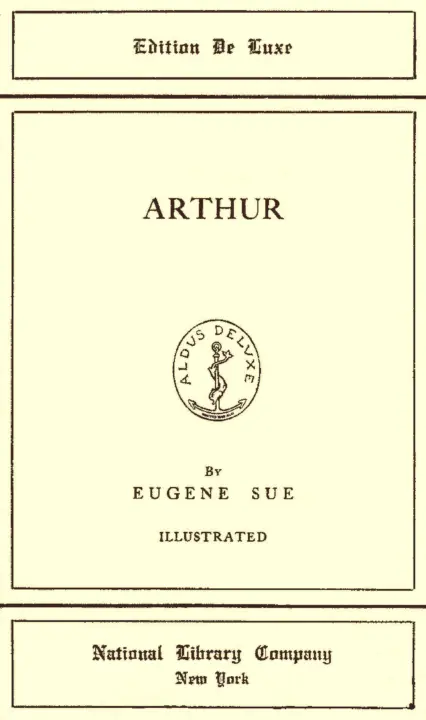
THE CLASSIC COLLECTION · 1839
"Arthur" by Eugène Sue is a novel written in the late 19th century. The story unfolds through the intertwining lives of various characters, with an emphasis on the mysterious figure of Count Arthur and the tragedy surrounding his household. The opening portions hint at themes of intrigue, love, and loss, captivating readers who are drawn to character-driven narratives steeped in emotion and moral complexity. At the start of the novel, the protagonist, who remains unnamed, recounts a chance encounter that leads him to explore a quaint southern village, drawn by the allure of a country house rumored to be for sale. As he journeys through the picturesque landscape, he learns intriguing tales of previous travelers to the village, notably one ominous story involving a mysterious carriage that never returned. Upon reaching the village, he meets the curé and his sister, who are steeped in sadness related to the house's past. This foreshadows deeper explorations of love and loss and sets the stage for revelations regarding Count Arthur, a character woven into the fabric of the village's tragic history. The sense of curiosity and impending revelations builds a compelling narrative thread that invites readers further into the novel's intricate plot.
Introduction adapted from the source catalogue; source summaries may be automatically generated.
Free to read · English · 180,723 words · No account needed
MAKE TIME FOR A GOOD BOOK
On by default. Untick to stop anonymous reading totals. Each page counts after 10 seconds in view. How this works.
Anonymous counting is on unless you have switched it off.
The slightest details of this dreadful scene are still present to my
mind.
Midnight struck as I entered the antechamber of Madame de Fersen's
apartment.
It was dark, and I found none of her people about. This seemed to me very strange. Led by a dim light, I crossed several rooms, only one of which was faintly lighted; my heart shrank with terror.
As I reached a half-open door, stifled sobs greeted my ear.
Noiselessly I pushed the door open.
Gracious heavens! what a picture!
Irene's cot, placed next to her mother's bed, occupied the end of the
room facing the door.
Kneeling by the bedside, Catherine held one of the child's hands in
hers.
I could not see the face of the unfortunate mother, only from time to time a sudden, convulsive movement shook her frame.
At the left side was Frank, the great painter, Hélène's husband.
Seated on a low chair, he sketched Irene's dying countenance.
A harrowing remembrance, which, no doubt, Madame de Fersen wished to
preserve.
Frank, by means of a shade, had so arranged the lamp that the full light
fell on Irene's face.
The rest of the apartment was plunged into almost total darkness.
A tall man, in a fur-lined coat, stood at the foot of the cot. His hair was white; his prominent bald forehead shone like old ivory; a ray of bright light brought out his sharply marked profile.
This was Doctor Ralph, Madame de Fersen's medical attendant.
He seemed watching with an anxious eye the slightest change in Irene's
face.
In a dark corner of the room the nurse was seated, leaning her head against the wall, and scarcely able to smother her sobs.
As I entered, her sobbing became so uncontrollable that, holding her handkerchief to her mouth, she left the room.
I, also, was weeping bitterly at the sight of that angelic, childish face, so tender, so resigned, which, in spite of approaching death, preserved a character of sublime serenity.
Brilliantly lighted, her pale face stood out vividly against the white pillows; her beautiful black locks fell in disorder, covering her forehead; her large eyes half closed, and encircled by dark rings, showed under the heavy lids her half-extinct pupils. From her pretty half-open mouth, from her lips, formerly so roseate, and now so discoloured, came forth a panting breath, and often a feeble plaintive murmur. This poor little face, formerly so plump, so fresh and childlike, was already becoming livid.
From time to time the unhappy child moved her hands restlessly into space, or turned her head heavily on her pillows, with a deep sigh. Then she again became frightfully still.
Your reading position is saved on this browser. Take it to another device with a library code. Reading pages adapt to text, rather than matching a printed edition.
Eugène Sue
Eugène Sue
Eugène Sue
Eugène Sue
BEHIND THE BOOK
This eBook is for the use of anyone anywhere in the United States and most other parts of the world at no cost and with almost no restrictions whatsoever. You may copy it, give it away or re-use it under the terms of the Project Gutenberg License included with this eBook or online at www.gutenberg.org. If you are not located in the United States, you will have to check the laws of the country where you are located before using this eBook. Read the source licence.
The original source file, including credits and licence, is retained by this library. Request an original-format copy at no charge. Please include the book title and Project Gutenberg identifier #66473.
KEEP YOUR CURIOSITY GOING
Coulson Kernahan

Maurice Baring
Frances Wright
Cécile Tormay

Frederic Jesup Stimson

W. H. P. (William Henry Pope) Jarvis