THE CLASSIC COLLECTION✦The Knight of MaltaCLASSIC FREE BOOKS
The Knight of Malta
Eugène Sue
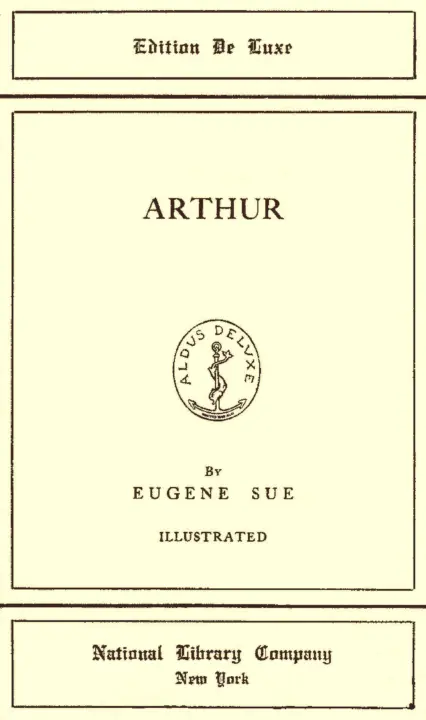
THE CLASSIC COLLECTION · 1839
"Arthur" by Eugène Sue is a novel written in the late 19th century. The story unfolds through the intertwining lives of various characters, with an emphasis on the mysterious figure of Count Arthur and the tragedy surrounding his household. The opening portions hint at themes of intrigue, love, and loss, captivating readers who are drawn to character-driven narratives steeped in emotion and moral complexity. At the start of the novel, the protagonist, who remains unnamed, recounts a chance encounter that leads him to explore a quaint southern village, drawn by the allure of a country house rumored to be for sale. As he journeys through the picturesque landscape, he learns intriguing tales of previous travelers to the village, notably one ominous story involving a mysterious carriage that never returned. Upon reaching the village, he meets the curé and his sister, who are steeped in sadness related to the house's past. This foreshadows deeper explorations of love and loss and sets the stage for revelations regarding Count Arthur, a character woven into the fabric of the village's tragic history. The sense of curiosity and impending revelations builds a compelling narrative thread that invites readers further into the novel's intricate plot.
Introduction adapted from the source catalogue; source summaries may be automatically generated.
Free to read · English · 180,723 words · No account needed
MAKE TIME FOR A GOOD BOOK
On by default. Untick to stop anonymous reading totals. Each page counts after 10 seconds in view. How this works.
Anonymous counting is on unless you have switched it off.
There is nothing very remarkable about the incident I am about to relate, but I am very curious and excited.
A Russian frigate has just come in from Constantinople; fearing bad weather, she has put into Khios, instead of going on to Smyrna, or the Oulach Islands.
That frigate fired a cannon-shot for a pilot, and that was the salute I
heard this morning.
Who is that lady who, in spite of the high wind, came on shore as soon as the vessel was anchored? The sight of that simple little blue bonnet, the cashmere shawl drawn snugly over the shoulders, that little foot so well shod, that little hand so well gloved, has operated a retrograde movement in regard to my ideas of beauty.
From the antique Greek I have passed to the Parisian type. I would now give all the Noémis, the Anathasias, and the Daphnés in the world, with all their fezzes, their yellaks, and embroidered belts, to be able to offer my arm to that pretty stranger; for she is pretty, I could see that much from the trellis of my kiosk. She is tall and slender, and has beautiful blue eyes, which is something very charming in a fair-skinned brunette.
The gentleman whose arm she leans on is middle-aged, and has a fine,
intelligent face.
Who can these strangers be?
KHIOS, October, 18--.
What a strange meeting! Events are so strange that it is well worth while to continue my journal.
Yesterday I sent my old Cypriote to find a Calabrian, who fills the position of port-warden, and attends to the Marquis Justiniani's business, and ask him who were the travellers on the frigate.
That ship is commanded by the Duke of Fersen, ex-ambassador of Russia to the Sublime Porte; he is on his way to Toulon, with the princess, his wife, and several distinguished persons. It was Madame de Fersen that I saw yesterday on the landing.
This morning, about one o'clock, I was lazily stretched on my divan, smoking my Turkish pipe, whose bowl Noémi held, while Anathasia was burning some perfumes in a silver pan, when the curtains of my apartments were suddenly thrust aside, and Daphné entered triumphantly, leading a party of strangers, among whom were M. and Madame de Fersen.
I could have strangled Daphné, for I was furious to be caught in my
Oriental costume.
My hair and beard had grown quite long, and my neck was bare. I wore the long, white skirt of the Albanians, a cherry-coloured jacket embroidered with orange silk, red morocco gaiters, embroidered with silver, and an orange-coloured sash.
Your reading position is saved on this browser. Take it to another device with a library code. Reading pages adapt to text, rather than matching a printed edition.
Eugène Sue
Eugène Sue
Eugène Sue
Eugène Sue
BEHIND THE BOOK
This eBook is for the use of anyone anywhere in the United States and most other parts of the world at no cost and with almost no restrictions whatsoever. You may copy it, give it away or re-use it under the terms of the Project Gutenberg License included with this eBook or online at www.gutenberg.org. If you are not located in the United States, you will have to check the laws of the country where you are located before using this eBook. Read the source licence.
The original source file, including credits and licence, is retained by this library. Request an original-format copy at no charge. Please include the book title and Project Gutenberg identifier #66473.
KEEP YOUR CURIOSITY GOING
Coulson Kernahan

Maurice Baring
Frances Wright
Cécile Tormay

Frederic Jesup Stimson

W. H. P. (William Henry Pope) Jarvis