THE CLASSIC COLLECTION✦The Knight of MaltaCLASSIC FREE BOOKS
The Knight of Malta
Eugène Sue
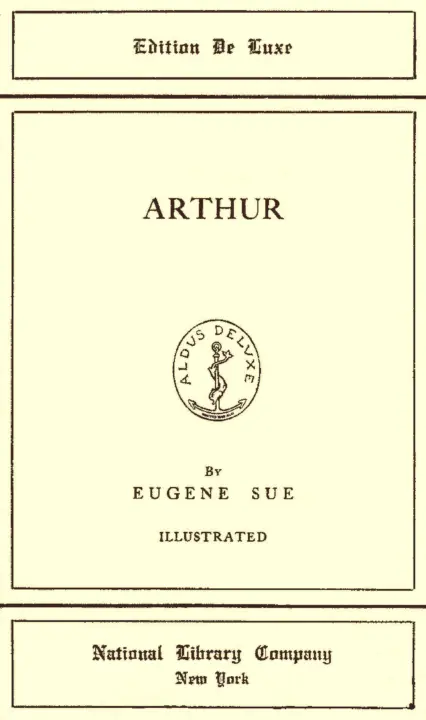
THE CLASSIC COLLECTION · 1839
"Arthur" by Eugène Sue is a novel written in the late 19th century. The story unfolds through the intertwining lives of various characters, with an emphasis on the mysterious figure of Count Arthur and the tragedy surrounding his household. The opening portions hint at themes of intrigue, love, and loss, captivating readers who are drawn to character-driven narratives steeped in emotion and moral complexity. At the start of the novel, the protagonist, who remains unnamed, recounts a chance encounter that leads him to explore a quaint southern village, drawn by the allure of a country house rumored to be for sale. As he journeys through the picturesque landscape, he learns intriguing tales of previous travelers to the village, notably one ominous story involving a mysterious carriage that never returned. Upon reaching the village, he meets the curé and his sister, who are steeped in sadness related to the house's past. This foreshadows deeper explorations of love and loss and sets the stage for revelations regarding Count Arthur, a character woven into the fabric of the village's tragic history. The sense of curiosity and impending revelations builds a compelling narrative thread that invites readers further into the novel's intricate plot.
Introduction adapted from the source catalogue; source summaries may be automatically generated.
Free to read · English · 180,723 words · No account needed
MAKE TIME FOR A GOOD BOOK
On by default. Untick to stop anonymous reading totals. Each page counts after 10 seconds in view. How this works.
Anonymous counting is on unless you have switched it off.
For the last few moments, the plunging of the yacht had become worse and worse. I could hear a continuous roaring, which became constantly more violent. Very soon there were flashes of lightning, followed by the deep rolling of distant thunder.
Sometimes I heard the hurried steps of the sailors overhead, then again the sound was hushed, and I heard the loud voice of Williams, giving orders.
I could no longer doubt of it; we were overtaken by a tempest. I could no longer remain inactive.
Feeble as I was, I tried to get up, hoping that the fresh air would do me good. I rang the bell, and, with the aid of my valet de chambre, succeeded in dressing.
I had almost completely lost the use of my left arm.
I went up on deck. Falmouth was not there.
The waves were furious.
Though it was only four o'clock, it was so dark that I could scarcely
see.
On the horizon, the immense undulations of the waves were outlined against a band of gleaming light, the colour of red-hot iron.
Above this strip of blazing sky, the clouds were piled in heavy masses of ochre and black; the vault of the firmament was reflected in the sea, and the waves seemed to have lost their azure or emerald transparency, and looked like solid mountains streaked with foam.
The wind whistled through the ropes loudly and furiously. Though blowing a gale, the wind was hot, and the water that it raised up in solid sheets, and dashed over the deck of the yacht, was warm.
Very soon the doctor came up on deck. "You are very imprudent," said he to me, "to leave your cabin."
"I was stifling down there, doctor, the motion of the ship made me almost crazy. I feel better up here."
"What frightful weather!" said the doctor. "If we can only get to Malta
to anchor before night!"
"Are we not some distance off yet from that island?"
"We are very near, but that heavy cloud prevents our seeing land. In about an hour the yacht will put up a signal for a pilot, provided that in such a storm they can hear our cannon and see our signal."
An hour afterwards the sky became more clear.
We saw ahead of us, on the horizon, high hills, which were still covered with clouds; Williams said this was Cape Harrach, the northern point of the island of Malta, on the height of which was built the tower of Espinasse, which was used as a lookout. Williams then brought the yacht to, and fired several shots to call for a pilot.
Your reading position is saved on this browser. Take it to another device with a library code. Reading pages adapt to text, rather than matching a printed edition.
Eugène Sue
Eugène Sue
Eugène Sue
Eugène Sue
BEHIND THE BOOK
This eBook is for the use of anyone anywhere in the United States and most other parts of the world at no cost and with almost no restrictions whatsoever. You may copy it, give it away or re-use it under the terms of the Project Gutenberg License included with this eBook or online at www.gutenberg.org. If you are not located in the United States, you will have to check the laws of the country where you are located before using this eBook. Read the source licence.
The original source file, including credits and licence, is retained by this library. Request an original-format copy at no charge. Please include the book title and Project Gutenberg identifier #66473.
KEEP YOUR CURIOSITY GOING
Coulson Kernahan

Maurice Baring
Frances Wright
Cécile Tormay

Frederic Jesup Stimson

W. H. P. (William Henry Pope) Jarvis