THE CLASSIC COLLECTION✦The Knight of MaltaCLASSIC FREE BOOKS
The Knight of Malta
Eugène Sue
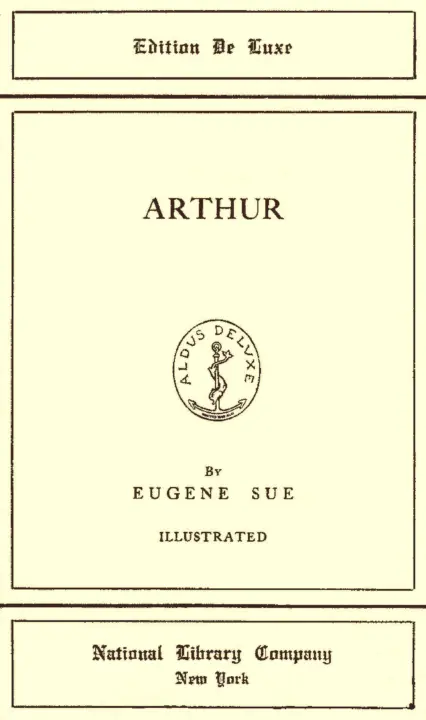
THE CLASSIC COLLECTION · 1839
"Arthur" by Eugène Sue is a novel written in the late 19th century. The story unfolds through the intertwining lives of various characters, with an emphasis on the mysterious figure of Count Arthur and the tragedy surrounding his household. The opening portions hint at themes of intrigue, love, and loss, captivating readers who are drawn to character-driven narratives steeped in emotion and moral complexity. At the start of the novel, the protagonist, who remains unnamed, recounts a chance encounter that leads him to explore a quaint southern village, drawn by the allure of a country house rumored to be for sale. As he journeys through the picturesque landscape, he learns intriguing tales of previous travelers to the village, notably one ominous story involving a mysterious carriage that never returned. Upon reaching the village, he meets the curé and his sister, who are steeped in sadness related to the house's past. This foreshadows deeper explorations of love and loss and sets the stage for revelations regarding Count Arthur, a character woven into the fabric of the village's tragic history. The sense of curiosity and impending revelations builds a compelling narrative thread that invites readers further into the novel's intricate plot.
Introduction adapted from the source catalogue; source summaries may be automatically generated.
Free to read · English · 180,723 words · No account needed
MAKE TIME FOR A GOOD BOOK
On by default. Untick to stop anonymous reading totals. Each page counts after 10 seconds in view. How this works.
Anonymous counting is on unless you have switched it off.
I wrote the following hasty lines in answer to Lord Falmouth's admirable
letter.
I rang the bell and sent him the note.[4]
Just as it has always happened, no sooner was the letter gone than I came to my senses, and when I was able to think of the infamous outrage I had committed, I was overcome with horror.
What if I were mistaken?
I would have given my very life to have been able to recall those
dreadful lines.
It was too late.
My cabin was only separated from Lord Falmouth's by a slight partition.
Seized by the most frightful anxiety, I listened. When the servant who had taken my letter to Falmouth closed the door, there was a dead silence. Then suddenly an impetuous movement upset a chair, and I heard Falmouth start towards the door with heavy and uncertain steps, for he could scarcely walk as yet.
He was coming.
My heart beat as though it was going to break.
His heavy steps came nearer.
I felt that I was breaking into a cold perspiration.
I was afraid!
My door was suddenly opened. He entered holding himself up on his cane.
In all my life--no, never in all my life shall I forget the look of fiery rage that gleamed in his eyes. His face was like a marble mask lit up by two blazing eyeballs.
"Defend yourself!" cried he, in a voice that shook with indignation, and holding out my letter in his hand; "where is your weapon?"
A frightful remorse seized me, so violent was it that a cowardly retraction of my infamy was on my lips.
"Henry!" said I, in despair, pointing to my letter, "pardon!"
"Pardon! You don't mean to fight?" cried Falmouth, in a fury.
The blood rushed to my face, the shame of being thought a coward exasperated me, and I answered, "Monsieur, I will fight with whatever weapon you choose."
"Thanks for such extreme politeness. What weapon do you fight with? I have had enough of this," repeated he, savagely.
I was almost bursting with rage, but remembering that Falmouth was on his own yacht, I controlled myself.
"Both you and I," said I, "are too badly wounded to use our swords,--pistols would be the most suitable arm."
"That is quite true," said Falmouth, as he sank into an armchair.
He rang the bell.
One of his servants entered.
"Beg Mr. Williams to come below," said Falmouth. The valet went out.
"Williams and Geordy will be our seconds," said Falmouth, imperiously.
I gave a mechanical sign of assent,--I was annihilated.
Williams came down into the cabin.
"Where are we, Williams? What is the nearest land?"
Your reading position is saved on this browser. Take it to another device with a library code. Reading pages adapt to text, rather than matching a printed edition.
Eugène Sue
Eugène Sue
Eugène Sue
Eugène Sue
BEHIND THE BOOK
This eBook is for the use of anyone anywhere in the United States and most other parts of the world at no cost and with almost no restrictions whatsoever. You may copy it, give it away or re-use it under the terms of the Project Gutenberg License included with this eBook or online at www.gutenberg.org. If you are not located in the United States, you will have to check the laws of the country where you are located before using this eBook. Read the source licence.
The original source file, including credits and licence, is retained by this library. Request an original-format copy at no charge. Please include the book title and Project Gutenberg identifier #66473.
KEEP YOUR CURIOSITY GOING
Coulson Kernahan

Maurice Baring
Frances Wright
Cécile Tormay

Frederic Jesup Stimson

W. H. P. (William Henry Pope) Jarvis