THE CLASSIC COLLECTION✦The Knight of MaltaCLASSIC FREE BOOKS
The Knight of Malta
Eugène Sue
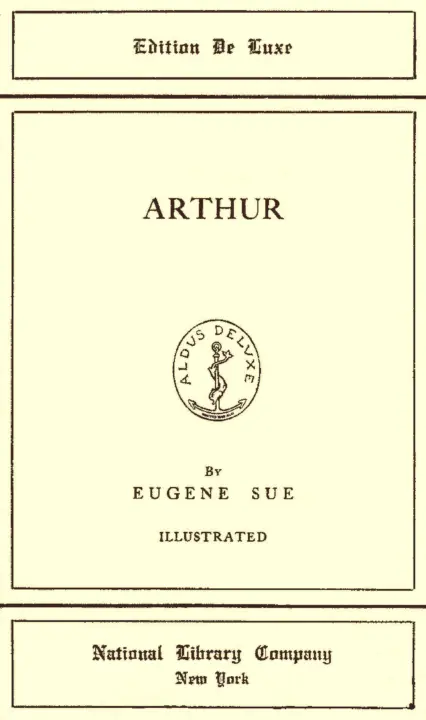
THE CLASSIC COLLECTION · 1839
"Arthur" by Eugène Sue is a novel written in the late 19th century. The story unfolds through the intertwining lives of various characters, with an emphasis on the mysterious figure of Count Arthur and the tragedy surrounding his household. The opening portions hint at themes of intrigue, love, and loss, captivating readers who are drawn to character-driven narratives steeped in emotion and moral complexity. At the start of the novel, the protagonist, who remains unnamed, recounts a chance encounter that leads him to explore a quaint southern village, drawn by the allure of a country house rumored to be for sale. As he journeys through the picturesque landscape, he learns intriguing tales of previous travelers to the village, notably one ominous story involving a mysterious carriage that never returned. Upon reaching the village, he meets the curé and his sister, who are steeped in sadness related to the house's past. This foreshadows deeper explorations of love and loss and sets the stage for revelations regarding Count Arthur, a character woven into the fabric of the village's tragic history. The sense of curiosity and impending revelations builds a compelling narrative thread that invites readers further into the novel's intricate plot.
Introduction adapted from the source catalogue; source summaries may be automatically generated.
Free to read · English · 180,723 words · No account needed
MAKE TIME FOR A GOOD BOOK
On by default. Untick to stop anonymous reading totals. Each page counts after 10 seconds in view. How this works.
Anonymous counting is on unless you have switched it off.
Frank's face, which I had not seen for two years, wore an expression of
heart-breaking sadness.
He, also, could not repress his tears every time he glanced at the face
of the dying child.
The calmness, the silence of this scene, which I seized at one glance, made such an impression upon me that for an instant I stood rooted to the threshold.
Madame de Fersen turned towards the clock, then shook her head, with a
gesture of despair.
I understood, she was beginning to lose faith in me.
I pushed the door open.
Catherine saw me; in an instant she was at my side, and drawing me to the cot, she said, in a heartrending tone, "Save her! have pity on me, and save her!"
Madame de Fersen's voice was low and broken; her beautiful face was tear-stained and worn; yet under this appearance of weakness one felt the superhuman energy which always sustains a mother, so long as her child needs her.
"One moment," said Doctor Ralph, in a low, solemn voice. "This is our last hope, let us not take too great a risk."
The unhappy woman hid her face in her hands.
"I have told you, madame," said the doctor, showing a vial containing a dark liquid, "this potion will restore this child to consciousness, will light up the faint spark of intelligence which still remains, perhaps. Then the sight of the person who exercises on her so strange an influence may work a miracle, for, alas! madame, nothing but a miracle can bring your child back to life."
"I know it, I know it," said Catherine, choking back her tears, "I am prepared for the worst. But, tell me, the potion,--what effect will it have?"
"I can answer for its immediate effects; but not for the consequences
that may follow."
"What is to be done? Mon Dieu! what is to be done?" cried Catherine,
in accents of anguish.
"Do not hesitate, madame," I said; "since all hope is gone, accept the only chance that remains!"
"I am of the same opinion, do not hesitate, madame," said Frank, who
shared our emotion.
"Proceed, monsieur," whispered Madame de Fersen, in an accent of desperate determination; and she knelt down by her child's cot.
Her lips moved in prayer.
She, Frank, and I fixed upon the doctor sorrowing and apprehensive
looks.
He alone was calm, as with slow and silent steps he approached Irene's
bedside.
At the sight of his tall figure, his austere countenance, his long white hair, his peculiar garb, one might have supposed him a man gifted with some occult power, ready to perform by a potion some mysterious charm.
Your reading position is saved on this browser. Take it to another device with a library code. Reading pages adapt to text, rather than matching a printed edition.
Eugène Sue
Eugène Sue
Eugène Sue
Eugène Sue
BEHIND THE BOOK
This eBook is for the use of anyone anywhere in the United States and most other parts of the world at no cost and with almost no restrictions whatsoever. You may copy it, give it away or re-use it under the terms of the Project Gutenberg License included with this eBook or online at www.gutenberg.org. If you are not located in the United States, you will have to check the laws of the country where you are located before using this eBook. Read the source licence.
The original source file, including credits and licence, is retained by this library. Request an original-format copy at no charge. Please include the book title and Project Gutenberg identifier #66473.
KEEP YOUR CURIOSITY GOING
Coulson Kernahan

Maurice Baring
Frances Wright
Cécile Tormay

Frederic Jesup Stimson

W. H. P. (William Henry Pope) Jarvis