THE CLASSIC COLLECTION✦The Knight of MaltaCLASSIC FREE BOOKS
The Knight of Malta
Eugène Sue
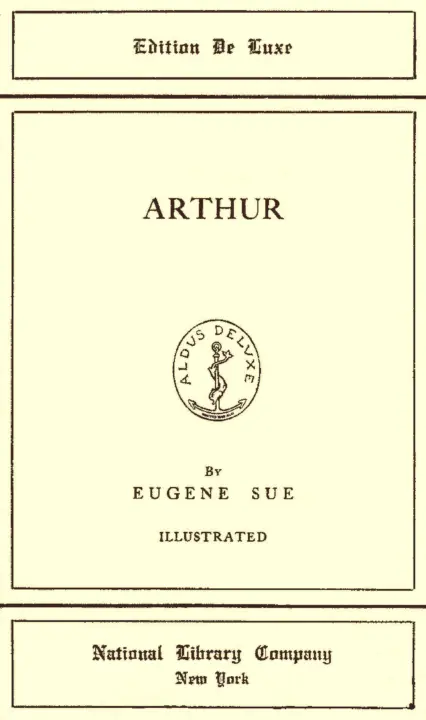
THE CLASSIC COLLECTION · 1839
"Arthur" by Eugène Sue is a novel written in the late 19th century. The story unfolds through the intertwining lives of various characters, with an emphasis on the mysterious figure of Count Arthur and the tragedy surrounding his household. The opening portions hint at themes of intrigue, love, and loss, captivating readers who are drawn to character-driven narratives steeped in emotion and moral complexity. At the start of the novel, the protagonist, who remains unnamed, recounts a chance encounter that leads him to explore a quaint southern village, drawn by the allure of a country house rumored to be for sale. As he journeys through the picturesque landscape, he learns intriguing tales of previous travelers to the village, notably one ominous story involving a mysterious carriage that never returned. Upon reaching the village, he meets the curé and his sister, who are steeped in sadness related to the house's past. This foreshadows deeper explorations of love and loss and sets the stage for revelations regarding Count Arthur, a character woven into the fabric of the village's tragic history. The sense of curiosity and impending revelations builds a compelling narrative thread that invites readers further into the novel's intricate plot.
Introduction adapted from the source catalogue; source summaries may be automatically generated.
Free to read · English · 180,723 words · No account needed
MAKE TIME FOR A GOOD BOOK
On by default. Untick to stop anonymous reading totals. Each page counts after 10 seconds in view. How this works.
Anonymous counting is on unless you have switched it off.
Among other plays at the Variétés that evening, they were giving "The Bear and the Pacha." This was one of M. de Fersen's triumphs at Constantinople, where he had taken, with great success, the part of Schaabaham, and he was most eager to see Brunet playing the same part.
Madame de Fersen arrived about nine o'clock, with her husband and the Duchess of ----. They took their places in a proscenium box, of which the lattices were half raised.
Catherine saw me, and gave me a gracious bow.
I found her pale and changed.
I have no recollection of the piece they played, and on the fall of the curtain I went to Madame de Fersen's box.
She was not well. I was looking at her attentively, when the prince said: "Be our umpire; you rarely see Madame de Fersen, and can better than any one notice a change; do you not find she has fallen away very much?"
I said I did not think so; that Madame de Fersen seemed to me in perfect health. The prince proclaimed me an impudent flatterer, etc.
The curtain rose, and I left the box.
I returned to my seat.
They began "The Bear and the Pacha."
This burlesque did not bring a smile to Madame de Fersen's countenance, but her husband applauded frantically, and I must confess I shared the general merriment.
One of those loudest in laughter was a man seated just in front of me, and of whom I could only see the thick, gray, curly locks.
I had never heard such ringing, joyous laughter,--at times it became almost convulsive. At these times the man clung with both hands to the barrier dividing the stalls from the orchestra, and, strengthened by this prop, gave full scope to his hilarity.
Nothing is more contagious than laughter; the witticisms of the play had already excited my risible faculties, and, in spite of myself, the wild uproariousness of this man so affected me that I soon was nothing more than his echo, and to each of his immoderate bursts I responded with a no less boisterous explosion of laughter.
In short, I had not noticed that Madame de Fersen had left the theatre.
The curtain fell, and I rose.
The man who had yielded to such boisterous mirth also rose, turned towards me as he put on his hat, and exclaimed, with a return of joyful glee: "What a buffoon that Odry is!"
Amazed, I leaned on the back of my stall.
I had recognised the pirate of Porquerolles, the pilot of Malta.
Your reading position is saved on this browser. Take it to another device with a library code. Reading pages adapt to text, rather than matching a printed edition.
Eugène Sue
Eugène Sue
Eugène Sue
Eugène Sue
BEHIND THE BOOK
This eBook is for the use of anyone anywhere in the United States and most other parts of the world at no cost and with almost no restrictions whatsoever. You may copy it, give it away or re-use it under the terms of the Project Gutenberg License included with this eBook or online at www.gutenberg.org. If you are not located in the United States, you will have to check the laws of the country where you are located before using this eBook. Read the source licence.
The original source file, including credits and licence, is retained by this library. Request an original-format copy at no charge. Please include the book title and Project Gutenberg identifier #66473.
KEEP YOUR CURIOSITY GOING
Coulson Kernahan

Maurice Baring
Frances Wright
Cécile Tormay

Frederic Jesup Stimson

W. H. P. (William Henry Pope) Jarvis