THE CLASSIC COLLECTION✦The Knight of MaltaCLASSIC FREE BOOKS
The Knight of Malta
Eugène Sue
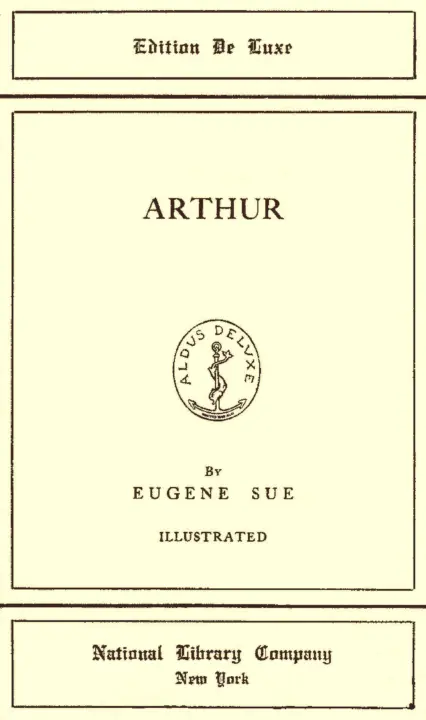
THE CLASSIC COLLECTION · 1839
"Arthur" by Eugène Sue is a novel written in the late 19th century. The story unfolds through the intertwining lives of various characters, with an emphasis on the mysterious figure of Count Arthur and the tragedy surrounding his household. The opening portions hint at themes of intrigue, love, and loss, captivating readers who are drawn to character-driven narratives steeped in emotion and moral complexity. At the start of the novel, the protagonist, who remains unnamed, recounts a chance encounter that leads him to explore a quaint southern village, drawn by the allure of a country house rumored to be for sale. As he journeys through the picturesque landscape, he learns intriguing tales of previous travelers to the village, notably one ominous story involving a mysterious carriage that never returned. Upon reaching the village, he meets the curé and his sister, who are steeped in sadness related to the house's past. This foreshadows deeper explorations of love and loss and sets the stage for revelations regarding Count Arthur, a character woven into the fabric of the village's tragic history. The sense of curiosity and impending revelations builds a compelling narrative thread that invites readers further into the novel's intricate plot.
Introduction adapted from the source catalogue; source summaries may be automatically generated.
Free to read · English · 180,723 words · No account needed
MAKE TIME FOR A GOOD BOOK
On by default. Untick to stop anonymous reading totals. Each page counts after 10 seconds in view. How this works.
Anonymous counting is on unless you have switched it off.
I reëntered Paris, from which I had been absent eighteen months, with a certain heartache. I had a faint hope, or rather some dread, of meeting Hélène or Marguerite.
I fancied myself completely cured of my fatal monomania of distrust; my great love for Madame de Fersen had, in my eyes, performed this prodigy. I promised myself, in case I should meet my cousin, or Madame de Pënâfiel, frankly to ask their forgiveness, and to endeavour by the most affectionate and friendly attentions to make amends for the hateful follies of the lover of former days.
I met M. de Cernay, who from the Opéra had transferred his amorous worship to the Comédie-Française, in the suite of Mlle. ----, a most enticing soubrette.
M. de Pommerive was heavier, more slanderous, and more wearisome than ever. Cernay greeted me with effusive cordiality, and asked me about my travels with Falmouth, for as yet nothing had transpired.
As I was very reserved on this subject, as much by natural tendency as by premeditation, Cernay and Pommerive ended by imagining the most unheard-of things on the pretended mystery of my adventures.
In accordance with my arrangement with the prince, I begged a man of my acquaintance, very intimate with the Russian ambassador, to present me to Madame de Fersen.
The prince had rented a handsome furnished mansion in the Faubourg St.
Germain.
Before long his salons were the customary meeting-place of the corps diplomatique and of the cream of Parisian society, regardless of political opinions.
Madame de Fersen's appearance in the world caused a sensation. Her beauty, her name, and her reputation as a woman versed in politics and interested in the great topics of the day, the respect which she inspired, all contributed to place her very high in public estimation.
In a short time the just appreciation of the rare qualities that distinguished her was followed by the most pronounced infatuation.
The women who shared her austere principles were delighted and proud to strengthen their ranks with such a recruit. Those, on the contrary, who might have dreaded her coldness, taking it as a mute censure of their flightiness, were charmed and surprised at her great amiability. Assured of not finding in her a rival, they became enthusiastic regarding the beautiful stranger.
I can scarcely express my happiness at Madame de Fersen's success.
I went to her house for the first time one evening, five or six days
after my arrival in Paris.
Though rather late, there were as yet few people assembled.
She greeted me very gracefully; but I observed in her a certain reserve, uneasiness, and sadness.
Your reading position is saved on this browser. Take it to another device with a library code. Reading pages adapt to text, rather than matching a printed edition.
Eugène Sue
Eugène Sue
Eugène Sue
Eugène Sue
BEHIND THE BOOK
This eBook is for the use of anyone anywhere in the United States and most other parts of the world at no cost and with almost no restrictions whatsoever. You may copy it, give it away or re-use it under the terms of the Project Gutenberg License included with this eBook or online at www.gutenberg.org. If you are not located in the United States, you will have to check the laws of the country where you are located before using this eBook. Read the source licence.
The original source file, including credits and licence, is retained by this library. Request an original-format copy at no charge. Please include the book title and Project Gutenberg identifier #66473.
KEEP YOUR CURIOSITY GOING
Coulson Kernahan

Maurice Baring
Frances Wright
Cécile Tormay

Frederic Jesup Stimson

W. H. P. (William Henry Pope) Jarvis