THE CLASSIC COLLECTION✦The Knight of MaltaCLASSIC FREE BOOKS
The Knight of Malta
Eugène Sue
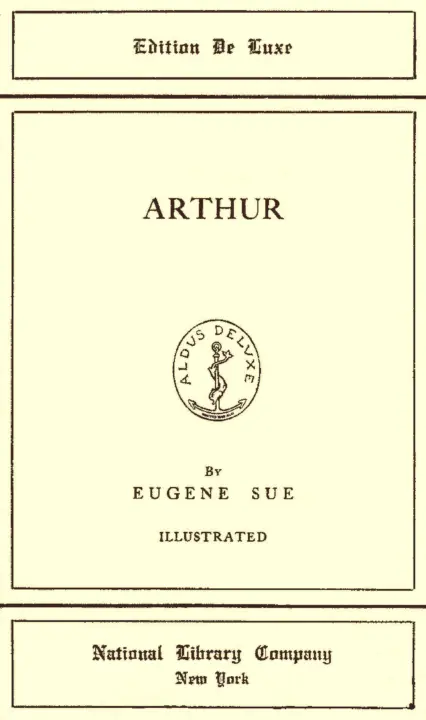
THE CLASSIC COLLECTION · 1839
"Arthur" by Eugène Sue is a novel written in the late 19th century. The story unfolds through the intertwining lives of various characters, with an emphasis on the mysterious figure of Count Arthur and the tragedy surrounding his household. The opening portions hint at themes of intrigue, love, and loss, captivating readers who are drawn to character-driven narratives steeped in emotion and moral complexity. At the start of the novel, the protagonist, who remains unnamed, recounts a chance encounter that leads him to explore a quaint southern village, drawn by the allure of a country house rumored to be for sale. As he journeys through the picturesque landscape, he learns intriguing tales of previous travelers to the village, notably one ominous story involving a mysterious carriage that never returned. Upon reaching the village, he meets the curé and his sister, who are steeped in sadness related to the house's past. This foreshadows deeper explorations of love and loss and sets the stage for revelations regarding Count Arthur, a character woven into the fabric of the village's tragic history. The sense of curiosity and impending revelations builds a compelling narrative thread that invites readers further into the novel's intricate plot.
Introduction adapted from the source catalogue; source summaries may be automatically generated.
Free to read · English · 180,723 words · No account needed
MAKE TIME FOR A GOOD BOOK
On by default. Untick to stop anonymous reading totals. Each page counts after 10 seconds in view. How this works.
Anonymous counting is on unless you have switched it off.
I again ascended to the deck.
I had taken a double-barrelled carbine, and a heavy Turkish damaskeened battle-axe, formerly bought as an object of curiosity, and which, under these circumstances, became an excellent weapon, for, besides its heavy blade, it ended in a very sharp iron spear.
I tried to discover the pirate, but whether because the ship had put out its light, or because it had greatly prolonged its tack, I could no longer see it. The yacht's crew had been promptly armed.
By the glimmer of some gun-lighters, fixed by their iron points in some buckets filled with water, we saw the sailors placed in charge of the guns, standing near the carronades; others, placed on either side of the schooner, were loading their guns, while an old gray-haired boatswain had just taken the tiller from the hands of one of his much younger comrades, whose experience was, doubtless, not sufficient to enable him to take this important post, during the combat.
All this took place in profound silence; one could hear only the dull noise of the ramrods on the wads, or the sound of the butt end of the muskets on the bridge. Williams, at the stern, stood on his quarter-deck, giving the last order. Geordy, charged with the direction of the gunners, superintended this part of the service.
Falmouth stood on the bridge. He had again put on his mask of habitual
indifference.
"All is ready, my lord," said Williams to him. "Does your Grace wish to fight this pirate under sail or shall we board her?"
"Which do you prefer, a fight on board or a fight under sail?" Falmouth asked me, as if he were asking me to choose between Bordeaux or Madeira wine.
"I am absolutely indifferent," I replied, smiling; "let us act without ceremony; trust to the judgment of Williams, it is safer."
"What do you think, Williams?" demanded Falmouth.
"That we keep under sail. With the artillery of your Grace's yacht we can destroy this pirate without its being able to approach us, or do us much harm; for I do not suppose it could have taken artillery aboard."
"And the boarding?" asked Falmouth.
"I believe my lord knows the crew of the yacht well enough to be certain that, after a good contest, the pirates will be repulsed, or perhaps that their boat will remain in our power. But," suddenly cried Williams, pointing to a white spot with the end of his spy-glass, "the ship has put about; here it is returning upon us, my lord."
In fact, I soon saw its white sails appear in the darkness as it rapidly
approached.
Your reading position is saved on this browser. Take it to another device with a library code. Reading pages adapt to text, rather than matching a printed edition.
Eugène Sue
Eugène Sue
Eugène Sue
Eugène Sue
BEHIND THE BOOK
This eBook is for the use of anyone anywhere in the United States and most other parts of the world at no cost and with almost no restrictions whatsoever. You may copy it, give it away or re-use it under the terms of the Project Gutenberg License included with this eBook or online at www.gutenberg.org. If you are not located in the United States, you will have to check the laws of the country where you are located before using this eBook. Read the source licence.
The original source file, including credits and licence, is retained by this library. Request an original-format copy at no charge. Please include the book title and Project Gutenberg identifier #66473.
KEEP YOUR CURIOSITY GOING
Coulson Kernahan

Maurice Baring
Frances Wright
Cécile Tormay

Frederic Jesup Stimson

W. H. P. (William Henry Pope) Jarvis