THE CLASSIC COLLECTION✦The Knight of MaltaCLASSIC FREE BOOKS
The Knight of Malta
Eugène Sue
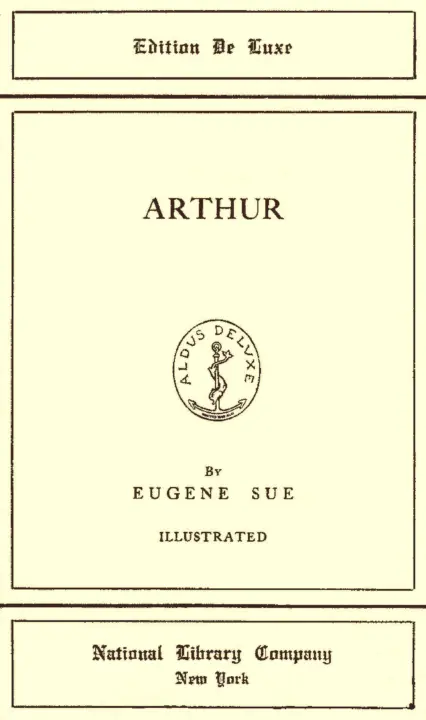
THE CLASSIC COLLECTION · 1839
"Arthur" by Eugène Sue is a novel written in the late 19th century. The story unfolds through the intertwining lives of various characters, with an emphasis on the mysterious figure of Count Arthur and the tragedy surrounding his household. The opening portions hint at themes of intrigue, love, and loss, captivating readers who are drawn to character-driven narratives steeped in emotion and moral complexity. At the start of the novel, the protagonist, who remains unnamed, recounts a chance encounter that leads him to explore a quaint southern village, drawn by the allure of a country house rumored to be for sale. As he journeys through the picturesque landscape, he learns intriguing tales of previous travelers to the village, notably one ominous story involving a mysterious carriage that never returned. Upon reaching the village, he meets the curé and his sister, who are steeped in sadness related to the house's past. This foreshadows deeper explorations of love and loss and sets the stage for revelations regarding Count Arthur, a character woven into the fabric of the village's tragic history. The sense of curiosity and impending revelations builds a compelling narrative thread that invites readers further into the novel's intricate plot.
Introduction adapted from the source catalogue; source summaries may be automatically generated.
Free to read · English · 180,723 words · No account needed
MAKE TIME FOR A GOOD BOOK
On by default. Untick to stop anonymous reading totals. Each page counts after 10 seconds in view. How this works.
Anonymous counting is on unless you have switched it off.
Henry owed his life to me!
I cannot tell with what pride I continually repeated these words:
"I have saved Henry's life."
How I blessed the fortunate chance that permitted me to prove to Falmouth that my friendship was warm and true.
Until then, though I was entirely absorbed in my affection for him, I felt that there was wanting some great sacrifice, which would be a solemn consecration of my devotedness.
If my act had any value in my own eyes, it was because I should stand higher in his. It showed me that I was capable of a generous resolution, and reassured me on the firmness of my attachment to Falmouth.
Now, with a nature like mine, to believe in myself was to believe in him; to think of myself as a true, warm, and devoted friend, was to believe myself capable of inspiring true, ardent, and devoted friendship.
I felt that intrepid confidence of the soldier who, being perfectly sure of his conduct under fire, waits impatiently and securely for another occasion to show his courage. The reaction of this self-reliance was so great that it influenced even my former sentiments.
Proud of my conduct towards Falmouth, I understood that Hélène and Marguerite had loved me for qualities they saw in me, and which I had never discovered until now. For the first time I knew real happiness. I at last was able to understand all the devotion these two noble beings had bestowed on me.
An hour after the doctor left me, the door of my chamber opened, and I saw Falmouth, who was carried in by two of his servants.
His armchair was scarcely at my bedside, before Henry threw himself in
my arms.
In this mute embrace, his head was leaning on my shoulder, and I could feel his tears and his trembling hands; he was only able to say these words: "Arthur,--Arthur,--my friend, my friend!"
Although this was so long ago, and black care has dimmed the radiance of that happy day, nothing has ever wiped out the remembrance of it, which is still vivid enough to quicken my heart's pulses and thrill me with delight.
It would be impossible to tell with what delicacy and effusion Falmouth expressed his gratitude. Words can never describe his accent, his look, nor his voice.
The head winds lasted for several days longer, and prevented our reaching Malta as soon as we had hoped.
Lord Falmouth's wound was healing rapidly, but mine was making very slow progress towards improvement.
Henry, in the meantime, tended me with the most affectionate solicitude.
Your reading position is saved on this browser. Take it to another device with a library code. Reading pages adapt to text, rather than matching a printed edition.
Eugène Sue
Eugène Sue
Eugène Sue
Eugène Sue
BEHIND THE BOOK
This eBook is for the use of anyone anywhere in the United States and most other parts of the world at no cost and with almost no restrictions whatsoever. You may copy it, give it away or re-use it under the terms of the Project Gutenberg License included with this eBook or online at www.gutenberg.org. If you are not located in the United States, you will have to check the laws of the country where you are located before using this eBook. Read the source licence.
The original source file, including credits and licence, is retained by this library. Request an original-format copy at no charge. Please include the book title and Project Gutenberg identifier #66473.
KEEP YOUR CURIOSITY GOING
Coulson Kernahan

Maurice Baring
Frances Wright
Cécile Tormay

Frederic Jesup Stimson

W. H. P. (William Henry Pope) Jarvis