THE CLASSIC COLLECTION✦The Knight of MaltaCLASSIC FREE BOOKS
The Knight of Malta
Eugène Sue
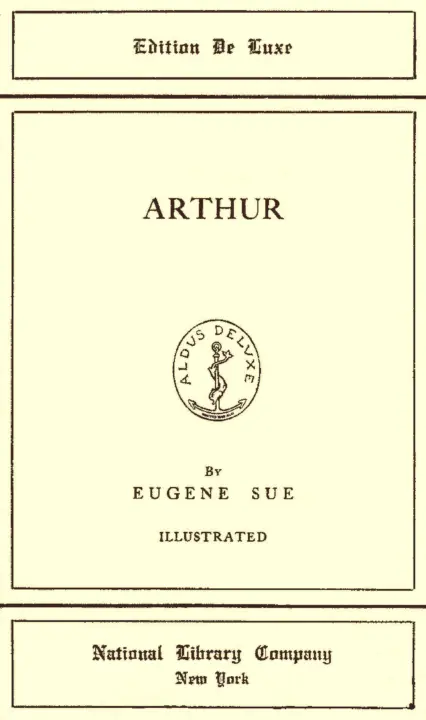
THE CLASSIC COLLECTION · 1839
"Arthur" by Eugène Sue is a novel written in the late 19th century. The story unfolds through the intertwining lives of various characters, with an emphasis on the mysterious figure of Count Arthur and the tragedy surrounding his household. The opening portions hint at themes of intrigue, love, and loss, captivating readers who are drawn to character-driven narratives steeped in emotion and moral complexity. At the start of the novel, the protagonist, who remains unnamed, recounts a chance encounter that leads him to explore a quaint southern village, drawn by the allure of a country house rumored to be for sale. As he journeys through the picturesque landscape, he learns intriguing tales of previous travelers to the village, notably one ominous story involving a mysterious carriage that never returned. Upon reaching the village, he meets the curé and his sister, who are steeped in sadness related to the house's past. This foreshadows deeper explorations of love and loss and sets the stage for revelations regarding Count Arthur, a character woven into the fabric of the village's tragic history. The sense of curiosity and impending revelations builds a compelling narrative thread that invites readers further into the novel's intricate plot.
Introduction adapted from the source catalogue; source summaries may be automatically generated.
Free to read · English · 180,723 words · No account needed
MAKE TIME FOR A GOOD BOOK
On by default. Untick to stop anonymous reading totals. Each page counts after 10 seconds in view. How this works.
Anonymous counting is on unless you have switched it off.
Thanks to this amiable forethought of Madame de Fersen, I met her very frequently. I went regularly to her receptions, and, therefore, saw her almost every evening; but as in society I confined myself to greeting her most respectfully, exchanging merely a few ceremonious words, our meetings were unobserved.
Once or twice I called on her of a morning; but by a singular chance, or rather in consequence of the assiduities with which she was surrounded, I never found her alone.
Had I asked her for a private interview she would have granted it, but, true to the plan I had mapped out, I would not ask for it at present.
Besides, a smile, a glance that we mysteriously exchanged in the crowd, did it not repay me a thousand times for my reserve and my discretion?
Would I not give the most public and most marked attentions for the slightest favour which should be unknown to the world!
Notwithstanding the daily intercourse which I maintained with Madame de Fersen through Irene, notwithstanding our exchange of flowers (for each day I also brought Irene a beautiful bouquet of roses, which her mother wore at night), not a soul suspected this delightful intimacy.
As a measure of prudence I would meet Irene in turn at the Tuileries, at the Luxembourg, at Mousseaux, or on the boulevards. I never made use of my horses to go to these meetings, for fear of attracting attention.
I wrapped myself up in a cloak, and took delight in putting as much mystery in these meetings as if Madame de Fersen herself had been in question.
It was perfect folly, but I waited for the hour of meeting with this child full of candour and innocence with a loving, restless, ardent impatience; I counted the minutes, the seconds; I feared and hoped by turns; in fact, I experienced all the irritating and delicious emotions of the most passionate love.
I commented eagerly on each of Irene's words, to seek, to discover, her mother's secret thought! And when I fancied I could interpret this thought in a manner more tender than usual, I returned home with paradise in my heart.
Inexhaustible treasures of a pure and chaste love! Philosophers, atheists, or the strong-minded in love will, doubtless, mock me. I myself, before my sojourn at Khios, would not have understood all its charm.
I was now more than ever in love.
By the rare versatility of her endowments, Madame de Fersen achieved an exalted position in society. Calumny itself admired her and praised her beyond measure, doubtless to give a colour of impartiality, whereby its accusations became more dangerous.
Your reading position is saved on this browser. Take it to another device with a library code. Reading pages adapt to text, rather than matching a printed edition.
Eugène Sue
Eugène Sue
Eugène Sue
Eugène Sue
BEHIND THE BOOK
This eBook is for the use of anyone anywhere in the United States and most other parts of the world at no cost and with almost no restrictions whatsoever. You may copy it, give it away or re-use it under the terms of the Project Gutenberg License included with this eBook or online at www.gutenberg.org. If you are not located in the United States, you will have to check the laws of the country where you are located before using this eBook. Read the source licence.
The original source file, including credits and licence, is retained by this library. Request an original-format copy at no charge. Please include the book title and Project Gutenberg identifier #66473.
KEEP YOUR CURIOSITY GOING
Coulson Kernahan

Maurice Baring
Frances Wright
Cécile Tormay

Frederic Jesup Stimson

W. H. P. (William Henry Pope) Jarvis