THE CLASSIC COLLECTION✦The Knight of MaltaCLASSIC FREE BOOKS
The Knight of Malta
Eugène Sue
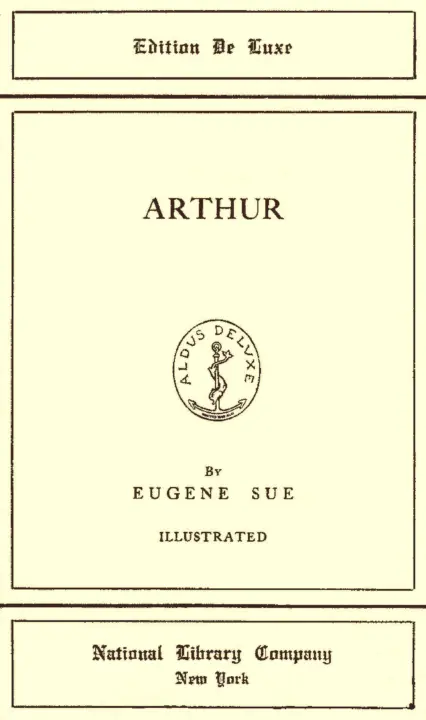
THE CLASSIC COLLECTION · 1839
"Arthur" by Eugène Sue is a novel written in the late 19th century. The story unfolds through the intertwining lives of various characters, with an emphasis on the mysterious figure of Count Arthur and the tragedy surrounding his household. The opening portions hint at themes of intrigue, love, and loss, captivating readers who are drawn to character-driven narratives steeped in emotion and moral complexity. At the start of the novel, the protagonist, who remains unnamed, recounts a chance encounter that leads him to explore a quaint southern village, drawn by the allure of a country house rumored to be for sale. As he journeys through the picturesque landscape, he learns intriguing tales of previous travelers to the village, notably one ominous story involving a mysterious carriage that never returned. Upon reaching the village, he meets the curé and his sister, who are steeped in sadness related to the house's past. This foreshadows deeper explorations of love and loss and sets the stage for revelations regarding Count Arthur, a character woven into the fabric of the village's tragic history. The sense of curiosity and impending revelations builds a compelling narrative thread that invites readers further into the novel's intricate plot.
Introduction adapted from the source catalogue; source summaries may be automatically generated.
Free to read · English · 180,723 words · No account needed
MAKE TIME FOR A GOOD BOOK
On by default. Untick to stop anonymous reading totals. Each page counts after 10 seconds in view. How this works.
Anonymous counting is on unless you have switched it off.
"And she will be spared, be assured! Children who are silent and thoughtful are always dreamy and excitable; it is not surprising. Do not be uneasy. Well, good-bye, Irene; and you, Madame Paul, assure the princess of my respectful regards, and say how grateful I am for the promise she made me to send me daily my little friend."
"Adieu, then, till to-morrow, Irene," and I kissed her tenderly.
"Till to-morrow," repeated the child, with a happy but grave and serious
smile.
Then her nurse wrapped her warm pelisse around her, and Irene went off, turning several times, however, to say adieu with her little hand.
Superstitious as I am, and inclined to tender and lofty sentiments by my love for Catherine, this conversation had aroused in me the most varied emotions,--emotions at once sombre and beaming, cruel and radiant.
I was happy. The strange predictions which Irene repeated to her mother must, if Catherine loved me, recall me to her heart daily, and it was the voice of her child, her beloved child, which continually uttered my name!
And this strange, fatal connection between Ivan's death and the fate that might be awaiting me,--must it not act upon Madame de Fersen's imagination and excite her interest in me? If she saw but little of me, did she not know that this reserve on my part was a cruel sacrifice I imposed upon myself for her sake?
At other times, I acknowledge the weakness, the persistency of Irene's predictions, in spite of myself, chilled me.
I experienced a sort of vertigo, of fearful attraction, similar to that which draws you to look down a precipice when you are walking at its edge.
Unless the weather was too cold or rainy, the nurse brought Irene to me
every day.
By degrees she returned to blooming health.
About a fortnight after our first meeting, she brought me a large bouquet of roses, telling me her mother sent them, but, unfortunately, they were not as beautiful as the roses of Khios.
This souvenir of Catherine's overjoyed me, for I had spoken to her with enthusiasm of those lovely roses.
Every day after that Irene brought me roses; and every day also she told me, with an air of mystery, without ever making a mistake, what her mother would do that evening, whether she was going to court, or in society, or to the theatre.
Your reading position is saved on this browser. Take it to another device with a library code. Reading pages adapt to text, rather than matching a printed edition.
Eugène Sue
Eugène Sue
Eugène Sue
Eugène Sue
BEHIND THE BOOK
This eBook is for the use of anyone anywhere in the United States and most other parts of the world at no cost and with almost no restrictions whatsoever. You may copy it, give it away or re-use it under the terms of the Project Gutenberg License included with this eBook or online at www.gutenberg.org. If you are not located in the United States, you will have to check the laws of the country where you are located before using this eBook. Read the source licence.
The original source file, including credits and licence, is retained by this library. Request an original-format copy at no charge. Please include the book title and Project Gutenberg identifier #66473.
KEEP YOUR CURIOSITY GOING
Coulson Kernahan

Maurice Baring
Frances Wright
Cécile Tormay

Frederic Jesup Stimson

W. H. P. (William Henry Pope) Jarvis