THE CLASSIC COLLECTION✦The Knight of MaltaCLASSIC FREE BOOKS
The Knight of Malta
Eugène Sue
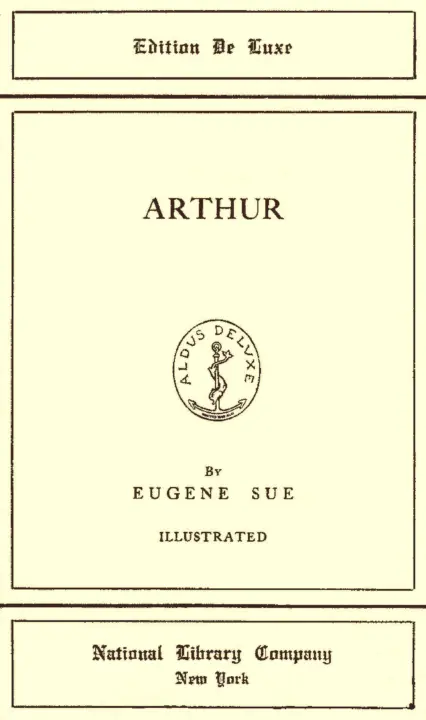
THE CLASSIC COLLECTION · 1839
"Arthur" by Eugène Sue is a novel written in the late 19th century. The story unfolds through the intertwining lives of various characters, with an emphasis on the mysterious figure of Count Arthur and the tragedy surrounding his household. The opening portions hint at themes of intrigue, love, and loss, captivating readers who are drawn to character-driven narratives steeped in emotion and moral complexity. At the start of the novel, the protagonist, who remains unnamed, recounts a chance encounter that leads him to explore a quaint southern village, drawn by the allure of a country house rumored to be for sale. As he journeys through the picturesque landscape, he learns intriguing tales of previous travelers to the village, notably one ominous story involving a mysterious carriage that never returned. Upon reaching the village, he meets the curé and his sister, who are steeped in sadness related to the house's past. This foreshadows deeper explorations of love and loss and sets the stage for revelations regarding Count Arthur, a character woven into the fabric of the village's tragic history. The sense of curiosity and impending revelations builds a compelling narrative thread that invites readers further into the novel's intricate plot.
Introduction adapted from the source catalogue; source summaries may be automatically generated.
Free to read · English · 180,723 words · No account needed
MAKE TIME FOR A GOOD BOOK
On by default. Untick to stop anonymous reading totals. Each page counts after 10 seconds in view. How this works.
Anonymous counting is on unless you have switched it off.
But my astonishment was great when I saw Madame de Fersen look with amazement, first at Irene, and then at me, as if she attached a great importance to what her little girl had just said to me.
"Although I have nothing now to envy the happy Ivan, this is a declaration, madame, which I much fear will be forgotten ten years hence," said I to the princess.
"Forgotten! Irene forgets nothing. See her tears at the remembrance of
Ivan."
In fact two large pearls were rolling down the child's cheeks, while she continued to fix upon me a glance at once sweet, sad, and questioning.
"But who, then, was Ivan?"
Madame de Fersen's features darkened, and she answered me, with a sigh: "Ivan was one of our relatives who died quite young,"--she hesitated a moment,--"died a violent and frightful death two years ago. Irene had become so attached to him that I was almost jealous. I can hardly tell you of the incredible grief of this child when she no longer saw Ivan, for whom she asked incessantly. She was then four years old, and so deep was her sorrow that she fell seriously ill, and came nigh unto death. At this time it was that I dedicated her to the wearing of white, and implored God to spare her to me. But what astonishes me exceedingly, is that, for the past two years, you are the only person to whom Irene has said that she would love him."
Irene, who had listened to her mother with all attention, now took my hand, and, with an almost inspired air, she raised to heaven her eyes still wet with tears, and said:
"Yes, I shall love him like Ivan, for soon he will go up there, like
Ivan."
"Irene, my child, what are you saying? Ah, pardon her, monsieur!" cried Madame de Fersen, almost with terror, looking at me with an imploring glance.
"Were I even to purchase it with the same end as poor Ivan," said I, smiling, "allow me, madame, the enjoyment of so touching an affection."
I am neither weak nor superstitious, but I can hardly describe the strange impression produced upon me by this childish speech which I will explain presently. There is no half-way. Such incidents are either of the utmost absurdity, or they act powerfully on certain minds.
By a happy chance, M. de Fersen came in at this moment to beg his wife to accompany him in a vaudeville song, and thus a strange scene came to an end.
I noticed that Madame de Fersen did not mention to her husband the strange declaration that Irene had made me.
Your reading position is saved on this browser. Take it to another device with a library code. Reading pages adapt to text, rather than matching a printed edition.
Eugène Sue
Eugène Sue
Eugène Sue
Eugène Sue
BEHIND THE BOOK
This eBook is for the use of anyone anywhere in the United States and most other parts of the world at no cost and with almost no restrictions whatsoever. You may copy it, give it away or re-use it under the terms of the Project Gutenberg License included with this eBook or online at www.gutenberg.org. If you are not located in the United States, you will have to check the laws of the country where you are located before using this eBook. Read the source licence.
The original source file, including credits and licence, is retained by this library. Request an original-format copy at no charge. Please include the book title and Project Gutenberg identifier #66473.
KEEP YOUR CURIOSITY GOING
Coulson Kernahan

Maurice Baring
Frances Wright
Cécile Tormay

Frederic Jesup Stimson

W. H. P. (William Henry Pope) Jarvis