THE CLASSIC COLLECTION✦The Knight of MaltaCLASSIC FREE BOOKS
The Knight of Malta
Eugène Sue
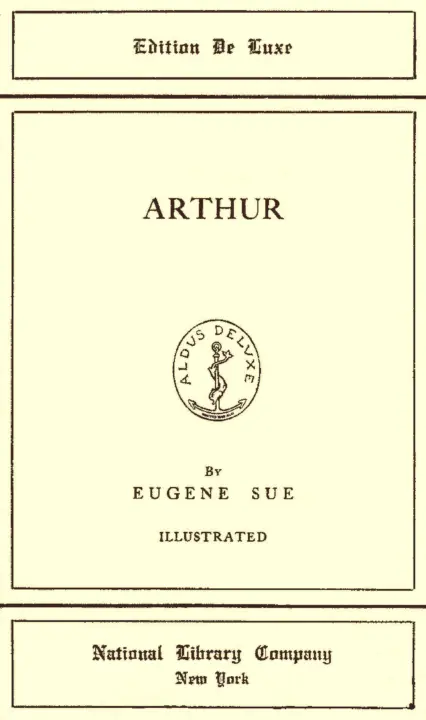
THE CLASSIC COLLECTION · 1839
"Arthur" by Eugène Sue is a novel written in the late 19th century. The story unfolds through the intertwining lives of various characters, with an emphasis on the mysterious figure of Count Arthur and the tragedy surrounding his household. The opening portions hint at themes of intrigue, love, and loss, captivating readers who are drawn to character-driven narratives steeped in emotion and moral complexity. At the start of the novel, the protagonist, who remains unnamed, recounts a chance encounter that leads him to explore a quaint southern village, drawn by the allure of a country house rumored to be for sale. As he journeys through the picturesque landscape, he learns intriguing tales of previous travelers to the village, notably one ominous story involving a mysterious carriage that never returned. Upon reaching the village, he meets the curé and his sister, who are steeped in sadness related to the house's past. This foreshadows deeper explorations of love and loss and sets the stage for revelations regarding Count Arthur, a character woven into the fabric of the village's tragic history. The sense of curiosity and impending revelations builds a compelling narrative thread that invites readers further into the novel's intricate plot.
Introduction adapted from the source catalogue; source summaries may be automatically generated.
Free to read · English · 180,723 words · No account needed
MAKE TIME FOR A GOOD BOOK
On by default. Untick to stop anonymous reading totals. Each page counts after 10 seconds in view. How this works.
Anonymous counting is on unless you have switched it off.
It may be seen that, apart from the limit of the walks, we led the life of a château, the most intimate and the most secluded.
On the third day after our departure from Khios, an incident occurred, very slight, apparently, but which had, which was bound to have, a very strange influence on my destiny.
Madame de Fersen had a little daughter called Irene, towards whom she displayed a fondness almost approaching idolatry. It was impossible to dream of anything more perfect, more ideal, than this child.
She was of a severe and stately beauty. Many mothers would have preferred for their daughters a more childish and smiling face. I must acknowledge I myself could not avoid, at times, a feeling of sadness, while gazing on this adorable countenance, expressive of an indefinable melancholy, incomprehensible at so tender an age.
Irene's brow was broad, her complexion bore a healthy pallor, and her rounded checks denoted robust health. Her dark brown hair, very abundant, fine, and silky, curled naturally about her neck; her large eyes, of a liquid and velvety black, had a remarkably deep look, more especially when, with that faculty natural to children, she would gaze at you fixedly, without lowering the dark fringes of her eyelids. Her nose was slender and beautiful, her mouth small and coral red, and her lower lip slightly pouting and disdainful, if disdain had not seemed incompatible with her youth. Her form, her hands, and her feet were of a rare perfection.
Irene, by a touching superstition of her mother's, after a long illness, had been dedicated to wear only white; the almost religious simplicity of this garb gave marked individuality to her appearance.
As I have already stated, it was the third day of our departure from
Khios.
Irene, who until then had appeared to observe me with a kind of restless mistrust, and who by degrees had become more friendly, came resolutely towards me and said, with childish solemnity:
"Look at me, that I may see whether I am going to love you."
Then after having fixed upon me one of those long, piercing glances of which I have spoken, and which compelled me to lower my eyes, Irene continued:
"Yes, I shall love you very much." And after a renewed silence, she turned to Madame de Fersen, saying:
"Yes, my dear mother, I shall love him very much. I shall love him as I
loved Ivan!"
In saying these words, her childish face assumed such a fascinating expression of gravity that I could not avoid smiling.
Your reading position is saved on this browser. Take it to another device with a library code. Reading pages adapt to text, rather than matching a printed edition.
Eugène Sue
Eugène Sue
Eugène Sue
Eugène Sue
BEHIND THE BOOK
This eBook is for the use of anyone anywhere in the United States and most other parts of the world at no cost and with almost no restrictions whatsoever. You may copy it, give it away or re-use it under the terms of the Project Gutenberg License included with this eBook or online at www.gutenberg.org. If you are not located in the United States, you will have to check the laws of the country where you are located before using this eBook. Read the source licence.
The original source file, including credits and licence, is retained by this library. Request an original-format copy at no charge. Please include the book title and Project Gutenberg identifier #66473.
KEEP YOUR CURIOSITY GOING
Coulson Kernahan

Maurice Baring
Frances Wright
Cécile Tormay

Frederic Jesup Stimson

W. H. P. (William Henry Pope) Jarvis