THE CLASSIC COLLECTION✦The Knight of MaltaCLASSIC FREE BOOKS
The Knight of Malta
Eugène Sue
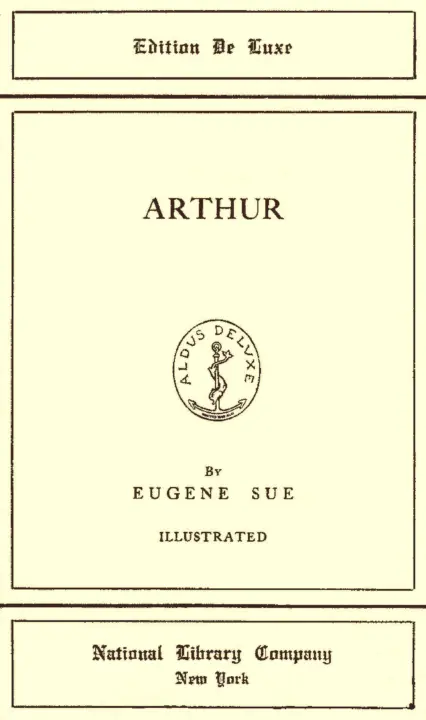
THE CLASSIC COLLECTION · 1839
"Arthur" by Eugène Sue is a novel written in the late 19th century. The story unfolds through the intertwining lives of various characters, with an emphasis on the mysterious figure of Count Arthur and the tragedy surrounding his household. The opening portions hint at themes of intrigue, love, and loss, captivating readers who are drawn to character-driven narratives steeped in emotion and moral complexity. At the start of the novel, the protagonist, who remains unnamed, recounts a chance encounter that leads him to explore a quaint southern village, drawn by the allure of a country house rumored to be for sale. As he journeys through the picturesque landscape, he learns intriguing tales of previous travelers to the village, notably one ominous story involving a mysterious carriage that never returned. Upon reaching the village, he meets the curé and his sister, who are steeped in sadness related to the house's past. This foreshadows deeper explorations of love and loss and sets the stage for revelations regarding Count Arthur, a character woven into the fabric of the village's tragic history. The sense of curiosity and impending revelations builds a compelling narrative thread that invites readers further into the novel's intricate plot.
Introduction adapted from the source catalogue; source summaries may be automatically generated.
Free to read · English · 180,723 words · No account needed
MAKE TIME FOR A GOOD BOOK
On by default. Untick to stop anonymous reading totals. Each page counts after 10 seconds in view. How this works.
Anonymous counting is on unless you have switched it off.
On the right hand, as a contrast to that dazzling mass of marble and of sunshine, there is a lawn of clover, where some of the large Syrian sheep, with their heavy tails, are grazing, also a few gazelles with silvery coats. Beyond the lawn, and extending in a parallel direction with the palace, I see a deep, damp, and shady wood.
The gigantic tops of the oak-trees, the cedars, and the secular platanes form an ocean of dark verdure. The sun is setting, and, with its glowing rays, throws a golden light on those masses of foliage.
On that waving curtain of dark and opaque green, a thousand other shades of green are visible, which become more faint and transparent as they approach the banks of the River Belophano, which, widening in front of the palace, forms a sort of lake.
The banks are planted with bladdernut-trees, umbrella pines with their reddish trunks, satin-leaved poplars, arbutus, and buckthorn. On these, once in awhile, shines a ray of sunlight, which slips beneath the great domes of verdure whenever the sea breeze lifts their branches.
Near the shore, there are fan-leaved latanias, whose trunks are hidden beneath vines that bear orange-coloured bell-flowers, and hydrangeas, whose flowers are rose-coloured.
Then there are wide green avenues, where the sun's rays scarcely ever penetrate, which are carpeted by soft grass, and lead to a hemicycle of foliage, quite near the palace.
These paths are so long and shady that I cannot see their end, through the bluish vapour that veils them.
Lastly, in the foreground, and on a level with my window, is a terrace of white marble, adorned with vases and statues. From this, you can descend to the banks of the canal.
Protected by the palace, one half of the staircase is in the shade, the other is bathed in the sunlight. On one of the lower steps a black dwarf, that I have dressed in a scarlet doublet in Venetian style, is sleeping beside two greyhounds of great size and beautiful form.
By a caprice of the sunlight, the dwarf is in the dazzling zone of its rays, which seem to cover each step with gold dust, while the greyhounds are in the shadow, which is unequally traced on the staircase, and throws its cool, blue, transparent shadows on the white coats of the sleeping dogs.
A little farther on, a peacock sits perched on the balustrade in the bright sun. His feathers flash like a rain of rubies, topazes, and emeralds, glittering against a background of ultramarine.
Your reading position is saved on this browser. Take it to another device with a library code. Reading pages adapt to text, rather than matching a printed edition.
Eugène Sue
Eugène Sue
Eugène Sue
Eugène Sue
BEHIND THE BOOK
This eBook is for the use of anyone anywhere in the United States and most other parts of the world at no cost and with almost no restrictions whatsoever. You may copy it, give it away or re-use it under the terms of the Project Gutenberg License included with this eBook or online at www.gutenberg.org. If you are not located in the United States, you will have to check the laws of the country where you are located before using this eBook. Read the source licence.
The original source file, including credits and licence, is retained by this library. Request an original-format copy at no charge. Please include the book title and Project Gutenberg identifier #66473.
KEEP YOUR CURIOSITY GOING
Coulson Kernahan

Maurice Baring
Frances Wright
Cécile Tormay

Frederic Jesup Stimson

W. H. P. (William Henry Pope) Jarvis