THE CLASSIC COLLECTION✦The Knight of MaltaCLASSIC FREE BOOKS
The Knight of Malta
Eugène Sue
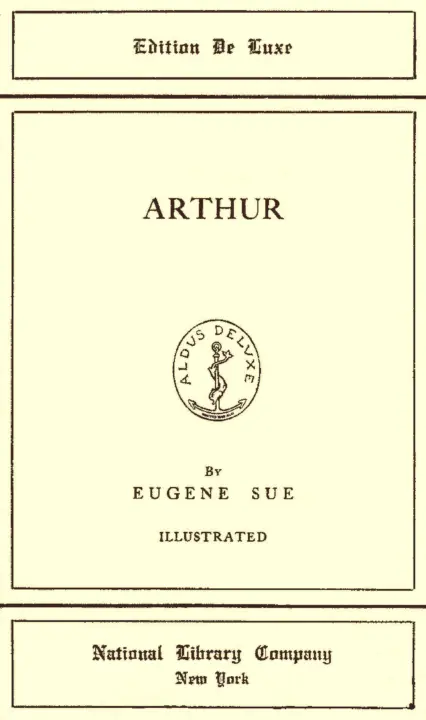
THE CLASSIC COLLECTION · 1839
"Arthur" by Eugène Sue is a novel written in the late 19th century. The story unfolds through the intertwining lives of various characters, with an emphasis on the mysterious figure of Count Arthur and the tragedy surrounding his household. The opening portions hint at themes of intrigue, love, and loss, captivating readers who are drawn to character-driven narratives steeped in emotion and moral complexity. At the start of the novel, the protagonist, who remains unnamed, recounts a chance encounter that leads him to explore a quaint southern village, drawn by the allure of a country house rumored to be for sale. As he journeys through the picturesque landscape, he learns intriguing tales of previous travelers to the village, notably one ominous story involving a mysterious carriage that never returned. Upon reaching the village, he meets the curé and his sister, who are steeped in sadness related to the house's past. This foreshadows deeper explorations of love and loss and sets the stage for revelations regarding Count Arthur, a character woven into the fabric of the village's tragic history. The sense of curiosity and impending revelations builds a compelling narrative thread that invites readers further into the novel's intricate plot.
Introduction adapted from the source catalogue; source summaries may be automatically generated.
Free to read · English · 180,723 words · No account needed
MAKE TIME FOR A GOOD BOOK
On by default. Untick to stop anonymous reading totals. Each page counts after 10 seconds in view. How this works.
Anonymous counting is on unless you have switched it off.
And finally, should I wish to abandon my day-dreams, and give myself up to the thoughts of others, I have them near at hand, the works of the poets I love: Shakespeare, Goethe, Schiller, Scott; the great, the divine, the modern Homer,--Byron, whose black yacht I saw pass on the horizon yesterday.
Although the air is cool, it is saturated with perfume; the vapours of aloes and myrrh, burning in small ruby jars, mingle their odour with that of the flowers, for since I mean to live for the senses, let me not forget the sense of smelling.
I have given myself up enthusiastically to my enjoyment of delightful smells, a sense so misunderstood or so blamed. I have realised my dream of arranging a scale of perfumes, beginning at the faintest, and gradually ascending to the most powerful odours, the inhaling of which causes a sort of intoxication, which adds a new ecstasy to voluptuousness.
Besides, one could almost live on perfumes on the island of Khios, for it is the island which furnished all the perfumes to the harems, the essences of rose, jasmin, and tuberose, which are used in the seraglio of the sultanas.
Khios alone produces the precious lentisk, whose gum the dreamy and indolent odalisk chews between her ivory teeth; Khios, whose commerce even has a charming suggestion of elegance, for her exports are silks, tapestries, flowers, fruits, birds, and honey. And it is young girls and beautiful women of the purest antique type who gather the treasures of the island, the most favoured of all the islands of Ionia.
From the windows of the apartment I occupy, in one of the wings of this immense dwelling, I gaze on a beautiful scene.
May its remembrance be an everlasting regret, if ever I leave this adorable retreat for some dark and noisy city, with a horizon of high walls, filthy streets, and close atmosphere.
On my left is the front of the palace, whose carved porticos, arcades, and white marble staircases seem endless.
From its porphyry inlaid basement, to its roof, adorned with balustrades, statues, and great vases filled with myrtle and oleanders, the whole building is bathed in sunshine, and its golden silhouette stands out against a sky of that sapphire blue which is only seen in the East.
In the distance the azure of the sky would blend with the azure of the sea, were it not for a wavy line of purplish red. This is the chain of the mountains of Roumania, whose summits are bathed in brilliant clouds.
Your reading position is saved on this browser. Take it to another device with a library code. Reading pages adapt to text, rather than matching a printed edition.
Eugène Sue
Eugène Sue
Eugène Sue
Eugène Sue
BEHIND THE BOOK
This eBook is for the use of anyone anywhere in the United States and most other parts of the world at no cost and with almost no restrictions whatsoever. You may copy it, give it away or re-use it under the terms of the Project Gutenberg License included with this eBook or online at www.gutenberg.org. If you are not located in the United States, you will have to check the laws of the country where you are located before using this eBook. Read the source licence.
The original source file, including credits and licence, is retained by this library. Request an original-format copy at no charge. Please include the book title and Project Gutenberg identifier #66473.
KEEP YOUR CURIOSITY GOING
Coulson Kernahan

Maurice Baring
Frances Wright
Cécile Tormay

Frederic Jesup Stimson

W. H. P. (William Henry Pope) Jarvis