
The Writing of News A Handbook with Chapters on Newspaper Correspondence and Copy Reading
Charles G. (Charles Griffith) Ross
THE CLASSIC COLLECTION · 1905
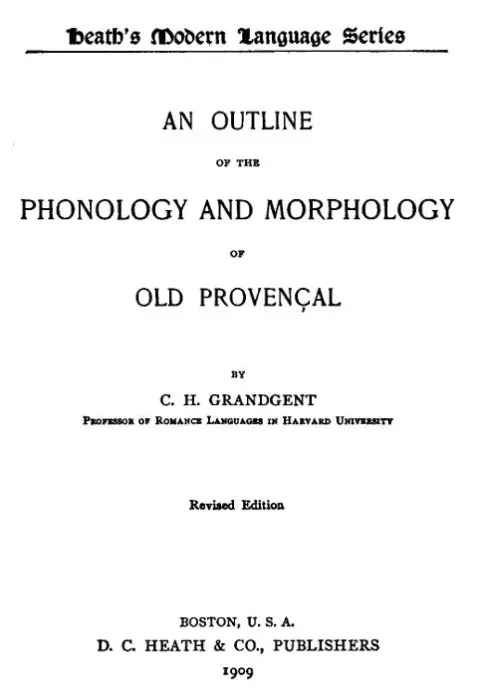
"An Outline of the Phonology and Morphology of Old Provençal" by C. H. Grandgent is a scientific publication written in the early 20th century. This work serves as a comprehensive guide for students of Romance Philology, specifically examining the phonetic and grammatical aspects of the Old Provençal language. It focuses on the literary language used mainly by the poets of Southern France during the 12th and 13th centuries. The opening portion of the work provides a preface from the author, outlining his extensive research journey that spanned two decades. Grandgent discusses the resources he utilized, including foundational grammars and various treatises on Provençal linguistics. He clarifies that while his study centers on the older literary language of Provençal, it also considers regional dialects to illuminate historical phonetic variations across time. The subsequent sections promise a detailed examination of phonology, accent, vowels, and consonants, ultimately aiming to present a systematic understanding for students of the language.
Introduction adapted from the source catalogue; source summaries may be automatically generated.
Free to read · English · 49,465 words · No account needed
MAKE TIME FOR A GOOD BOOK
On by default. Untick to stop anonymous reading totals. Each page counts after 10 seconds in view. How this works.
Anonymous counting is on unless you have switched it off.
lhun = nulh < nūllum: analogy of negun. Cf. Fr. nune
part (Balzac).
presseguier (also pess-) < ✱préssega < pĕrsĭca.
rẹnc (also regne) < rēgnum.
trida < τίγριδα.
tronar < tonitruāre + thrŏnus.
truǫill < tŏrculum.
trobar <?tŭrbāre: see Körting.
1. In ginhol = genolh < genŭcŭlum the palatalization is shifted from the liquid to the nasal. In lunh = nulh < nullum, on the other hand, the palatalization remains at the end of the word, but the liquid and the nasal change places.
87. Dissimilation, like the other irregular phenomena, affects mainly liquids and nasals, particularly r; it is not, however, entirely confined to these classes. The two nasals, m and n, are similar enough to undergo dissimilation. Some of the cases go back to Vulgar Latin, while others are peculiar to Provençal or to Provençal and French. In the table below, a dash indicates the total disappearance of the consonant in question.
β + β > β + -- (v + --): habēbam > ✱aβēa > avia, ✱vivāciārium > viacier, vivācius > viatz. Vianda, whatever its ultimate origin may be, was probably borrowed from French.
kw + kw > k + kw: quīnque > cīnque > cinc.
l + l > r + l, -- + l, d + l: calamĕllum > calamęl caramęl, ✱umbilīcŭlum > emborígol, flēbĭlem > flẹble frẹble fẹble, ŭlulāre > ulular udolar. Perhaps püs = plüs < plūs is to be explained by dissimilation, occurring in such phrases as plus larc, plus lonc.
m + m > n + m: memorāre > membrar nembrar (renembransa).
m + n > m + r: ✱comĭnicāre > comenegar comergar, ✱indomĭnicātum > endomeniat endomergat, mancĭpium > mansip massip marsip, manĭcum > margue, mŏnăchum > mongue morgue.
n + m > r + m: anĭma > anma arma, ✱mĭnimāre > mermar.
n + n > n + r, r + n; ? d + n: canŏnĭcum > canónegue canorgue, venēnum > verin; nec ūnum > negün degün? (cf. Andalusian and Asturian dengun, Catalan dingu, apparently from nec ūnum + nĭngŭlum).
r + r > r + --, -- + r, l + r: ✱Bernhardum > Bernart Bernat, marmor > marbre marme, prŏprium > prǫpri prǫpi; dīe Mércūrī (influenced by dīe Vénĕris) > dimęrcres dimęcres, grandem rem > granrẹ ganrẹ, pr(eh)ĕndĕre > prenre penre, prĕsby̆ter > pręstre pęstre; arbĭtrium > albire, ✱Arvĕrnium > Alvęrnhe, peregrīnus > pele(g)rīnus > peleris, pŭrpŭra > pọlpra.
s + s > -- + s: ✱spasmāre > (espasme) pasmar (cf. French pâmer), perhaps through confusion of the initial es- with the prefix ex-.
t + t? > -- + t: statiōnem? > sazọ (cf. French saison, Spanish
sazon).
Your reading position is saved on this browser. Take it to another device with a library code. Reading pages adapt to text, rather than matching a printed edition.
BEHIND THE BOOK
This eBook is for the use of anyone anywhere in the United States and most other parts of the world at no cost and with almost no restrictions whatsoever. You may copy it, give it away or re-use it under the terms of the Project Gutenberg License included with this eBook or online at www.gutenberg.org. If you are not located in the United States, you will have to check the laws of the country where you are located before using this eBook. Read the source licence.
The original source file, including credits and licence, is retained by this library. Request an original-format copy at no charge. Please include the book title and Project Gutenberg identifier #49692.
KEEP YOUR CURIOSITY GOING
Charles G. (Charles Griffith) Ross
Hannah Webster Foster

Emily Lawless
Edwin Hamlin Carr

Charles De Lano Hine
Andrew Ure