
The Writing of News A Handbook with Chapters on Newspaper Correspondence and Copy Reading
Charles G. (Charles Griffith) Ross
THE CLASSIC COLLECTION · 1905
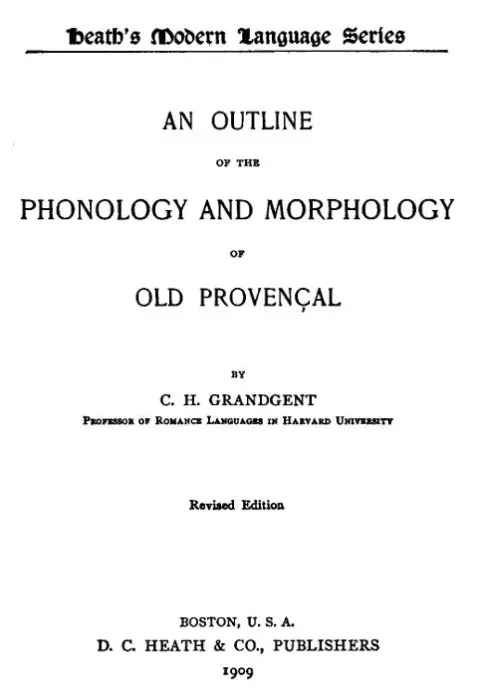
"An Outline of the Phonology and Morphology of Old Provençal" by C. H. Grandgent is a scientific publication written in the early 20th century. This work serves as a comprehensive guide for students of Romance Philology, specifically examining the phonetic and grammatical aspects of the Old Provençal language. It focuses on the literary language used mainly by the poets of Southern France during the 12th and 13th centuries. The opening portion of the work provides a preface from the author, outlining his extensive research journey that spanned two decades. Grandgent discusses the resources he utilized, including foundational grammars and various treatises on Provençal linguistics. He clarifies that while his study centers on the older literary language of Provençal, it also considers regional dialects to illuminate historical phonetic variations across time. The subsequent sections promise a detailed examination of phonology, accent, vowels, and consonants, ultimately aiming to present a systematic understanding for students of the language.
Introduction adapted from the source catalogue; source summaries may be automatically generated.
Free to read · English · 49,465 words · No account needed
MAKE TIME FOR A GOOD BOOK
On by default. Untick to stop anonymous reading totals. Each page counts after 10 seconds in view. How this works.
Anonymous counting is on unless you have switched it off.
72. This class includes not only Latin gu̯, qu̯, but all combinations of consonant + u̯, cf. § 40, (2). A w thus evolved seems to have developed like Germanic w (cf. § 56, W): it became gw (assimilating the preceding consonant, unless that consonant was a liquid or a nasal), and then was reduced, before the literary period, to g, cf. § 62, (2). Pw, however, had a quite different history, owing, on the one hand, to the affinity of its two labial elements, and, on the other, to the stability of the voiceless stop, which prevented the assimilation that we find in βw > ww.
1. G. Körting (Zs., XXII, 258) would explain through the analogy of the perfects in -cui all other perfect forms which in Provençal have g and c corresponding to Latin -ui etc.
ßw > ww > gw > g: habuĭssem > aguẹs, dēbuit > dẹc (§ 63); ✱co(g)nōvuit (cf. Meyer-Lübke, Gram., II, p. 357) > conọc, ✱crevuĭstī > creguist, ✱movuĭsset > mogues, ✱plŏvuit > plǫc. We seem to have the same combination in Germanic treuwa > tręgua tręga (treva is probably French).
1. The diphthong of aic = habuī is probably not a phonetic development. The first and third persons of the preterit, aic and ac (< habuit), have been differentiated after the pattern of the present--ai and a.
Dw > gw > g: ✱sĕduit > sęc.
1. Vezoa < vĭdua must be an early learned word: veuva is perhaps from veua < veuða < veðua.
Kw > gw > g: antīqua > antiga, ĕqua > ęga, æquālem > egal (engal has received through a mistake in etymology the prefix en- or e- < in-), nŏcuit > nǫc, placuĭstī > plaguist, ✱sĕquĕre (= sĕqui) > sęgre, ✱sequīre > seguir, tacuĭssem > taguẹs.
1. Several words show a different development: cf. Ltblt., XXIV, 335; Zs., XXVIII, 381. In aqua (or acqua) and aquĭla (or ✱acquĭla) the first consonant became, for some reason, a spirant, which later changed to i: aχwa > aiwa > aigua aiga, áχwila > áiwila > áigwila > aigla. So aiglentina. These same words show irregularities in other languages. Perhaps the dialect form eigal (Auvergne, Arles) for egal is to be explained in the same way; but the ei here may be analogical.
2. In several words kw was reduced to c (or c´) in Vulgar Latin: coquĕre (+ cŏcus) > cŏcĕre > cǫzer, tŏrquēre ✱tŏrquĕre (+ ✱tŏrco ✱tŏrcunt) > ✱tŏrcĕre > tǫrser. Cf. § 55, W.
Lw > lgw > lg: caluit > calc, ✱toluĭstī > tolguist, valuĭssem > valguẹs, vŏluĕrunt (§ 16, 2) > vǫlgron.
Nw, ngw, nkw > ngw > ng: tĕnuit > tẹnc, ✱venuĭsset > venguẹs; sanguem > sanc; cīnque (= quinque) > cinc.
Your reading position is saved on this browser. Take it to another device with a library code. Reading pages adapt to text, rather than matching a printed edition.
BEHIND THE BOOK
This eBook is for the use of anyone anywhere in the United States and most other parts of the world at no cost and with almost no restrictions whatsoever. You may copy it, give it away or re-use it under the terms of the Project Gutenberg License included with this eBook or online at www.gutenberg.org. If you are not located in the United States, you will have to check the laws of the country where you are located before using this eBook. Read the source licence.
The original source file, including credits and licence, is retained by this library. Request an original-format copy at no charge. Please include the book title and Project Gutenberg identifier #49692.
KEEP YOUR CURIOSITY GOING
Charles G. (Charles Griffith) Ross
Hannah Webster Foster

Emily Lawless
Edwin Hamlin Carr

Charles De Lano Hine
Andrew Ure