
The Writing of News A Handbook with Chapters on Newspaper Correspondence and Copy Reading
Charles G. (Charles Griffith) Ross
THE CLASSIC COLLECTION · 1905
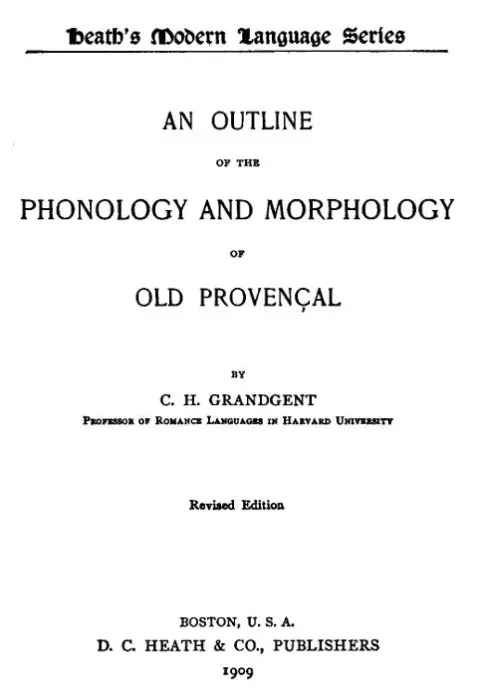
"An Outline of the Phonology and Morphology of Old Provençal" by C. H. Grandgent is a scientific publication written in the early 20th century. This work serves as a comprehensive guide for students of Romance Philology, specifically examining the phonetic and grammatical aspects of the Old Provençal language. It focuses on the literary language used mainly by the poets of Southern France during the 12th and 13th centuries. The opening portion of the work provides a preface from the author, outlining his extensive research journey that spanned two decades. Grandgent discusses the resources he utilized, including foundational grammars and various treatises on Provençal linguistics. He clarifies that while his study centers on the older literary language of Provençal, it also considers regional dialects to illuminate historical phonetic variations across time. The subsequent sections promise a detailed examination of phonology, accent, vowels, and consonants, ultimately aiming to present a systematic understanding for students of the language.
Introduction adapted from the source catalogue; source summaries may be automatically generated.
Free to read · English · 49,465 words · No account needed
MAKE TIME FOR A GOOD BOOK
On by default. Untick to stop anonymous reading totals. Each page counts after 10 seconds in view. How this works.
Anonymous counting is on unless you have switched it off.
F is very rare (cf. § 59). The few examples appear to show that f (presumably in the 6th century or earlier) became β, and then developed like any other β (see β): Stĕphănum > Estęve, co(n)fortāre? > ✱coβortar > ✱coortar > conortar (through the common use of the double forms, con-, co-), gryphum > griu, raphănum > rave rafe, ✱refusāre > rehusar refusar, ✱prefŭndum (= pro-) > preọn. Nevertheless, cofịn < cŏphĭnum, defǫrs < de fŏris, grifọ, profięg < profĕctum, rafe, would seem to indicate that in some words, possibly less popular at the outset, f was retained.
1. In purely learned words, f was kept: antifona, Caifas,
philozophia.
G, representing original c and g, had a varied development.[48] For the fall of g in some words in Vulgar Latin, see § 55, G.
(1) Before a, g remained in the greater part of the territory, but in the north and east it early became y; and this y was generally retained in the eastern dialects (often fusing with a preceding i), while in most of the northern it developed into dž (cf. Y): amīca > amiga amiia amia, dīcam > diga dia, mīca > miga miia mia,[49] pacāre > pagar paiar, precāre > pregar preiar; castigāre > castigar castiar, legālem > leial leyal lial, ligāmen > liam, lĭgātum > legat liat, plaga > plaga plaia, regālem > reial, rūga > rüa.[50]
(2) Before o and u (ü), g was preserved, except in a few words which (doubtless in Vulgar Latin times) lost it either in all or in many dialects: acūtum > agüt, secŭndum > segọn, secūrus > segürs; ✱a(u)gūrium > agür aür, a(u)gŭstum > agọst[51] ahọst, proclitic ĕgo > ęu, ✱fagŏttum > fagǫt, figūra > figüra, Hugōnem > Ugọ. For a g that becomes final or contiguous to final s, see § 63, (6): amīcus > amics amis, Auriācum > Auriac, cŏcum (= cŏquum) > cǫc, jŏcus > iǫcs, Ludovīcum > Lozoic Lozoi, prĕco > pręc; castīgo > chastic chasti.
(3) Between the last two vowels of a proparoxytone, g, early in the Provençal period, became y, which developed into dž before the literary epoch; cf. § 49, (4): clĕrĭcum > clęrge, ✱coratĭcum > coratge, domĭnĭcum > dimẹnge, manĭca > mania, mĕdĭcum > męge, mŏnăchum > monge, ✱paratĭcum > paratge, viatĭcum > viatie. In some dialects, however, the vowel of the penult, after liquids and nasals, fell too early for the g to become y: clęrgue,[52] esta(t)ga, mętgue, mongue.
Your reading position is saved on this browser. Take it to another device with a library code. Reading pages adapt to text, rather than matching a printed edition.
BEHIND THE BOOK
This eBook is for the use of anyone anywhere in the United States and most other parts of the world at no cost and with almost no restrictions whatsoever. You may copy it, give it away or re-use it under the terms of the Project Gutenberg License included with this eBook or online at www.gutenberg.org. If you are not located in the United States, you will have to check the laws of the country where you are located before using this eBook. Read the source licence.
The original source file, including credits and licence, is retained by this library. Request an original-format copy at no charge. Please include the book title and Project Gutenberg identifier #49692.
KEEP YOUR CURIOSITY GOING
Charles G. (Charles Griffith) Ross
Hannah Webster Foster

Emily Lawless
Edwin Hamlin Carr

Charles De Lano Hine
Andrew Ure