
The Writing of News A Handbook with Chapters on Newspaper Correspondence and Copy Reading
Charles G. (Charles Griffith) Ross
THE CLASSIC COLLECTION · 1905
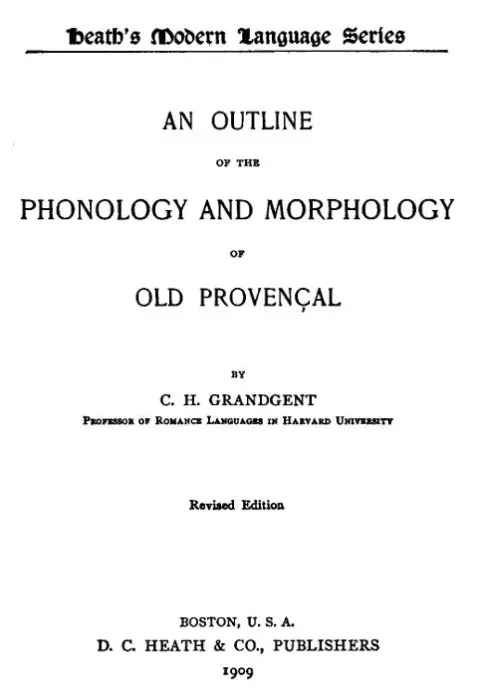
"An Outline of the Phonology and Morphology of Old Provençal" by C. H. Grandgent is a scientific publication written in the early 20th century. This work serves as a comprehensive guide for students of Romance Philology, specifically examining the phonetic and grammatical aspects of the Old Provençal language. It focuses on the literary language used mainly by the poets of Southern France during the 12th and 13th centuries. The opening portion of the work provides a preface from the author, outlining his extensive research journey that spanned two decades. Grandgent discusses the resources he utilized, including foundational grammars and various treatises on Provençal linguistics. He clarifies that while his study centers on the older literary language of Provençal, it also considers regional dialects to illuminate historical phonetic variations across time. The subsequent sections promise a detailed examination of phonology, accent, vowels, and consonants, ultimately aiming to present a systematic understanding for students of the language.
Introduction adapted from the source catalogue; source summaries may be automatically generated.
Free to read · English · 49,465 words · No account needed
MAKE TIME FOR A GOOD BOOK
On by default. Untick to stop anonymous reading totals. Each page counts after 10 seconds in view. How this works.
Anonymous counting is on unless you have switched it off.
(1) Alcüs < ✱alĭqu’ ūnus = alĭquī ūnus, ‘someone’. Inflection: alcüs, alcü(n); alcüna.
(2) Alquant < aliquantum, aliquanti, ‘somewhat’, ‘some’;
diminutive, alquantet.
(3) Alques alque < alĭquĭd, used as an invariable neuter pronoun or adverb, ‘something’, ‘somewhat’. The -s form, which originally developed before a vowel, was preferred because of the analogy of other neuter pronouns and adverbs. The preservation of the e is due to association with quez que. Alque was sometimes used as an adjective.
(4) Als al au, used as an invariable neuter pronoun, ‘something else’. Al (au) may have been detached from alques, understood as al ques. Meyer-Lübke, however, takes it, as well as Old French el, from ✱alum = aliud: Gram., II, p. 649. Als owes its -s to the analogy of other neuter pronouns, such as alques, ẹis, mais, męlhs, mẹns, pęis, etc.
(5) Altre autre < alter, ‘other’, pronoun and adjective. A dative ✱altrūī, following illūī, goes back to Vulgar Latin. The Provençal forms autrüs, autrü show the influence of alcüs and negüs; autri belongs to the southeastern dialects (cf. aquẹli, ẹli, nǫstri, tüti, etc.). Inflection:--
Sg. {nom.: autre autres autrüs autra
{obj.: autre autrüi autrü autra
Pl. {nom.: autre autri autras
{obj.: autres autras
(6) Altretals autretals < alter talis; by dissimilation, atretals: by substitution of ai- (first syllable of aissi < ac sīc) for atre-, aitals; by fusion of aitals and atretals, aitretals; through analogy of atressi, atrestals. Cf. § 74, 2. Inflection like that of cals (§ 134).
(7) Altretan atretan aitan atrestan etc. < alter + tantum: see
altretals.
(8) Cada un < κατά + ūnum,‘every one’. The Greek preposition κατά was introduced into the Latin territory, probably by Greek merchants, in stating prices: καθ᾽ἕνα = cata ūnum, κατά τρεῐς = cata trēs; hence cada ün, cada trẹi. Inflection: cada üs, cada ü(n); cada üna.
(9) Calacom qualacom qualaquom, ‘something’, ‘a little’, seems to be a Provençal compound of cal and acǫ (§ 132), the last syllable of which was perhaps understood as cọm cọ < quōmŏ(do). Cf. quezacom below. There is a diminutive calacomet, which helped to maintain the m of calacom.
(10) Cals que quals que, cal que qual que, ‘whoever’, is a Provençal
compound.
(11) Cant quant can quan < quantum quanti, ‘how much’, ‘how many’. Cant, inflected like bęl (§ 103), is used also as an adjective and as a masculine and feminine pronoun.
(12) Cascüs chascüs, ‘everyone’, ‘every’, appears to be a fusion of cada üs and ✱cescüs < ✱cisqu’ ūnus = quĭsque ūnus = ūnus quĭsque. Inflection: cascüs, cascü(n); cascüna.
(13) Ent en n ne < ĭnde,‘some’: cf. § 123.
Your reading position is saved on this browser. Take it to another device with a library code. Reading pages adapt to text, rather than matching a printed edition.
BEHIND THE BOOK
This eBook is for the use of anyone anywhere in the United States and most other parts of the world at no cost and with almost no restrictions whatsoever. You may copy it, give it away or re-use it under the terms of the Project Gutenberg License included with this eBook or online at www.gutenberg.org. If you are not located in the United States, you will have to check the laws of the country where you are located before using this eBook. Read the source licence.
The original source file, including credits and licence, is retained by this library. Request an original-format copy at no charge. Please include the book title and Project Gutenberg identifier #49692.
KEEP YOUR CURIOSITY GOING
Charles G. (Charles Griffith) Ross
Hannah Webster Foster

Emily Lawless
Edwin Hamlin Carr

Charles De Lano Hine
Andrew Ure