
The Writing of News A Handbook with Chapters on Newspaper Correspondence and Copy Reading
Charles G. (Charles Griffith) Ross
THE CLASSIC COLLECTION · 1905
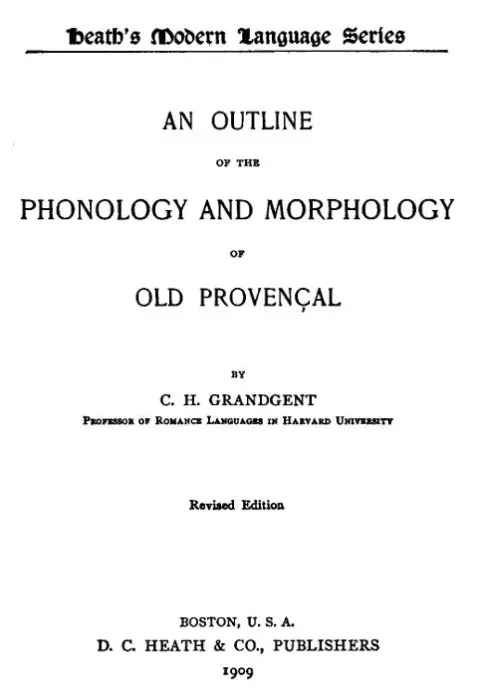
"An Outline of the Phonology and Morphology of Old Provençal" by C. H. Grandgent is a scientific publication written in the early 20th century. This work serves as a comprehensive guide for students of Romance Philology, specifically examining the phonetic and grammatical aspects of the Old Provençal language. It focuses on the literary language used mainly by the poets of Southern France during the 12th and 13th centuries. The opening portion of the work provides a preface from the author, outlining his extensive research journey that spanned two decades. Grandgent discusses the resources he utilized, including foundational grammars and various treatises on Provençal linguistics. He clarifies that while his study centers on the older literary language of Provençal, it also considers regional dialects to illuminate historical phonetic variations across time. The subsequent sections promise a detailed examination of phonology, accent, vowels, and consonants, ultimately aiming to present a systematic understanding for students of the language.
Introduction adapted from the source catalogue; source summaries may be automatically generated.
Free to read · English · 49,465 words · No account needed
MAKE TIME FOR A GOOD BOOK
On by default. Untick to stop anonymous reading totals. Each page counts after 10 seconds in view. How this works.
Anonymous counting is on unless you have switched it off.
83. Ks remained in Vulgar Latin at the end of monosyllables only (§ 55, X); there it became, in Provençal, is: rēx > rẹis, sĕx > sęis. Grecx, nicx are Latinisms.
Nt was generally reduced to n; but in the extreme north and some parts of the south the t was retained in -ant: amant > aman, habē(b)ant > avian aviant; cantent > canten; vēndunt > vẹndon. In some dialects the n fell after o, u (vẹndo, au); -on and -o were used concurrently by the poets.
St > s in ĕst > ęs. Cf. § 28, 5.
84. For certain consonant changes no laws have been established.[81] Some of them doubtless originate in the language of children, which is governed by principles different from those which regulate the speech of adults. Others are due to vague associations of sound or sense. Borrowed and learned words are especially exposed to such whimsical alteration.
85. The insertion (or addition) of a consonant, in such cases as those mentioned below, is probably always due to some false association or wrong etymology, but the specific cause often cannot be ascertained; the added consonant seems to be generally a liquid or a nasal:--
alhọndre -s < aliŭnde: V. L. ✱aliŭnder?
consi = cossi < eccu’ sīc: analogy of the prefix co- con-. Cf. § 76, (1), nf, ns.
enclutge < incūdĭnem: cf. French enclume.
engal = egal < æquālem: analogy of the prefix e- en-.
Cf. § 76, (1), nf, ns.
invęrn = ivern < hibĕrnum: hi- mistaken for the prefix in-; cf. Italian inverno, etc.
parven (hence parvensa) < parĕntem (parēre): analogy of ferven, serven, or of espaven, espavensa, or influence of parui, etc.?
penchenar < pectināre: analogy of pencheire, penchura?
perdris = perditz < perdīcem: progressive assimilation?
Cf. French perdrix.
pǫuzer = pouze < pŏllĭcem: confusion with polgar <
pollicāre.
refreitọr = refeitor < refectōrium: association with
refreidar (freit).
renlinquir = relinquir < relĭnquĕre: analogy of e- en-; cf. reforsar and French renforcer.
86. Metathesis is not very common in Provençal, although a few texts
offer many examples; it is apparently restricted to liquids and
nasals:--
cabirǫl = ✱cabriol < capreŏ́lum.
cocodrilla < crocodīlum: cf. Italian coccodrillo.
craba = cabra < capra.
enfrondar = ✱enfondrar < French effondrer
<?✱infŭndulāre.
escremir < skirmôn: cf. French escrimer.
estanc < stagnum: cf. French étang.
esturmen = estrument < instrumĕntum: cf. Italian
stormento.
formir = fromir < frumjan: cf. French formir, etc.
freïr = ferir < ferīre.
grada = garda < ✱warda.
grepir = guerpir < wërpan.
Your reading position is saved on this browser. Take it to another device with a library code. Reading pages adapt to text, rather than matching a printed edition.
BEHIND THE BOOK
This eBook is for the use of anyone anywhere in the United States and most other parts of the world at no cost and with almost no restrictions whatsoever. You may copy it, give it away or re-use it under the terms of the Project Gutenberg License included with this eBook or online at www.gutenberg.org. If you are not located in the United States, you will have to check the laws of the country where you are located before using this eBook. Read the source licence.
The original source file, including credits and licence, is retained by this library. Request an original-format copy at no charge. Please include the book title and Project Gutenberg identifier #49692.
KEEP YOUR CURIOSITY GOING
Charles G. (Charles Griffith) Ross
Hannah Webster Foster

Emily Lawless
Edwin Hamlin Carr

Charles De Lano Hine
Andrew Ure