
The Writing of News A Handbook with Chapters on Newspaper Correspondence and Copy Reading
Charles G. (Charles Griffith) Ross
THE CLASSIC COLLECTION · 1905
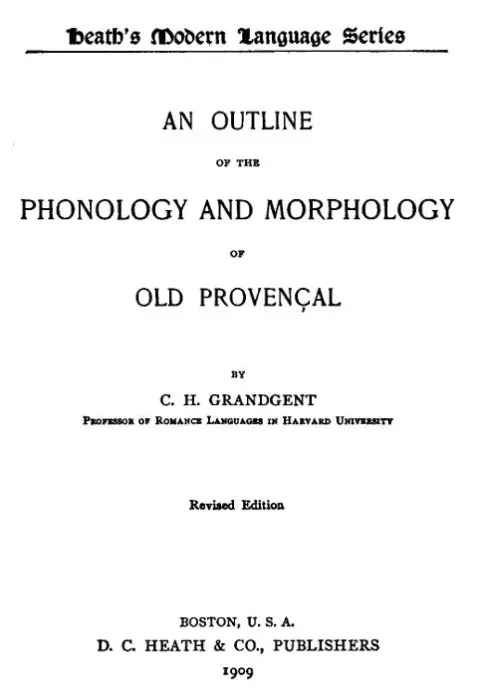
"An Outline of the Phonology and Morphology of Old Provençal" by C. H. Grandgent is a scientific publication written in the early 20th century. This work serves as a comprehensive guide for students of Romance Philology, specifically examining the phonetic and grammatical aspects of the Old Provençal language. It focuses on the literary language used mainly by the poets of Southern France during the 12th and 13th centuries. The opening portion of the work provides a preface from the author, outlining his extensive research journey that spanned two decades. Grandgent discusses the resources he utilized, including foundational grammars and various treatises on Provençal linguistics. He clarifies that while his study centers on the older literary language of Provençal, it also considers regional dialects to illuminate historical phonetic variations across time. The subsequent sections promise a detailed examination of phonology, accent, vowels, and consonants, ultimately aiming to present a systematic understanding for students of the language.
Introduction adapted from the source catalogue; source summaries may be automatically generated.
Free to read · English · 49,465 words · No account needed
MAKE TIME FOR A GOOD BOOK
On by default. Untick to stop anonymous reading totals. Each page counts after 10 seconds in view. How this works.
Anonymous counting is on unless you have switched it off.
44. Local or partial phonetic changes affected the initial syllable of many words: demandar (do-) < demandāre, emplir (üm-) < implēre; ciutat cieutat < cīvĭtātem; eissir issir < exīre, getar gitar < ✱jĕctāre; crear criar < creāre; mercẹ (mar-) < mercēdem; delgat (dal-) < delicātum.
1. Nearly everywhere there is a tendency to change e to o, u, or ü before a labial, especially before m: premier promier prumier, remas romas, semblar somblar, trebalh trubalh. So de ves > ✱do ves > dous.
2. In the 13th century, nearly everywhere, iu > ieu: piucela
pieucela.
3. Many dialects of the north and west change ei and e to i: deissendre dissendre, eissam issam, eissi issi, eissilh issilh, leisso lisso, meitat mitat; degerir (i), denhar (i), disnar, en in, enfern (i), entrar (i), envers (i), escien icient, proclitic est ist, estar (i), estiers (i), Felip (i), gelos (i), genhos (i), genolh (i), gequir (i), guereiar (i), guerensa (i), i(n)vern, isnel irnel, peior pigor, proclitic per pir, premier (i), semblar (i), serven (i), serventes (i), sevals (i), trebalhar (i), tremblar (i). In disnar, ivern, isnel only i is found. In some dialects there is an alternation of e and i, e being used when there is an í in the next syllable, i when there is none, fenít, sirvén. In vezí < vīcīnum the e probably goes back to V. L.: cf. Fr.
4. In a few dialects e in hiatus with a following vowel becomes i: crear criar, leal lial, prear priar, preon prion, real rial.
5. In many dialects of the north and west e has a tendency to become a before r: guerentia garensa, merce marce, pergamen pargamen.
6. In some dialects there is a tendency to assimilate e to an á in the next syllable: delgat dalgat, gigant iaian, deman (a), semblar (a), serrar (a), tremblar (a). So de vás (§ 42, 1) > da vás > dávas; hence daus, under the influence of deus > de ves.
45. The term intertonic is applied to the syllable that follows the secondary (§ 18) and precedes the primary accent. In this position all vowels, except a, regularly disappeared in popular words, probably between the 5th and the 8th century[27]; a apparently remained: ✱bŭllĭcāre > boiar (bollegar), bŏnĭtātem > bontat, ✱carrĭcāre > carcar cargar, caballĭcāre > cavalcar cavalgar, cĕrĕbĕllum > cervęl, cīvĭtātem > ciutat, cŏllŏcāre > colcar colgar, dēlĭcātum > delcat delgat, excommūnĭcāre ✱excommĭnĭcāre > escomeniar, vĕrēcŭndia > vergọnha; calamĕllum > calamęl, invadĕre ✱invadīre > envazir, margarīta > margarida, mīrabĭlia > miravilha, parav(e)rēdus > palafrẹs.
Your reading position is saved on this browser. Take it to another device with a library code. Reading pages adapt to text, rather than matching a printed edition.
BEHIND THE BOOK
This eBook is for the use of anyone anywhere in the United States and most other parts of the world at no cost and with almost no restrictions whatsoever. You may copy it, give it away or re-use it under the terms of the Project Gutenberg License included with this eBook or online at www.gutenberg.org. If you are not located in the United States, you will have to check the laws of the country where you are located before using this eBook. Read the source licence.
The original source file, including credits and licence, is retained by this library. Request an original-format copy at no charge. Please include the book title and Project Gutenberg identifier #49692.
KEEP YOUR CURIOSITY GOING
Charles G. (Charles Griffith) Ross
Hannah Webster Foster

Emily Lawless
Edwin Hamlin Carr

Charles De Lano Hine
Andrew Ure