
The Writing of News A Handbook with Chapters on Newspaper Correspondence and Copy Reading
Charles G. (Charles Griffith) Ross
THE CLASSIC COLLECTION · 1905
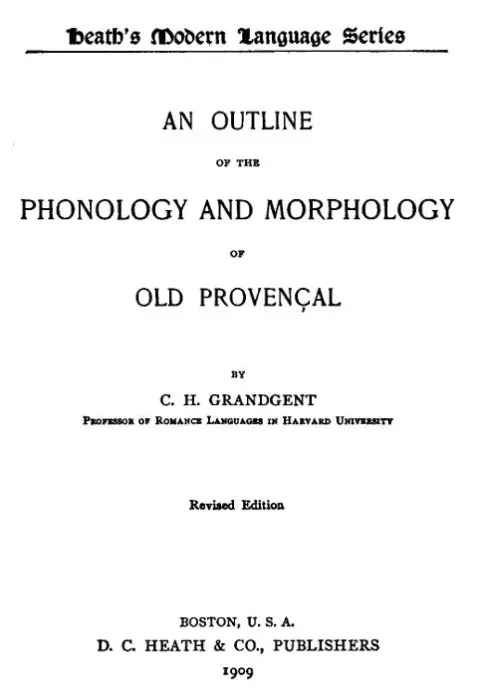
"An Outline of the Phonology and Morphology of Old Provençal" by C. H. Grandgent is a scientific publication written in the early 20th century. This work serves as a comprehensive guide for students of Romance Philology, specifically examining the phonetic and grammatical aspects of the Old Provençal language. It focuses on the literary language used mainly by the poets of Southern France during the 12th and 13th centuries. The opening portion of the work provides a preface from the author, outlining his extensive research journey that spanned two decades. Grandgent discusses the resources he utilized, including foundational grammars and various treatises on Provençal linguistics. He clarifies that while his study centers on the older literary language of Provençal, it also considers regional dialects to illuminate historical phonetic variations across time. The subsequent sections promise a detailed examination of phonology, accent, vowels, and consonants, ultimately aiming to present a systematic understanding for students of the language.
Introduction adapted from the source catalogue; source summaries may be automatically generated.
Free to read · English · 49,465 words · No account needed
MAKE TIME FOR A GOOD BOOK
On by default. Untick to stop anonymous reading totals. Each page counts after 10 seconds in view. How this works.
Anonymous counting is on unless you have switched it off.
Düi dọi are from Vulgar Latin dŭī = dŭo; dọs is from dŭos, dọas from dŭas. Trẹs has a form trẹi (originally nom. m.), patterned after düi, and a form trẹis, which seems to be a cross between trẹs and trẹi. For the dialect forms of ọnze--sętze, see § 76, (1), Ndc´, and § 80, Dc´. Cen, multiplied by another number, took a plural form when used substantively; when used adjectively, it generally did not, but we find dozentas with a feminine noun. Mil had four plurals, milia miria melia mila; millięrs is a noun.
1. As an example of a longer compound numeral, we have cen e
quatre vint e ueg.
2. From ambo we have the obj. forms, m. and f., ams, ambas. Ambo combined with dŭī (dŭos dŭas), and perhaps influenced by Pr. ab (§ 65, P, 2), had this inflection:
amdui andui abdui ambedui amdoas amdos andos abdos ambedos amdoas
112. The ordinal numerals had separate forms for the two genders; the masculine forms followed the second declension type, the feminine forms, the first declension. After 5th, they were made by adding to the cardinal numeral the originally distributive ending -ēnus -ēna.
primięr, primięra
segọn(t), segọnda
tęrz, tęrza
quart, quarta
quint, quinta
seizẹ(n), seizẹna
setẹ(n), setẹna
ochẹ(n), ochẹna
novẹ(n), novẹna
dezẹ(n), dezẹna
onzẹ(n), onzẹna
dozẹ(n), dozẹna
vintẹ(n), vintẹna
centẹ(n), centẹna
milẹ(n), milẹna
113. Beside primięr we find premięr prümier promięr (§ 44, 1, 3), and also prim and primeiran; for the developments of the ending -ięr, see § 23, 1 and § 73, Ry, 1. Tęrz, tęrza regularly became tęrs, tęrsa (§ 73, Rty). Such forms as secọnda, tęrcia, sęxta, octava, nọna, dęcima are learned.
1. As an example of a compound ordinal numeral, we have
vintena tersa.
114. Under this head will be treated not only pronouns and pronominal adjectives, but also articles.
115. In popular Latin the personal, possessive, and demonstrative pronouns and adjectives had two sets of forms, according as they were accented or unaccented (§ 19). Ille, when stressed and used pronominally, became a disjunctive personal pronoun of the third person; when unstressed and used pronominally, it furnished the conjunctive forms of the third person; when unstressed and used adjectively, it developed into a definite article. Ipse had similar uses. These differentiations must have begun in Vulgar Latin times.
Your reading position is saved on this browser. Take it to another device with a library code. Reading pages adapt to text, rather than matching a printed edition.
BEHIND THE BOOK
This eBook is for the use of anyone anywhere in the United States and most other parts of the world at no cost and with almost no restrictions whatsoever. You may copy it, give it away or re-use it under the terms of the Project Gutenberg License included with this eBook or online at www.gutenberg.org. If you are not located in the United States, you will have to check the laws of the country where you are located before using this eBook. Read the source licence.
The original source file, including credits and licence, is retained by this library. Request an original-format copy at no charge. Please include the book title and Project Gutenberg identifier #49692.
KEEP YOUR CURIOSITY GOING
Charles G. (Charles Griffith) Ross
Hannah Webster Foster

Emily Lawless
Edwin Hamlin Carr

Charles De Lano Hine
Andrew Ure