
The Writing of News A Handbook with Chapters on Newspaper Correspondence and Copy Reading
Charles G. (Charles Griffith) Ross
THE CLASSIC COLLECTION · 1905
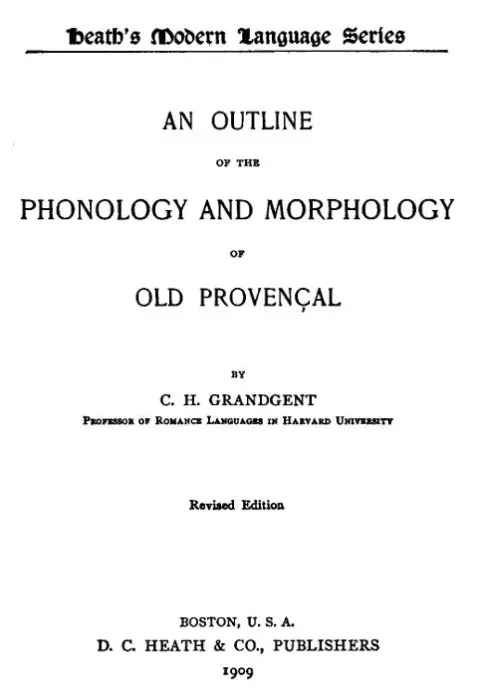
"An Outline of the Phonology and Morphology of Old Provençal" by C. H. Grandgent is a scientific publication written in the early 20th century. This work serves as a comprehensive guide for students of Romance Philology, specifically examining the phonetic and grammatical aspects of the Old Provençal language. It focuses on the literary language used mainly by the poets of Southern France during the 12th and 13th centuries. The opening portion of the work provides a preface from the author, outlining his extensive research journey that spanned two decades. Grandgent discusses the resources he utilized, including foundational grammars and various treatises on Provençal linguistics. He clarifies that while his study centers on the older literary language of Provençal, it also considers regional dialects to illuminate historical phonetic variations across time. The subsequent sections promise a detailed examination of phonology, accent, vowels, and consonants, ultimately aiming to present a systematic understanding for students of the language.
Introduction adapted from the source catalogue; source summaries may be automatically generated.
Free to read · English · 49,465 words · No account needed
MAKE TIME FOR A GOOD BOOK
On by default. Untick to stop anonymous reading totals. Each page counts after 10 seconds in view. How this works.
Anonymous counting is on unless you have switched it off.
Bc > (✱pc), ptš (before a): ✱reprŏb(ĭ)cat > reprǫpcha.
Brg > rg or urg in fabrĭca ✱fabrĭga > farga faurga. Cf. § 70, Br.
Bs > bs in the learned words absens, absensa.
Bsc > sc: obscūrus > escürs.
Bst > st: sŭbstat > sọsta.
Bt > bt, t: subtīlem > sobtil sotil. See also βt below.
Bts > ts: sŭbtus > sọtz.
βc > uc: ✱avĭca ✱aβca > auca.
βc´ > udz or uts, later uz, us: avicĕllum ✱aβcĕllu > auzęl aucęl. Cf. § 65, C´, 1.
βd > ud, in the west bd: dēbĭtum ✱dēβĭdu ✱deβdu > dẹude, mal’habĭtum ✱malaβĭdu ✱malaβdu > malaude; cīvitātem ✱cīβidāde ✱ciβdad > cibdat. Cf. βt below.
βt > ut, in the west pt: dēbĭtum ✱dēβtu > dẹute dẹpte, dŭbĭto ✱dŭβto > dọute dọpte, mal’habĭtum ✱malaβtu > malaute malapte; cīvitātem ✱cīβtate > ciutat (later cieutat: § 44, 2) ciptat, ✱mŏvĭta ✱mŏβta > mǫuta, ✱remōvĭtum? > remọute (Girart). Depte, malapte are not confined to the west (modern Limousin dete, Dauphiné malate); they come also from Latin dēb’tum, mal’hab’tum: cf. § 47, (3).
Cc´ > its > is; in the west and the extreme east itš or tš: ecc’hīc > eici eissi eichi achi.
Cm > cm, m: ✱Jácomus > Iacmes Iames (also, perhaps borrowed, Iaimes,
Iaumes).
C´m > im or sm: dĕcĭmum > dęime dęsme, facĭmu(s) > faim. Cf. § 52,
(4).
Ct > tš in most of the territory; but in the north and northeast, and in the southwest, it became, as in French, it: coctāre > cochar coitar, dīctum > dig dit, factum > fag fait, lacte > lag lait, lĕctum > lięg lęit, lūcta > lücha, nŏctem > nuęg nuęit, pactum-a > pacha, pĕctus > pięg pęitz, ŏcto > uęich[78] uęit. The ct of (e-)jectāre > getar does not show popular treatment; the word is similarly irregular in most of the other languages.
C´t seems to give the same results as ct, namely tš and it: dīcĭtis > ditz, ✱explĭcitāre > esplechar espleitar, facĭtis > faitz, placĭtum > plach plait, (hence plaieiamen, plaideiar), ✱vŏcĭtum (= vacuum) > vuęch vǫig[79] vǫh (hence voiar; voidar would appear to presuppose a form ✱vǫit).
DC, dg: see § 73, D-g.
Your reading position is saved on this browser. Take it to another device with a library code. Reading pages adapt to text, rather than matching a printed edition.
BEHIND THE BOOK
This eBook is for the use of anyone anywhere in the United States and most other parts of the world at no cost and with almost no restrictions whatsoever. You may copy it, give it away or re-use it under the terms of the Project Gutenberg License included with this eBook or online at www.gutenberg.org. If you are not located in the United States, you will have to check the laws of the country where you are located before using this eBook. Read the source licence.
The original source file, including credits and licence, is retained by this library. Request an original-format copy at no charge. Please include the book title and Project Gutenberg identifier #49692.
KEEP YOUR CURIOSITY GOING
Charles G. (Charles Griffith) Ross
Hannah Webster Foster

Emily Lawless
Edwin Hamlin Carr

Charles De Lano Hine
Andrew Ure