
The Writing of News A Handbook with Chapters on Newspaper Correspondence and Copy Reading
Charles G. (Charles Griffith) Ross
THE CLASSIC COLLECTION · 1905
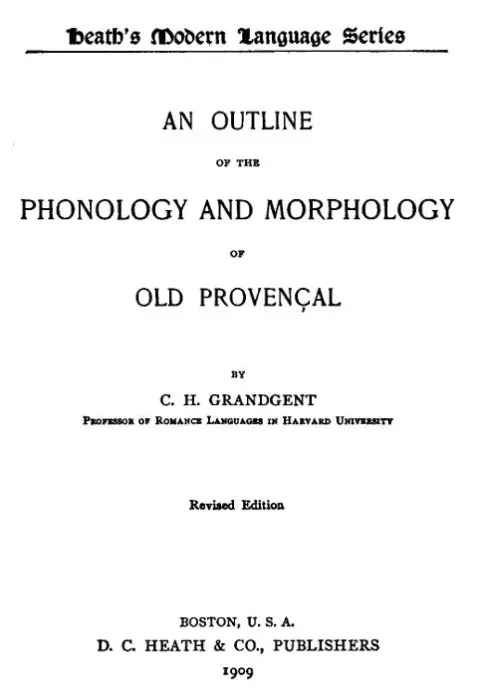
"An Outline of the Phonology and Morphology of Old Provençal" by C. H. Grandgent is a scientific publication written in the early 20th century. This work serves as a comprehensive guide for students of Romance Philology, specifically examining the phonetic and grammatical aspects of the Old Provençal language. It focuses on the literary language used mainly by the poets of Southern France during the 12th and 13th centuries. The opening portion of the work provides a preface from the author, outlining his extensive research journey that spanned two decades. Grandgent discusses the resources he utilized, including foundational grammars and various treatises on Provençal linguistics. He clarifies that while his study centers on the older literary language of Provençal, it also considers regional dialects to illuminate historical phonetic variations across time. The subsequent sections promise a detailed examination of phonology, accent, vowels, and consonants, ultimately aiming to present a systematic understanding for students of the language.
Introduction adapted from the source catalogue; source summaries may be automatically generated.
Free to read · English · 49,465 words · No account needed
MAKE TIME FOR A GOOD BOOK
On by default. Untick to stop anonymous reading totals. Each page counts after 10 seconds in view. How this works.
Anonymous counting is on unless you have switched it off.
54. The Latin consonants which we have to consider are: b, c (= k), d, f, g, h, j (= y), l, m, n, p, qu (= kw), r, s, t, v (= w), x (= ks). To these we must add the Vulgar Latin w coming from u̯, and y coming from e̯, i̯: see § 40, (2). Furthermore, in words borrowed from Germanic dialects we find b, ð, h, k, þ, w, which call for special notice; and, in words borrowed from Greek, ch, k, ph, th, z.
The Latin d, f, j, l, p, t call for no remark at present. Latin h, in popular speech, became silent very early (hŏc > ŏc, hŏmo > ŏmo), and, although an attempt was made to restore it in polite speech, it left no trace in the Romance languages: cf. Rom., XI, 399. Double consonants were pronounced distinctly longer than single ones: annus, ĭlle, ŏssum, tĕrra.
55. Latin b, c, g, m, n, qu, r, s, v, w, x, y show the following developments in popular Latin speech:--
B between vowels became, through failure to close the lips tightly, β (bilabial v), from the 1st to the 3d century of our era: habēre > aβẹre. The same change took place, to a certain extent, when the b was not intervocalic, but we have few, if any, traces of it in Provençal. Between vowels, even in learned words, the clerical pronunciation was probably β or v until the 7th century. Cf. V.
C before a front vowel (e, i), as early as the 3d century, doubtless had, in nearly all the Empire, a front or palatal articulation; that is, it was formed as close as possible to the following vowel[36]: cĕntum > c´ĕntu, dūcĕre > dūc´ĕre. The next step was the introduction of an audible glide, a brief y, between the c´ and the vowel[37]: c´yęntu, dục´yere. By the 5th century this c´y had developed into a kind of ty, the c´ having been drawn still further forward: t´yęntu dụt´yere. Through a modification of the y-glide, the group then became, in the 6th or 7th century, tš or ts: tšęntu tsęntu. See H. Schuchardt, Voc., I, 151, and Ltblt., XIV, 360; P. E. Guarnerio, in Supplementi all’ Archivio glottologico italiano, IV (1897), pp. 21-51 (cf. Rom., XXX, 617); G. Paris, in the Journal des savants, 1900, 359, in the Annuaire de l’École pratique des Hautes-Études, 1893, 7, in the Comptes rendus des séances de l’Académie des Inscriptions, 1893, 81, and in Rom., XXXIII, 322; W. Meyer-Lübke, Einf., pp. 123-126; F. G. Mohl, Zs., XXVI, 595; P. Marchot, Phon., pp. 51-53; W. Meyer-Lübke, in Bausteine zur romanischen Philologie, 313. Cf. G and X.[38]
Your reading position is saved on this browser. Take it to another device with a library code. Reading pages adapt to text, rather than matching a printed edition.
BEHIND THE BOOK
This eBook is for the use of anyone anywhere in the United States and most other parts of the world at no cost and with almost no restrictions whatsoever. You may copy it, give it away or re-use it under the terms of the Project Gutenberg License included with this eBook or online at www.gutenberg.org. If you are not located in the United States, you will have to check the laws of the country where you are located before using this eBook. Read the source licence.
The original source file, including credits and licence, is retained by this library. Request an original-format copy at no charge. Please include the book title and Project Gutenberg identifier #49692.
KEEP YOUR CURIOSITY GOING
Charles G. (Charles Griffith) Ross
Hannah Webster Foster

Emily Lawless
Edwin Hamlin Carr

Charles De Lano Hine
Andrew Ure