
The Writing of News A Handbook with Chapters on Newspaper Correspondence and Copy Reading
Charles G. (Charles Griffith) Ross
THE CLASSIC COLLECTION · 1905
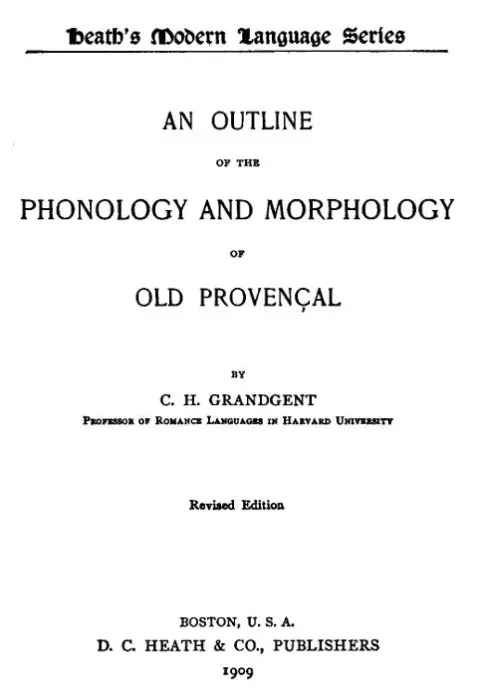
"An Outline of the Phonology and Morphology of Old Provençal" by C. H. Grandgent is a scientific publication written in the early 20th century. This work serves as a comprehensive guide for students of Romance Philology, specifically examining the phonetic and grammatical aspects of the Old Provençal language. It focuses on the literary language used mainly by the poets of Southern France during the 12th and 13th centuries. The opening portion of the work provides a preface from the author, outlining his extensive research journey that spanned two decades. Grandgent discusses the resources he utilized, including foundational grammars and various treatises on Provençal linguistics. He clarifies that while his study centers on the older literary language of Provençal, it also considers regional dialects to illuminate historical phonetic variations across time. The subsequent sections promise a detailed examination of phonology, accent, vowels, and consonants, ultimately aiming to present a systematic understanding for students of the language.
Introduction adapted from the source catalogue; source summaries may be automatically generated.
Free to read · English · 49,465 words · No account needed
MAKE TIME FOR A GOOD BOOK
On by default. Untick to stop anonymous reading totals. Each page counts after 10 seconds in view. How this works.
Anonymous counting is on unless you have switched it off.
73. This class contains: 1st, combinations of consonant + y < e̯ or i̯, cf. § 40, (2); 2d, consonant + g´ > y (§ 55, G), the g´ having been in some cases always contiguous to the preceding consonant, in others originally separated from it by a vowel; 3d, consonant + g > y, the g representing an original c or g between the last two vowels of a proparoxytone, cf. § 65, G, (3). It does not include dy and gy, which early became y: see § 65, Y. See § 63, (1). The groups will be considered in alphabetical order:--
Bry > bry in ebriācum > ebriac (iure is probably French).
βy was early reduced to y in habeo habeam etc. and dēbeo dēbeam etc., partly, no doubt, through the proclitic use of these words, partly under the influence of audio > ✱auyo audiam > ✱auya and video > ✱veyo vĭdeam > ✱veya; this y, like any other medial y (§ 65, Y), became džy̆ or remained y: ai (for some reason there seems to have been no form ✱ach), aia; dẹi dẹch, dẹia. Aside from these words, βy > udž and uy apparently in the north; elsewhere uy, by, vy--uy prevailing in the west, by and vy in the south and east. When the y became final, it changed to i, which, after a consonant, was syllabic. Ex.: abbrĕviat > abręuia, ✱aggrĕviat > agrẹuia, allĕviat > alęuia, avĭŏ́lum > aviǫl aiǫl, cavĕa > gabia cauia, labia > lavia-s, ✱leviarius > leugięrs, ✱rabiam (= rabiem) > rabia rauia,[67] ✱rabiāre > rabiar, rabiōsus > rabiọs rauiọs, rŭbeum > rọg rọi,[68] ✱sabium > savi sabi, atavia > tavia, vidŭvium > vezọig bedọi.[68] In purely learned words, Latin bi, vi, etc., are kept: abiurament, fluvial. Brĕvio > bręy: cf. § 65, β, 3.
Cc´y: see C´y.
Cly > l´: coclearium > cuilhięr.
Cty > is: factiōnem > faissọ, lectiōnem > leissọ, suspectiōnem > sospeissọ. In purely learned words we find the spellings cti, cci, which doubtless indicate ktsy or ksy: electio, accio. Cf. Ssy.
C´y, cc´y, kwy > ts; this ts, when it remained medial, was reduced, before and during the literary period, to s: bracchia > brassa, bracchium > bratz bras (§ 64), faciam > faza fassa, faciem > fatz fas, glaciem > glatz glas[69], laqueāre > lassar, laqueum > latz las, ✱pĕcia > pęssa, placeam > plassa. Learned words have zi and ci, doubtless pronounced at first dzi, tsi, later zi, si (cf. A. Horning, Zs., XXIV, 545; XXV, 736): iuzizi iudici, edifici, Grecia. Cf. Pty.
D-g > dž: jūdĭco > iütge, mĕdĭcum > męge, ✱sĕdĭcum > sęie[70].
Dy: see § 55, Y and § 65, Y.
Gdy: see § 80, Gd.
Gy: see § 55, Y and § 65, Y.
Kwy: see Cy.
Lc´y > lts > uts > us: calceāre > caussar. Cf. Lty. See § 74, (2).
Your reading position is saved on this browser. Take it to another device with a library code. Reading pages adapt to text, rather than matching a printed edition.
BEHIND THE BOOK
This eBook is for the use of anyone anywhere in the United States and most other parts of the world at no cost and with almost no restrictions whatsoever. You may copy it, give it away or re-use it under the terms of the Project Gutenberg License included with this eBook or online at www.gutenberg.org. If you are not located in the United States, you will have to check the laws of the country where you are located before using this eBook. Read the source licence.
The original source file, including credits and licence, is retained by this library. Request an original-format copy at no charge. Please include the book title and Project Gutenberg identifier #49692.
KEEP YOUR CURIOSITY GOING
Charles G. (Charles Griffith) Ross
Hannah Webster Foster

Emily Lawless
Edwin Hamlin Carr

Charles De Lano Hine
Andrew Ure