
The Writing of News A Handbook with Chapters on Newspaper Correspondence and Copy Reading
Charles G. (Charles Griffith) Ross
THE CLASSIC COLLECTION · 1905
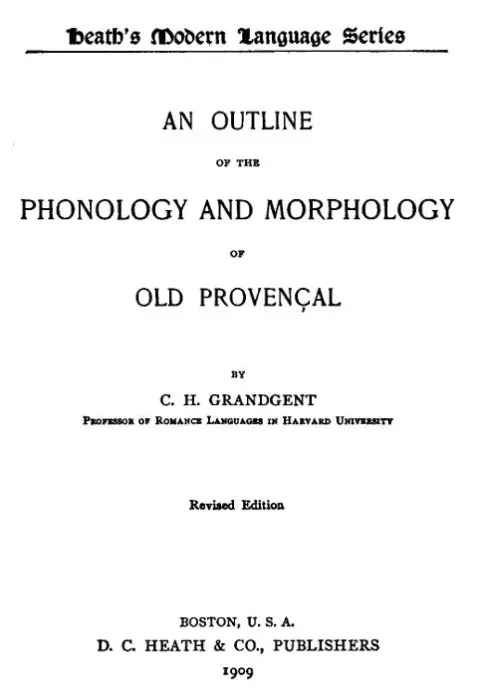
"An Outline of the Phonology and Morphology of Old Provençal" by C. H. Grandgent is a scientific publication written in the early 20th century. This work serves as a comprehensive guide for students of Romance Philology, specifically examining the phonetic and grammatical aspects of the Old Provençal language. It focuses on the literary language used mainly by the poets of Southern France during the 12th and 13th centuries. The opening portion of the work provides a preface from the author, outlining his extensive research journey that spanned two decades. Grandgent discusses the resources he utilized, including foundational grammars and various treatises on Provençal linguistics. He clarifies that while his study centers on the older literary language of Provençal, it also considers regional dialects to illuminate historical phonetic variations across time. The subsequent sections promise a detailed examination of phonology, accent, vowels, and consonants, ultimately aiming to present a systematic understanding for students of the language.
Introduction adapted from the source catalogue; source summaries may be automatically generated.
Free to read · English · 49,465 words · No account needed
MAKE TIME FOR A GOOD BOOK
On by default. Untick to stop anonymous reading totals. Each page counts after 10 seconds in view. How this works.
Anonymous counting is on unless you have switched it off.
Lg´ apparently became ldz > udz > uz in ✱fŭlgĕrem (= fŭlgur) >
fọuzer.
Ll-g´ > l´ in cŏllĭgit > cuęlh. Cf. Ly.
Lly: see Ly.
Lny > n´: balneum > banh.
Lty > lts >uts > us: ✱altiāre > auçar aussar. Cf. Lc´y. See § 74, (2).
Lvy > lby > uby in salvia > saubia (Gascon).
Ly, lly > l´: consĭlium > cossẹlh, fīlium > filh, fīlia > filha, nūllī + vowel > nülh. Learned words have li: familiarmens. Lili liri lire < līlium are doubtless learned; lis is French.
Mby > mby, mdž, and ndž; mdž being the usual form in the literary language: cambiāre > camiar caniar cambiar.
Mmy > my, mdž, and ndž: commeātus > comiatz coniatz.
Mny > n´ in Limousin and in the extreme east and southwest, elsewhere ndž: somniāre > sonhar soniar. Somni, beside suenh songe, is learned.
Mply > mply in ampliāre > ampliar, probably learned.
My > my and n´: sīmia > simia, vindēmia > vendẹmia vendanha.
Nc´y > nts > ns: ✱Francia > Fransa. Cf. Nty.
Nd-g > ndž: ✱pĕndĭcat > penia, vĭndĭco > vẹnie. Similarly mandūcāre > ✱mandugare manduyare mandyare > maniar[71].
Ndy > n´: ✱Burgŭndia > Borgọnha, verecŭndia > vergọnha.
N-g > ndž: ✱excommĭnĭco (= excommūnĭco) > escomẹnie[71], mŏnăchum > monie.
Ng´ > n´ and ndž: jŭngĕre > iọnher iọnger, ŭngĕre > ọnher ọnger, plangĕre > planher planger, pŭngĕre > pọnher pọnger. Angel is probably learned.
Ng´y > ndž: spŏngia > esponia.
Nny > n´: stanneum > estanh.
Nty > nts > us: cantiōnem > cansọ, comĭn(i)tiāre > comensar, sperantia > esperansa. Purely learned words have nti: essentia. Cf. Nc´y.
Ny > n´: extraneum > estranh, tĕneo > tenh, vĕniat > venha. Before or during the literary period final n´ or n´s lost its palatal quality in many dialects: ingĕnium > genh gen. If estraniar comes from extraneāre (and not from ✱extranicāre), it must be a word of later adoption; so estrangier. In sotran < subterraneum there is probably a change of suffix.
Pry probably became regularly bry: capreŏlum > ✱cabriǫl cabirǫl (cabrǫl seems to be a new formation from cabra). Coyre <? cŭpreum is unexplained.
Pty > ts, which, when it remained medial, was reduced, before and during the literary period, to s: ✱captiāre > cassar, ✱corrŭptiāre > corrossar, nĕptia > nęssa, ✱nŏptias (§ 38, 2) > nǫssas. Cf. C´y.
Your reading position is saved on this browser. Take it to another device with a library code. Reading pages adapt to text, rather than matching a printed edition.
BEHIND THE BOOK
This eBook is for the use of anyone anywhere in the United States and most other parts of the world at no cost and with almost no restrictions whatsoever. You may copy it, give it away or re-use it under the terms of the Project Gutenberg License included with this eBook or online at www.gutenberg.org. If you are not located in the United States, you will have to check the laws of the country where you are located before using this eBook. Read the source licence.
The original source file, including credits and licence, is retained by this library. Request an original-format copy at no charge. Please include the book title and Project Gutenberg identifier #49692.
KEEP YOUR CURIOSITY GOING
Charles G. (Charles Griffith) Ross
Hannah Webster Foster

Emily Lawless
Edwin Hamlin Carr

Charles De Lano Hine
Andrew Ure