
The Writing of News A Handbook with Chapters on Newspaper Correspondence and Copy Reading
Charles G. (Charles Griffith) Ross
THE CLASSIC COLLECTION · 1905
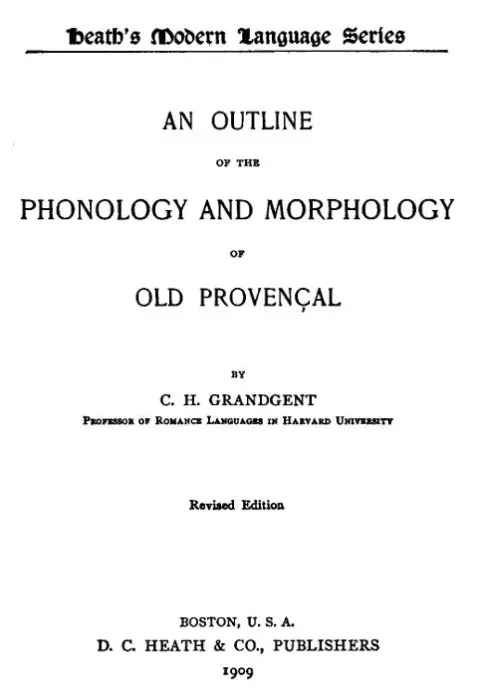
"An Outline of the Phonology and Morphology of Old Provençal" by C. H. Grandgent is a scientific publication written in the early 20th century. This work serves as a comprehensive guide for students of Romance Philology, specifically examining the phonetic and grammatical aspects of the Old Provençal language. It focuses on the literary language used mainly by the poets of Southern France during the 12th and 13th centuries. The opening portion of the work provides a preface from the author, outlining his extensive research journey that spanned two decades. Grandgent discusses the resources he utilized, including foundational grammars and various treatises on Provençal linguistics. He clarifies that while his study centers on the older literary language of Provençal, it also considers regional dialects to illuminate historical phonetic variations across time. The subsequent sections promise a detailed examination of phonology, accent, vowels, and consonants, ultimately aiming to present a systematic understanding for students of the language.
Introduction adapted from the source catalogue; source summaries may be automatically generated.
Free to read · English · 49,465 words · No account needed
MAKE TIME FOR A GOOD BOOK
On by default. Untick to stop anonymous reading totals. Each page counts after 10 seconds in view. How this works.
Anonymous counting is on unless you have switched it off.
[96] Cf. Thomas in Rom., XII, 334; Meyer-Lübke in Gram., II, page 104. For a different explanation, see Ascoli in Archivio glottologico italiano, XV, 314, 396.
[97] For a different explanation of mia, see Gram., I, pp. 246-248, also Horning in Zs., XXV, 341. Cf. Fr. moie.
[98] Cels shows the influence of masculine nouns and adjectives.
[99] Aquel has also aquilli. Cilha is evidently a combination of
cilh and celha.
[100] Aquel has also aqueli.
[101] Aquel has also aquelz and aquelses.
[102] See G. Rydberg, Le développement de facere dans les langues
romanes, 1893.
[103] See A. Zimmermann in Zs., XXV, 735.
[104] See C. C. Rice in Publications of the Modern Language
Association of America, XIX, 217.
[105] Cf. § 138.
[106] Cf. § 72, Sw.
[107] According to Raimon Vidal, a 13th century grammarian, tenir is
French.
[108] Esvanuir seems to come from the perfect, evanuī.
[109] Enfolhetir shows the influence of follet.
[110] For two different explanations of this ending, see A. Thomas, Essais de philologie française, 25, 281; E. Herzog, in Bausteine zur romanischen Philologie, 481.
[111] See K. Sittl in Archiv für lateinische Lexikographie und
Grammatik, I, 465.
[112] For ai estat we sometimes find soi agutz. The confusion arises perhaps from the use of both es and a in the sense of ‘there is’: hence es estat = a agut; and by a mixture of the two, es agut. Cf. L. Gauchat, Sone avuto, in Scritti vari di filologia (dedicated to E. Monaci), 1901, p. 61.
[113] Cf. P. Thielmann, Archiv für lateinische Lexikographie und
Grammatik, II, 48 and 157.
[114] For the accented vowels in these forms, see §§ 167, 168.
[115] See § 168.
[116] See § 37.
[117] See § 30.
[118] Also, by analogy, iassér.
[119] Raimon Vidal says that crei, vei are the proper forms for the 1st pers. sg. of the pres. indicative.
[120] According to Raimon Vidal, trac is the only correct form.
[121] Volemus occurs repeatedly in 7th century Latin.
[122] Cf. O. Schmidt, Ueber die Endungen des Præsens im
Altprovenzalischen, 1887.
[123] The loss of -s is not confined to the Provençal territory: it occurs also in western France, Catalonia, and the Engadine.
[124] Cf. the reduction of habēbam to aβea: § 153.
[125] Tenér tenír really belongs to the second conjugation.
[126] According to Raimon Vidal, this is the regular ending of the 3d pers. sg. of the fourth conjugation.
[127] In nasquec the ui ending occurs twice.
[128] Beside parẹc, coming perhaps from a V. L. ✱parēvit ✱parēvuit.
Your reading position is saved on this browser. Take it to another device with a library code. Reading pages adapt to text, rather than matching a printed edition.
BEHIND THE BOOK
This eBook is for the use of anyone anywhere in the United States and most other parts of the world at no cost and with almost no restrictions whatsoever. You may copy it, give it away or re-use it under the terms of the Project Gutenberg License included with this eBook or online at www.gutenberg.org. If you are not located in the United States, you will have to check the laws of the country where you are located before using this eBook. Read the source licence.
The original source file, including credits and licence, is retained by this library. Request an original-format copy at no charge. Please include the book title and Project Gutenberg identifier #49692.
KEEP YOUR CURIOSITY GOING
Charles G. (Charles Griffith) Ross
Hannah Webster Foster

Emily Lawless
Edwin Hamlin Carr

Charles De Lano Hine
Andrew Ure