
The Writing of News A Handbook with Chapters on Newspaper Correspondence and Copy Reading
Charles G. (Charles Griffith) Ross
THE CLASSIC COLLECTION · 1905
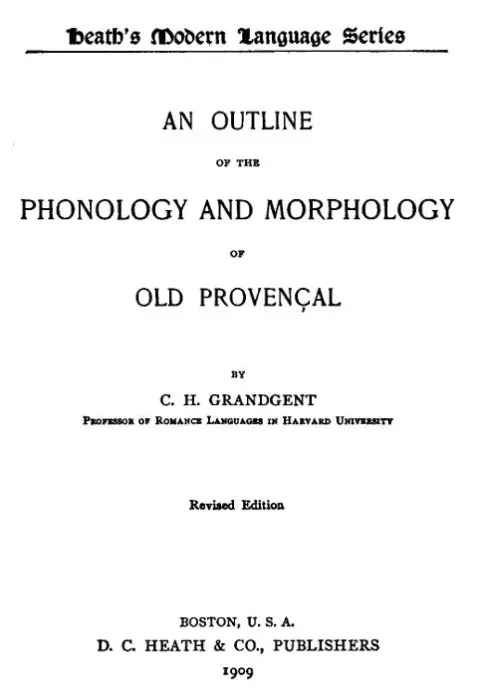
"An Outline of the Phonology and Morphology of Old Provençal" by C. H. Grandgent is a scientific publication written in the early 20th century. This work serves as a comprehensive guide for students of Romance Philology, specifically examining the phonetic and grammatical aspects of the Old Provençal language. It focuses on the literary language used mainly by the poets of Southern France during the 12th and 13th centuries. The opening portion of the work provides a preface from the author, outlining his extensive research journey that spanned two decades. Grandgent discusses the resources he utilized, including foundational grammars and various treatises on Provençal linguistics. He clarifies that while his study centers on the older literary language of Provençal, it also considers regional dialects to illuminate historical phonetic variations across time. The subsequent sections promise a detailed examination of phonology, accent, vowels, and consonants, ultimately aiming to present a systematic understanding for students of the language.
Introduction adapted from the source catalogue; source summaries may be automatically generated.
Free to read · English · 49,465 words · No account needed
MAKE TIME FOR A GOOD BOOK
On by default. Untick to stop anonymous reading totals. Each page counts after 10 seconds in view. How this works.
Anonymous counting is on unless you have switched it off.
[52] Clerc is from ✱clĕrcum, which must have existed
contemporaneously with clĕrĭcum.
[53] Possibly it comes from N. Greek σράδη: cf. Romanische
Forschungen, XV, 880.
[54] See Zs., XXXII, 434.
[55] Magis was probably reduced to mais in Vulgar Latin.
[56] Legir may have been reconstructed on the basis of leg <
lĕgit.
[57] For the groups ending in y, cf. L. J. Juroszek, Ein Beitrag zur Geschichte der jotazierten Konsonanten in Frankreich, in Zs., XXVII, 550 ff. The groups ending in y and those containing c or g have been studied by H. Sabersky, Zur provenzalischen Lautlehre, 1888.
[58] S is generally written ss between vowels, to distinguish it from
s = z.
[59] Most of the words in this category are semi-learned: cf. fabla
and faula. See § 55, B.
[60] See § 47, (2).
[61] See § 47, (2).
[62] Also faur: cf. § 52, (1), 1.
[63] Sozer < sŏcĕrum: cf. § 49, (1).
[64] For the vowel of nęr nięr, see § 25, 1, (e).
[65] Enteir, neir seem to have lost final e under the influence of numerous adjectives in -er -ier -ieir < -arium.
[66] In the modern dialects the d is probably commoner than it was
in the old literary language; it occurs in Bordeaux, Languedoc, and
Provence.
[67] Ratie is perhaps French.
[68] After o, the u disappears.
[69] Glai is due perhaps to the analogy of ney (§ 65, β, 3), perhaps to such double forms as fatz fai = facit.
[70] Seti (pronounced with two syllables) seems to be an improperly constructed post-verbal noun from assetiar. For metgue, etc., see § 65, G, (3).
[71] Apparently maniar, escomeniar developed in the region where g became y before a: cf. § 65, G, (1).
[72] The r remained palatal long enough to cause breaking: cf. §§ 30,
37.
[73] These sounds lost their palatal quality too early to cause breaking: cf. §§ 30, 37. Cf. Einf., § 133.
[74] Palaitz, however, is used by Marcabru, A. Daniel, and P. Vidal. Poizon occurs in Flamenca and in modern Limousin (beside pozon), raizo is found in the Boeci and other texts.
[75] Cf. § 49, (3).
[76] Daun, etc., are Gascon.
[77] Such forms as amda < amĭta, comde conde < compŭtum, show a late fall of the medial vowel.
[78] The i in ueich seems to be merely graphic.
[79] The i in voig seems to be merely graphic.
[80] Fret, freda occur also.
[81] The phenomena of dissimilation have been well classified by M. Grammont in La dissimilation consonantique dans les langues indo-européennes et dans les langues romanes, 1895. For metathesis, see Zs., XXVIII, 1.
[82] Cato uses fructi.
[83] The process began in classic Latin: materies materia, etc.
[84] See § 89, 1.
[85] See § 47, (3).
[86] See § 16, 1.
[87] See § 52, (1), 1.
[88] Perhaps from a fusion of plūs and pluriōres = plūres. Cf. Fr.
[89] These forms existed as early as the 1st century of our era. See Zs., XXVI, 600, 619. Ejus, ei may have had some influence.
[90] See § 67, (2).
[93] Cf. Meyer-Lübke, Gram., II, p. 104.
[94] See Suchier in Grundriss, I, p. 627.
[95] Cf. A. von Elsner, Ueber Form und Verwendung des Personalpronomens im Altprovenzalischen, 1886.
Your reading position is saved on this browser. Take it to another device with a library code. Reading pages adapt to text, rather than matching a printed edition.
BEHIND THE BOOK
This eBook is for the use of anyone anywhere in the United States and most other parts of the world at no cost and with almost no restrictions whatsoever. You may copy it, give it away or re-use it under the terms of the Project Gutenberg License included with this eBook or online at www.gutenberg.org. If you are not located in the United States, you will have to check the laws of the country where you are located before using this eBook. Read the source licence.
The original source file, including credits and licence, is retained by this library. Request an original-format copy at no charge. Please include the book title and Project Gutenberg identifier #49692.
KEEP YOUR CURIOSITY GOING
Charles G. (Charles Griffith) Ross
Hannah Webster Foster

Emily Lawless
Edwin Hamlin Carr

Charles De Lano Hine
Andrew Ure