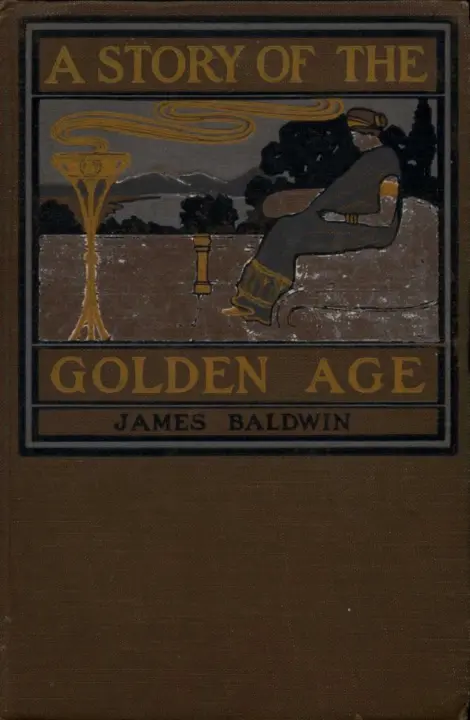
A Story of the Golden Age
James Baldwin
THE CLASSIC COLLECTION · 1892
"Six Centuries of English Poetry: Tennyson to Chaucer" by James Baldwin is a comprehensive anthology of Classic English poetry spanning from the 14th to the 19th century. Written in the late 19th century, this work is part of a series aimed at education, designed for students and teachers to explore notable English literary pieces alongside critical annotations and historical context. The book features selections from renowned poets like Tennyson, Wordsworth, and Chaucer, offering readers an insight into the evolution of English poetic expression through various eras. At the start of the anthology, Baldwin introduces the reader to the historical development of English poetry, suggesting that its roots trace back hundreds of years before Chaucer. He elaborates on the influence of earlier poets and the transition of language, connecting these historical elements to the richness found in later works. Baldwin points out the significance of understanding poetry not just as a literary form but as a reflection of cultural and historical shifts, emphasizing the importance of familiarizing oneself with poetic creations to appreciate their beauty fully. The opening sets a scholarly tone while making an engaging argument for the study of poetry as a vital component of English literature.
Introduction adapted from the source catalogue; source summaries may be automatically generated.
Free to read · English · 75,364 words · No account needed
MAKE TIME FOR A GOOD BOOK
On by default. Untick to stop anonymous reading totals. Each page counts after 10 seconds in view. How this works.
Anonymous counting is on unless you have switched it off.
[Sidenote: The History of English Poetry.]
A study of the development of English poetry such as we have outlined above would involve a knowledge of the history of the English people and of the various circumstances and events which from time to time influenced our language and literature. It would also embrace many other topics, biographical, philological, rhetorical, and speculative, which have only a secondary relationship to the central idea of poetry. In fact, it would be a study not of poetry, but about poetry,--of the circumstances which suggested it, of the men who produced it, and of the origin of the word-forms and methods of versification which distinguish it. Such a study, altogether interesting and eminently profitable though it be, should not be undertaken by any student until he has acquired an extensive personal acquaintance with poetry itself. We may enjoy the beautiful creations of Tennyson, of Shelley, of Burns, even of Chaucer, without knowing one word of the history of poetry, without so much as knowing the names of the writers or the circumstances under which they wrote. But, on the other hand, to him who knows nothing of the masterpieces of our literature, save at second hand, the history of English letters must of necessity be dull, uninteresting, and often unintelligible. While to him who has prepared himself for its study by fitting himself for an appreciation of these noble creations and becoming thoroughly imbued with their spirit, what a field of delightful study does it offer!
[Sidenote: Object of this Book.]
[Sidenote: Methods of Study.]
The object of the present compilation is to aid in this preparatory work,--that is, to offer a plan for promoting the study OF poetry before the broader but less important study ABOUT poetry is undertaken. To this end we present for the student's consideration a few representative poems written at different times and by men of widely different tastes and talents during the six centuries which may be said to have elapsed since the formation of the modern English tongue. Our chief aim is to lead to such a study of these selections as shall help the reader to perceive and appreciate their true poetic qualities and enter into full sympathy with the thoughts and feelings which their writers intended to express. The first object to be sought in the study of these poems is the perception of those characteristic excellences which have made them universally admired and placed them among the classics of our language. To accomplish this object rationally and successfully, it is best to begin with those productions which are nearest to us in point of time and which are more in harmony with our own thoughts, and therefore easiest to understand and enjoy. An attempt to pursue these studies in chronological order, beginning with the works of Chaucer and the older poets, would oblige the student to encounter at the outset so many purely mechanical difficulties that he would fail to discern the spiritual qualities of truth, beauty, and goodness, which are the very essence of all genuine poetry. He would very naturally acquire a distaste for poetry long before he was able to understand it, and while he might attain to some considerable knowledge of the history of poetical literature, that literature itself would remain to him practically a sealed book. Hence, in the study of this subject, as in that of other branches, the true method is to present first that which is the least difficult, to "proceed from the known to the unknown," to begin with that which is near at hand and from it to proceed to the consideration of things more remote. Not only are the most of Tennyson's poems easily understood, but their beauty is readily apparent even to the most superficial readers. By the time we have read and extracted all the sweets from three or four of these, we shall be prepared to go a step farther and undertake the study of Wordsworth's immortal productions,--productions but little more difficult and but little less poetic. Thus, step by step, we may review the six centuries of English poetry which lie behind, and when at last we reach the time of Chaucer we shall be able to take hold of his works with understanding and with the zest which is begotten of true sympathy and appreciation. After the book has been thus completed, it may be well to run through it again, reversing the order of the lessons and this time considering the subjects in strict chronological order. Our first study of the book will have introduced us to English poetry, our second study of it will have given us some insight into the history of its development.
Your reading position is saved on this browser. Take it to another device with a library code. Reading pages adapt to text, rather than matching a printed edition.
James Baldwin
James Baldwin
James Baldwin
James Baldwin
BEHIND THE BOOK
This eBook is for the use of anyone anywhere in the United States and most other parts of the world at no cost and with almost no restrictions whatsoever. You may copy it, give it away or re-use it under the terms of the Project Gutenberg License included with this eBook or online at www.gutenberg.org. If you are not located in the United States, you will have to check the laws of the country where you are located before using this eBook. Read the source licence.
The original source file, including credits and licence, is retained by this library. Request an original-format copy at no charge. Please include the book title and Project Gutenberg identifier #30235.
KEEP YOUR CURIOSITY GOING

Eric Mackay
Edmund Gosse
Sophia Margaretta Hensley
Gilbert Parker
George MacDonald

Elizabeth Bibesco