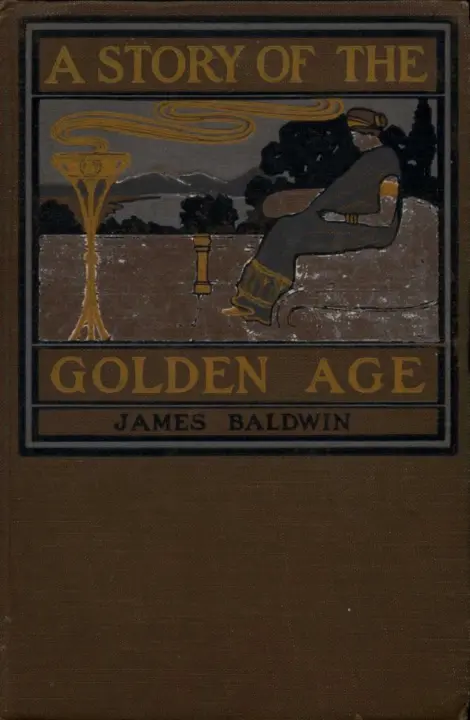
A Story of the Golden Age
James Baldwin
THE CLASSIC COLLECTION · 1892
"Six Centuries of English Poetry: Tennyson to Chaucer" by James Baldwin is a comprehensive anthology of Classic English poetry spanning from the 14th to the 19th century. Written in the late 19th century, this work is part of a series aimed at education, designed for students and teachers to explore notable English literary pieces alongside critical annotations and historical context. The book features selections from renowned poets like Tennyson, Wordsworth, and Chaucer, offering readers an insight into the evolution of English poetic expression through various eras. At the start of the anthology, Baldwin introduces the reader to the historical development of English poetry, suggesting that its roots trace back hundreds of years before Chaucer. He elaborates on the influence of earlier poets and the transition of language, connecting these historical elements to the richness found in later works. Baldwin points out the significance of understanding poetry not just as a literary form but as a reflection of cultural and historical shifts, emphasizing the importance of familiarizing oneself with poetic creations to appreciate their beauty fully. The opening sets a scholarly tone while making an engaging argument for the study of poetry as a vital component of English literature.
Introduction adapted from the source catalogue; source summaries may be automatically generated.
Free to read · English · 75,364 words · No account needed
MAKE TIME FOR A GOOD BOOK
On by default. Untick to stop anonymous reading totals. Each page counts after 10 seconds in view. How this works.
Anonymous counting is on unless you have switched it off.
Haill rois maist chois till clois thy fois greit micht, Haill stone quhilk schone vpon the throne of licht, Vertew, quhais trew sweit dew ouirthrew al vice, Was ay ilk day gar say the way of licht; Amend, offend, and send our end ay richt. Thow stant, ordant as sanct, of grant maist wise, Till be supplie, and the high gre of price. Delite the tite me quite of site to dicht, For I apply schortlie to thy deuise. --From "The Palice of Honour."
=afoir=, before.
=auance=, advance.
=ay=, ever, always.
=but=, without.
=conding=, condign, worthy.
=crynis=, diminishes.
=deid=, death.
=degest=, grave.
=dicht=, relieve.
=docht=, avails.
=feid=, hatred.
=fois=, time.
=glaiding=, happiness.
=gloir=, glory.
=grant=, giving.
=gre=, degree.
=guerdoun=, reward.
=ilk=, any.
=mekill=, much, mickle.
=peir=, peer.
=poureall=, the poor.
=puissance=, power.
=quhilk=, who, which.
=quhome=, without whom.
=reid=, advice.
=rois=, king.
=sanct=, saint.
=site=, shame.
=till=, to.
=tite=, quickly.
=tynis=, loses.
=wicht=, person, wight.
JOHN LYDGATE was born at the village of Lydgate, near Newmarket, about 1370. He was a Benedictine monk attached to the monastery of Bury St. Edmunds, and is remembered as the author of three poems, which, in their time, attracted much attention. These are "The Storie of Thebes," written in ten-syllable rhyming couplets, and founded upon the "Teseide" of Boccaccio; the "Troye Book," finished about 1420, and relating the story of the Trojan war as recounted by Guido di Colonna in his Latin prose history of Troy; and "The Falls of Princes," founded on a French version of Boccaccio's "De Casibus Virorum Illustrium." In 1433, Lydgate wrote a wearisome but somewhat amusing poem, "Pur le Roy," describing a visit to London, and the pageants, processions, and other rejoicings, on the occasion of the entrance of Henry VI. into the city after his coronation. The date of the poet's death is not exactly known, but it was probably not later than 1440.
ROBERT HENRYSON, "an accomplished man and a good and genuine poet," was born about the year 1425, and died near the close of the century. He was for a time a schoolmaster and notary public at Dunfermline, in Scotland, and was connected, in some capacity, with the University of Glasgow. He was probably, like Lydgate, a Benedictine monk. His principal works are "The Testament of Cresseid," a sequel to Chaucer's "Troilus and Cresseide," and a collection of thirteen fables. He wrote also many shorter poems, of which the ballad of "Robin and Makyne" (published in Percy's Reliques) is the best known.
Your reading position is saved on this browser. Take it to another device with a library code. Reading pages adapt to text, rather than matching a printed edition.
James Baldwin
James Baldwin
James Baldwin
James Baldwin
BEHIND THE BOOK
This eBook is for the use of anyone anywhere in the United States and most other parts of the world at no cost and with almost no restrictions whatsoever. You may copy it, give it away or re-use it under the terms of the Project Gutenberg License included with this eBook or online at www.gutenberg.org. If you are not located in the United States, you will have to check the laws of the country where you are located before using this eBook. Read the source licence.
The original source file, including credits and licence, is retained by this library. Request an original-format copy at no charge. Please include the book title and Project Gutenberg identifier #30235.
KEEP YOUR CURIOSITY GOING

Eric Mackay
Edmund Gosse
Sophia Margaretta Hensley
Gilbert Parker
George MacDonald

Elizabeth Bibesco