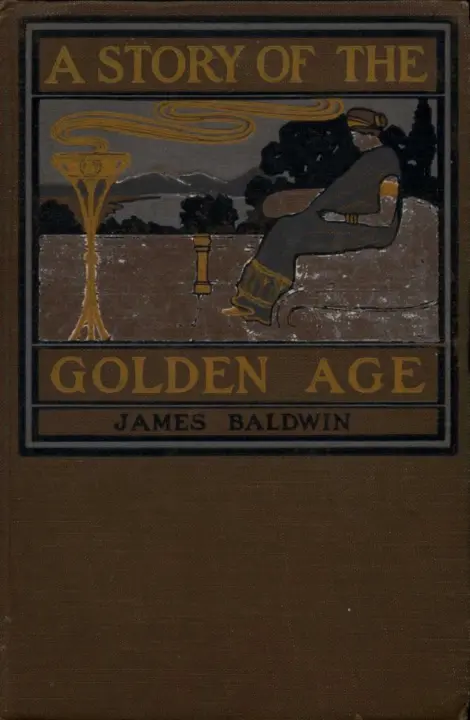
A Story of the Golden Age
James Baldwin
THE CLASSIC COLLECTION · 1892
"Six Centuries of English Poetry: Tennyson to Chaucer" by James Baldwin is a comprehensive anthology of Classic English poetry spanning from the 14th to the 19th century. Written in the late 19th century, this work is part of a series aimed at education, designed for students and teachers to explore notable English literary pieces alongside critical annotations and historical context. The book features selections from renowned poets like Tennyson, Wordsworth, and Chaucer, offering readers an insight into the evolution of English poetic expression through various eras. At the start of the anthology, Baldwin introduces the reader to the historical development of English poetry, suggesting that its roots trace back hundreds of years before Chaucer. He elaborates on the influence of earlier poets and the transition of language, connecting these historical elements to the richness found in later works. Baldwin points out the significance of understanding poetry not just as a literary form but as a reflection of cultural and historical shifts, emphasizing the importance of familiarizing oneself with poetic creations to appreciate their beauty fully. The opening sets a scholarly tone while making an engaging argument for the study of poetry as a vital component of English literature.
Introduction adapted from the source catalogue; source summaries may be automatically generated.
Free to read · English · 75,364 words · No account needed
MAKE TIME FOR A GOOD BOOK
On by default. Untick to stop anonymous reading totals. Each page counts after 10 seconds in view. How this works.
Anonymous counting is on unless you have switched it off.
"My Ben!
Or come again,
Or send to us
Thy wit's great overplus;
But teach us yet
Wisely to husband it,
Lest we that talent spend;
And having once brought to an end
That precious stock,--the store
Of such a wit the world should have no more."
The Sixteenth Century.
"In fifty-two years, without counting the drama, two hundred and thirty-three poets are enumerated, of whom forty have genius or talent. . . . What is this condition which gives rise to so universal a taste for poetry? What is it breathes life into their books? How happens it, that amongst the least, in spite of pedantrie, awkwardnesses, we meet with brilliant pictures and genuine love-cries? How happens it, that when this generation was exhausted, true poetry ended in England, as true painting in Italy and Flanders? It was because an epoch of the mind came and passed away,--that, namely, of instinctive and creative conception. These men had new senses, and no theories in their heads. . . . They are happy in contemplating beautiful things, and wish only that they should be the most beautiful possible. They do not excite themselves to express moral or philosophical ideas. They wish to enjoy through the imagination, through the eyes, like those Italian nobles, who, at the same time, were so captivated by fine colors and forms, that they covered with paintings not only their rooms and their churches, but the lids of their chests and the saddles of their horses. . . . Think what poetry was likely to spring from them, how superior to common events, how free from literal imitation, how smitten with ideal beauty, how capable of creating a world beyond our sad world."--TAINE.
Poets of the Sixteenth Century.
=Sir Thomas Wyatt= (1503-1542). See biographical note, page 252.
=Henry Howard, Earl of Surrey= (1517-1547). See biographical note, page
252.
=George Gascoigne= (1536-1577). "The Steel Glass"; "The Tragedy of
Iocaste."
=Thomas Sackville, Lord Buckhurst= (1536-1608). "The Induction to the Mirror for Magistrates"; "The Tragedy of Gorboduc."
=Edmund Spenser= (1552-1598). See biographical note, page 245.
=Sir Philip Sidney= (1554-1586). "Astrophel and Stella"; sonnets and short
poems.
=Thomas Watson= (1557-1592). "The Hecatompathia or Passionate Century of Love"; "Meliboeus"; "The Tears of Fancie."
=John Lyly= (1554-1606). Lyrical poems; "Alexander and Campaspe"; "Love's
Metamorphosis."
=Robert Greene= (1560-1592). Dramas and lyrical poems.
=Christopher Marlowe= (1564-1593). Dramas and lyrical poems.
=Thomas Lodge= (1556-1625). Dramas and lyrical poems.
=William Warner= (1550-1609). "Albion's England"; "Pan, his Syrinx or
Pipe."
=William Shakespeare= (1564-1616). See note, page 221.
=Samuel Daniel= (1562-1619). "History of the Civil Wars between the two Houses of York and Lancaster."
=Sir Walter Raleigh= (1552-1618). Short poems.
=George Chapman= (1559-1634). Translations of "Homer's Iliad" and "Homer's
Odyssey."
Your reading position is saved on this browser. Take it to another device with a library code. Reading pages adapt to text, rather than matching a printed edition.
James Baldwin
James Baldwin
James Baldwin
James Baldwin
BEHIND THE BOOK
This eBook is for the use of anyone anywhere in the United States and most other parts of the world at no cost and with almost no restrictions whatsoever. You may copy it, give it away or re-use it under the terms of the Project Gutenberg License included with this eBook or online at www.gutenberg.org. If you are not located in the United States, you will have to check the laws of the country where you are located before using this eBook. Read the source licence.
The original source file, including credits and licence, is retained by this library. Request an original-format copy at no charge. Please include the book title and Project Gutenberg identifier #30235.
KEEP YOUR CURIOSITY GOING

Eric Mackay
Edmund Gosse
Sophia Margaretta Hensley
Gilbert Parker
George MacDonald

Elizabeth Bibesco