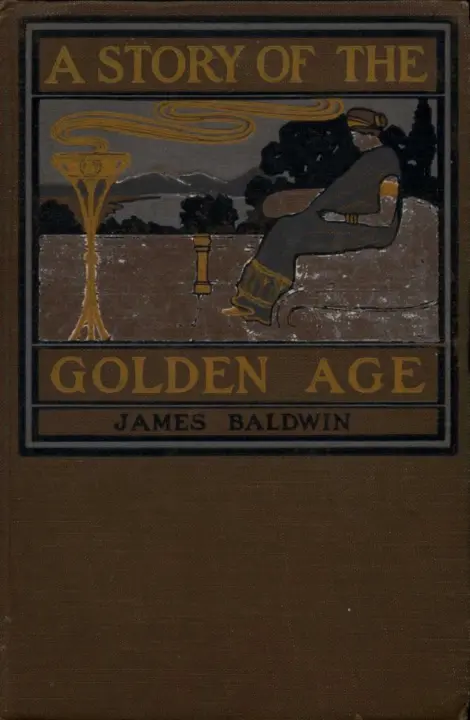
A Story of the Golden Age
James Baldwin
THE CLASSIC COLLECTION · 1892
"Six Centuries of English Poetry: Tennyson to Chaucer" by James Baldwin is a comprehensive anthology of Classic English poetry spanning from the 14th to the 19th century. Written in the late 19th century, this work is part of a series aimed at education, designed for students and teachers to explore notable English literary pieces alongside critical annotations and historical context. The book features selections from renowned poets like Tennyson, Wordsworth, and Chaucer, offering readers an insight into the evolution of English poetic expression through various eras. At the start of the anthology, Baldwin introduces the reader to the historical development of English poetry, suggesting that its roots trace back hundreds of years before Chaucer. He elaborates on the influence of earlier poets and the transition of language, connecting these historical elements to the richness found in later works. Baldwin points out the significance of understanding poetry not just as a literary form but as a reflection of cultural and historical shifts, emphasizing the importance of familiarizing oneself with poetic creations to appreciate their beauty fully. The opening sets a scholarly tone while making an engaging argument for the study of poetry as a vital component of English literature.
Introduction adapted from the source catalogue; source summaries may be automatically generated.
Free to read · English · 75,364 words · No account needed
MAKE TIME FOR A GOOD BOOK
On by default. Untick to stop anonymous reading totals. Each page counts after 10 seconds in view. How this works.
Anonymous counting is on unless you have switched it off.
Poets may boast, as safely vain,
Their works shall with the world remain:
Both bound together, live or die,
The verses and the prophecy.
But who can hope his line should long
Last, in a daily-changing tongue?
While they are new, envy prevails;
And as that dies our language fails.
When architects have done their part,
The matter may betray their art:
Time, if we use ill-chosen stone,
Soon brings a well-built palace down.
Poets, that lasting marble seek,
Must carve in Latin or in Greek:
We write in sand, our language grows,
And, like the tide, our work o'erflows.
Chaucer his sense can only boast,
The glory of his numbers lost!
Years have defac't his matchless strain,
And yet he did not sing in vain.
The beauties which adorn'd that age,
The shining subjects of his rage,
Hoping they should immortal prove,
Rewarded with success his love.
This was the gen'rous poet's scope,
And all an English pen can hope;
To make the fair approve his flame,
That can so far extend their fame.
Verse thus design'd has no ill fate,
If it arrive but at the date
Of fading beauty, if it prove
But as long-liv'd as present love.
That which her slender waist confin'd
Shall now my joyful temples bind;
No monarch but would give his crown
His arms might do what this has done.
It was my heaven's extremest sphere,
The pale which held that lovely deer:
My joy, my grief, my hope, my love,
Did all within this circle move!
A narrow compass! and yet there
Dwelt all that's good and all that's fair:
Give me but what this riband bound,
Take all the rest the sun goes round.
EDMUND WALLER, whose poetry is noticeable because he was the first English versifier to adopt the French fashion of writing in couplets, was born in Warwickshire in 1605. He was elected to Parliament at the age of seventeen, and was a member of that body during the greater part of his life. At the beginning of the difficulties between the king and the Parliament, he gained some notoriety by his opposition to the former, but when the Civil War broke out he attached himself to the Royalist cause. In 1643, being convicted of complicity in a plot against Parliament, he was fined £10,000 and imprisoned for twelve months. After his release he went to France; but in 1653 he returned to England and became reconciled to the new government, writing, soon afterward, "A Panegyric to my Lord Protector, of the present Greatness and joint Interest of his Highness and this Nation." At the Restoration he eagerly declared allegiance to Charles II., and wrote a congratulatory ode on that monarch's return. He became a court favorite, noted for his wit, was made provost of Eton, and returned to his old place in Parliament. He died October 21, 1687. The first edition of his poems was published in 1645, and from that time to the close of the seventeenth century he was quite generally regarded as the greatest of English poets. At the present time there are few writers so little considered as he.
Your reading position is saved on this browser. Take it to another device with a library code. Reading pages adapt to text, rather than matching a printed edition.
James Baldwin
James Baldwin
James Baldwin
James Baldwin
BEHIND THE BOOK
This eBook is for the use of anyone anywhere in the United States and most other parts of the world at no cost and with almost no restrictions whatsoever. You may copy it, give it away or re-use it under the terms of the Project Gutenberg License included with this eBook or online at www.gutenberg.org. If you are not located in the United States, you will have to check the laws of the country where you are located before using this eBook. Read the source licence.
The original source file, including credits and licence, is retained by this library. Request an original-format copy at no charge. Please include the book title and Project Gutenberg identifier #30235.
KEEP YOUR CURIOSITY GOING

Eric Mackay
Edmund Gosse
Sophia Margaretta Hensley
Gilbert Parker
George MacDonald

Elizabeth Bibesco