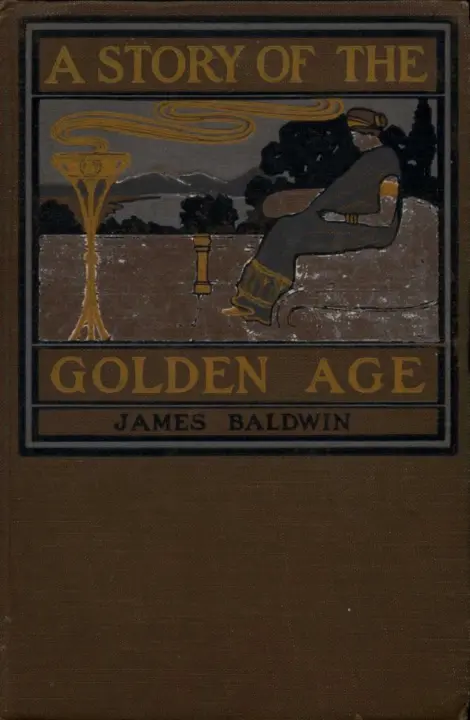
A Story of the Golden Age
James Baldwin
THE CLASSIC COLLECTION · 1892
"Six Centuries of English Poetry: Tennyson to Chaucer" by James Baldwin is a comprehensive anthology of Classic English poetry spanning from the 14th to the 19th century. Written in the late 19th century, this work is part of a series aimed at education, designed for students and teachers to explore notable English literary pieces alongside critical annotations and historical context. The book features selections from renowned poets like Tennyson, Wordsworth, and Chaucer, offering readers an insight into the evolution of English poetic expression through various eras. At the start of the anthology, Baldwin introduces the reader to the historical development of English poetry, suggesting that its roots trace back hundreds of years before Chaucer. He elaborates on the influence of earlier poets and the transition of language, connecting these historical elements to the richness found in later works. Baldwin points out the significance of understanding poetry not just as a literary form but as a reflection of cultural and historical shifts, emphasizing the importance of familiarizing oneself with poetic creations to appreciate their beauty fully. The opening sets a scholarly tone while making an engaging argument for the study of poetry as a vital component of English literature.
Introduction adapted from the source catalogue; source summaries may be automatically generated.
Free to read · English · 75,364 words · No account needed
MAKE TIME FOR A GOOD BOOK
On by default. Untick to stop anonymous reading totals. Each page counts after 10 seconds in view. How this works.
Anonymous counting is on unless you have switched it off.
Good morrow to the day so fair;
Good morning, sir, to you;
Good morrow to mine own torn hair,
Bedabbled with the dew.
Good morning to this primrose too;
Good morrow to each maid;
That will with flowers the tomb bestrew
Wherein my Love is laid.
Ah! woe is me, woe, woe is me,
Alack and well-a-day!
For pity, sir, find out that bee,
Which bore my Love away.
I'll seek him in your bonnet brave;
I'll seek him in your eyes;
Nay, now I think they've made his grave
I' th' bed of strawberries.
I'll seek him there; I know, ere this,
The cold, cold earth doth shake him;
But I will go, or send a kiss
By you, sir, to awake him.
Pray hurt him not; though he be dead,
He knows well who do love him;
And who with green turfs rear his head,
And who do rudely move him.
He's soft and tender, pray take heed,
With bands of cowslips bind him,
And bring him home;--but 'tis decreed
That I shall never find him.
Lord, thou hast given me a cell,
Wherein to dwell;
A little house, whose humble roof
Is weather proof;
Under the spars of which I lie
Both soft and dry;
Where thou, my chamber for to ward,
Hast set a guard
Of harmless thoughts, to watch and keep
Me, while I sleep.
Low is my porch, as is my fate;
Both void of state;
And yet the threshold of my door
Is worn by th' poor,
Who thither come, and freely get
Good words, or meat.
Like as my parlor, so my hall
And kitchen's small;
A little buttery, and therein
A little bin,
Which keeps my little loaf of bread
Unchipt, unflead;
Some brittle sticks of thorn or briar
Make me a fire,
Close by whose living coal I sit,
And glow like it.
Lord, I confess too, when I dine,
The pulse is thine,
And all those other bits that be
There placed by thee;
The worts, the purslain, and the mess
Of water-cress,
Which of thy kindness thou hast sent;
And my content
Makes those, and my belovèd beet,
To be more sweet.
'Tis thou that crown'st my glittering hearth
With guiltless mirth,
And giv'st me wassail bowls to drink,
Spiced to the brink.
Lord, 'tis thy plenty-dropping hand
That soils my land,
And giv'st me, for my bushel sown,
Twice ten for one;
Thou mak'st my teeming hen to lay
Her egg each day;
Besides, my healthful ewes to bear
Me twins each year;
The while the conduits of my kine
Run cream, for wine:
All these, and better, thou dost send
Me, to this end,--
That I should render, for my part,
A thankful heart;
Which, fired with incense, I resign,
As wholly thine;
--But the acceptance, that must be,
My Christ, by Thee.
Your reading position is saved on this browser. Take it to another device with a library code. Reading pages adapt to text, rather than matching a printed edition.
James Baldwin
James Baldwin

James Baldwin
James Baldwin
BEHIND THE BOOK
This eBook is for the use of anyone anywhere in the United States and most other parts of the world at no cost and with almost no restrictions whatsoever. You may copy it, give it away or re-use it under the terms of the Project Gutenberg License included with this eBook or online at www.gutenberg.org. If you are not located in the United States, you will have to check the laws of the country where you are located before using this eBook. Read the source licence.
The original source file, including credits and licence, is retained by this library. Request an original-format copy at no charge. Please include the book title and Project Gutenberg identifier #30235.
KEEP YOUR CURIOSITY GOING

Eric Mackay
Edmund Gosse
Sophia Margaretta Hensley
Gilbert Parker
George MacDonald

Elizabeth Bibesco