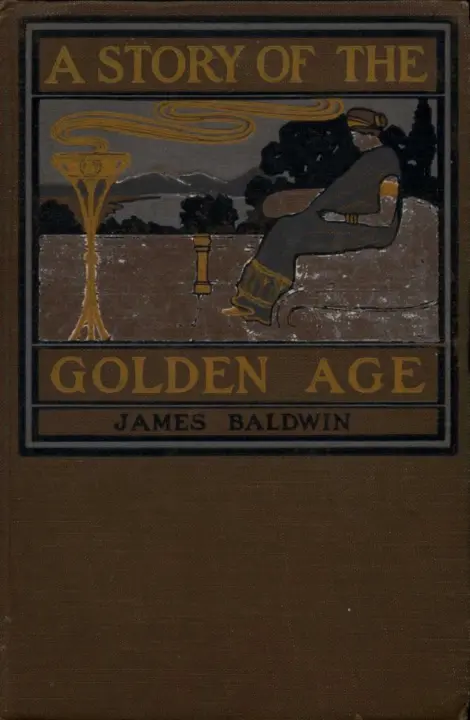
A Story of the Golden Age
James Baldwin
THE CLASSIC COLLECTION · 1892
"Six Centuries of English Poetry: Tennyson to Chaucer" by James Baldwin is a comprehensive anthology of Classic English poetry spanning from the 14th to the 19th century. Written in the late 19th century, this work is part of a series aimed at education, designed for students and teachers to explore notable English literary pieces alongside critical annotations and historical context. The book features selections from renowned poets like Tennyson, Wordsworth, and Chaucer, offering readers an insight into the evolution of English poetic expression through various eras. At the start of the anthology, Baldwin introduces the reader to the historical development of English poetry, suggesting that its roots trace back hundreds of years before Chaucer. He elaborates on the influence of earlier poets and the transition of language, connecting these historical elements to the richness found in later works. Baldwin points out the significance of understanding poetry not just as a literary form but as a reflection of cultural and historical shifts, emphasizing the importance of familiarizing oneself with poetic creations to appreciate their beauty fully. The opening sets a scholarly tone while making an engaging argument for the study of poetry as a vital component of English literature.
Introduction adapted from the source catalogue; source summaries may be automatically generated.
Free to read · English · 75,364 words · No account needed
MAKE TIME FOR A GOOD BOOK
On by default. Untick to stop anonymous reading totals. Each page counts after 10 seconds in view. How this works.
Anonymous counting is on unless you have switched it off.
St. Cecilia, the Christian Polyhymnia and patron saint of sacred music, is said to have suffered martyrdom about the year 230. In Chaucer's "Seconde Nonnes Tale"--which is an almost literal translation of the "Legenda Aurea," written in the thirteenth century--it is related that, on account of Cecilia's spotless purity, an angel came down from heaven to be her guardian. Her husband, Valerian, was also the recipient of angelic favors, for
"This angel had of roses and lilie
Corones two, the which he bare in honde,
And first to Cecile, as I understonde,
He yaf that on, and after gan he take
That other to Valerian hire make."
How and when Cecilia was first recognized as the patron saint of music does not appear. The legend only says, that
"While the organs maden melodie,
To God alone thus in hire hert song she;
'O Lord, my soule and eke my body gie
Unwemmed, lest that I confounded be.'"
There is also a tradition in the church that St. Cecilia was the inventor of the organ. Dryden calls her "inventress of the vocal frame" (see page 164). The origin of this musical instrument is not known, but the first organs used in Italy are said to have been brought thither from Greece. Some of the Roman churches are known to have had them in use in the seventh century, but they were not common until several hundred years later. The festival of St. Cecilia occurs on the 22d of November.
1. =ye Nine.= The nine Muses: (1) Calliope, the Muse of epic poetry; (2) Clio, the Muse of history; (3) Euterpe, the Muse of lyric poetry; (4) Melpomene, the Muse of tragedy; (5) Terpsichore, the Muse of choral dance and song; (6) Erato, the Muse of erotic poetry; (7) Polyhymnia, the Muse of the sublime hymn; (8) Urania, the Muse of astronomy; (9) Thalia, the Muse of comedy and idyllic poetry. The custom of invoking the Muses, at the beginning of poems, is derived from Homer:
"Of Peleus' son, Achilles, sing, O Muse." --Iliad, I, 1.
"Tell me, O Muse, of that sagacious man
Who, having overthrown the sacred town
Of Ilium, wandered far," etc.
--Odyssey, I, 1.
Milton invokes the
"heavenly Muse that on the secret top
Of Oreb, or of Sinai, didst inspire
That shepherd," etc.
--Paradise Lost, I, 1.
2. Observe how, in the sixteen lines following, the sound is made in some measure to be "an echo to the sense."
3. =equal temper know.= Evenness of disposition acquire. The music of Timotheus had an opposite effect on Alexander. See "Alexander's Feast."
Your reading position is saved on this browser. Take it to another device with a library code. Reading pages adapt to text, rather than matching a printed edition.
James Baldwin
James Baldwin
James Baldwin
James Baldwin
BEHIND THE BOOK
This eBook is for the use of anyone anywhere in the United States and most other parts of the world at no cost and with almost no restrictions whatsoever. You may copy it, give it away or re-use it under the terms of the Project Gutenberg License included with this eBook or online at www.gutenberg.org. If you are not located in the United States, you will have to check the laws of the country where you are located before using this eBook. Read the source licence.
The original source file, including credits and licence, is retained by this library. Request an original-format copy at no charge. Please include the book title and Project Gutenberg identifier #30235.
KEEP YOUR CURIOSITY GOING

Eric Mackay
Edmund Gosse
Sophia Margaretta Hensley
Gilbert Parker
George MacDonald

Elizabeth Bibesco