THE CLASSIC COLLECTION✦A dead man’s diaryCLASSIC FREE BOOKS
A dead man’s diary
Coulson Kernahan
THE CLASSIC COLLECTION · 1916
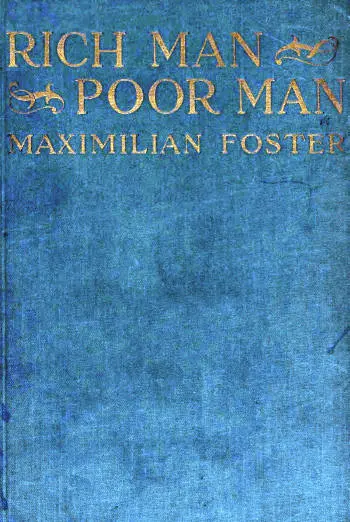
"Rich Man, Poor Man" by Maximilian Foster is a novel written in the early 20th century. The story explores themes of class, wealth, and personal connections, particularly focusing on the lives of Mr. Mapleson, a timid clerk in New York City, and Bab Wynne, a spirited young woman who is on the verge of discovering her true heritage. The interplay between these characters and their relationships will likely form a central part of the narrative as the plot unfolds. At the start of the novel, we meet Mr. Mapleson, an elderly clerk whose life appears mundane and lonely. On Christmas Eve, his character is established as he reflects on the loneliness and alienation he experiences, despite the joyful holiday spirit surrounding him. Meanwhile, the narrative shifts to Bab Wynne, who is depicted with a spirited demeanor that subtly suggests her yearning for a more exciting life, free from the confines of her boarding house existence. The initial chapters set the stage for a forthcoming transformation in their lives, hinting at the intertwining fates of the characters against the backdrop of societal expectations and personal dreams.
Introduction adapted from the source catalogue; source summaries may be automatically generated.
Free to read · English · 58,624 words · No account needed
MAKE TIME FOR A GOOD BOOK
On by default. Untick to stop anonymous reading totals. Each page counts after 10 seconds in view. How this works.
Anonymous counting is on unless you have switched it off.
"Mr. Lloyd was here, sir, and left. It was an hour ago."
Again a growl left Beeston.
"I know when he left! What I want to know is--has he come back?"
On being informed that Mr. Lloyd had not returned, Beeston struck the floor a vicious blow with his stick.
"He'll be back and I want to see him! You hear? You let me know the
instant he comes in!"
"Very good, sir," Crabbe replied and, dismissed with a brusque wave of the hand, withdrew to the pantry. Then, freeing his arm from Cater's, Beeston gave him, too, a knockdown scowl.
"Get out!" he ordered. Cater, as ordered, got out.
Bab was still there on the stairs. That raw, ill-mannered roughness so often Beeston's mood was too old a story now for her to give much heed to it, and she was moving off indifferently when he put a hand swiftly on her arm.
"Wait!" ordered Beeston. "You hear? Wait!" Bab gazed at him wide-eyed. "I want to have a look at you," said Beeston.
His mouth set, his lips protruding on themselves, he stamped up the hall a way, and, pushing a button set there in the wall, sent a flood of light pouring down from the chandelier. Then he came pounding back.
"Now stand where you are!" directed Beeston.
Bab in wonder obeyed. To be inspected, to be looked over, appraised and then admired may perhaps be the object all women have when they array themselves in all the allurement of their dress. But what an inspection this was! Not even in her last survey before the mirror had she given herself a closer, a more critical scrutiny.
"Turn round!" directed Beeston.
Bab turned.
"Now turn the other way!"
Again she turned. Her head poised, wondering, she watched him over her shoulder. Beeston had bent forward now, both his gnarled hands clasped upon his stick, and under their heavy lids his somber eyes pored over her. What his motive was in looking her over like that she had not the faintest notion. Then of a sudden Beeston spoke.
"Huh!" he said, his tone a half-contemptuous growl. "Good-looking, you are, aren't you! A handsome piece, and healthy and strong too! Yes, that's what you are!" Then with a sudden movement, surprising in its swiftness, he bent over and tapped her on the arm. "Lucky for you!" he said. "Lucky for you!" The words still on his lips, he indicated the library door. "Davy's in there. You go to him, you hear?" The next instant he was gone, calling as he stamped along the hall: "Crabbe, Crabbe, come give me an arm up the stairs!"
Your reading position is saved on this browser. Take it to another device with a library code. Reading pages adapt to text, rather than matching a printed edition.
BEHIND THE BOOK
This eBook is for the use of anyone anywhere in the United States and most other parts of the world at no cost and with almost no restrictions whatsoever. You may copy it, give it away or re-use it under the terms of the Project Gutenberg License included with this eBook or online at www.gutenberg.org. If you are not located in the United States, you will have to check the laws of the country where you are located before using this eBook. Read the source licence.
The original source file, including credits and licence, is retained by this library. Request an original-format copy at no charge. Please include the book title and Project Gutenberg identifier #46945.
KEEP YOUR CURIOSITY GOING
Coulson Kernahan

Maurice Baring
Frances Wright
Cécile Tormay

Frederic Jesup Stimson

W. H. P. (William Henry Pope) Jarvis