THE CLASSIC COLLECTION✦A dead man’s diaryCLASSIC FREE BOOKS
A dead man’s diary
Coulson Kernahan
THE CLASSIC COLLECTION · 1916
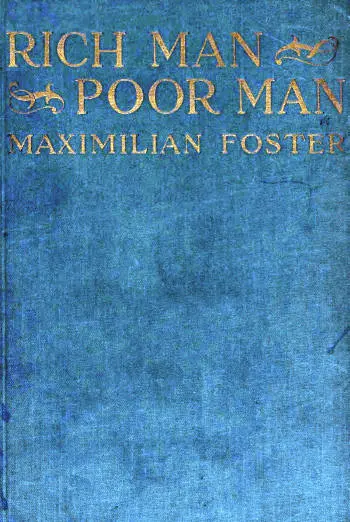
"Rich Man, Poor Man" by Maximilian Foster is a novel written in the early 20th century. The story explores themes of class, wealth, and personal connections, particularly focusing on the lives of Mr. Mapleson, a timid clerk in New York City, and Bab Wynne, a spirited young woman who is on the verge of discovering her true heritage. The interplay between these characters and their relationships will likely form a central part of the narrative as the plot unfolds. At the start of the novel, we meet Mr. Mapleson, an elderly clerk whose life appears mundane and lonely. On Christmas Eve, his character is established as he reflects on the loneliness and alienation he experiences, despite the joyful holiday spirit surrounding him. Meanwhile, the narrative shifts to Bab Wynne, who is depicted with a spirited demeanor that subtly suggests her yearning for a more exciting life, free from the confines of her boarding house existence. The initial chapters set the stage for a forthcoming transformation in their lives, hinting at the intertwining fates of the characters against the backdrop of societal expectations and personal dreams.
Introduction adapted from the source catalogue; source summaries may be automatically generated.
Free to read · English · 58,624 words · No account needed
MAKE TIME FOR A GOOD BOOK
On by default. Untick to stop anonymous reading totals. Each page counts after 10 seconds in view. How this works.
Anonymous counting is on unless you have switched it off.
The music had ended. In the stir that followed, the momentary confusion as the dancers, separating, strayed toward their seats, Varick glanced irresolutely about him. If he were to do anything he must do it quickly, he saw.
Beeston, his face menacing, was already halfway across the ballroom floor. The jig was up--that was evident. One needed but a look to see this, and Varick, as he caught the look on Beeston's face, felt his heart sink. It was not of himself, though, that Varick thought.
Bab stood there, gay in her borrowed plumes, the pearl, the great gem Beeston had given her, nestling on the snowy whiteness of her breast; and in spite of the cloud, the troubled bewilderment that still clung darkly to her eyes, Varick thought he had never seen her more brilliant, more bewitching. But now, it happened, not even her charm, her witchery, were to avail her.
Varick pondered swiftly. Should he tell her? It would be a mercy, he felt, however he told it, to forestall the brutal way he was sure Beeston would blurt it out. And that, too, was why he had come there, an unbidden guest, forcing his way into the house. It was to save Bab, it was to rescue her from just some such scene as this. But the instant Varick looked at her the words flocking to his lips died there. His heart failed him. He hadn't the courage to do it.
Tell her she was a fraud! Tell her she was a cheat, an impostor! He groaned to himself at the thought. Still irresolute, he had turned to glance apprehensively across the ballroom, when he felt a hand touch him quietly on the arm. David stood beside him.
From his place in the corner David, too, had seen Beeston enter the ballroom; and he too, it seemed, had divined instantly what brought his grandfather. Lloyd, David's father, had carried out his promise; he had told Beeston of the fraud. And David, knowing Beeston, knew too what they might expect of him now that he had learned. Surprisingly, however, it was for Varick, not Bab, that David was concerned. Bab he did not even seem to consider. As he touched Varick on the arm he spoke, and his voice was grave with warning.
"You'd better go," said David.
No need to tell Varick that. He had been convinced of this the instant he had glimpsed Beeston. Even so, however, this was not the question. It was, instead, how he could get Bab out of that ballroom, the house itself, too, so there should be no scene.
David interrupted his thoughts.
Your reading position is saved on this browser. Take it to another device with a library code. Reading pages adapt to text, rather than matching a printed edition.
BEHIND THE BOOK
This eBook is for the use of anyone anywhere in the United States and most other parts of the world at no cost and with almost no restrictions whatsoever. You may copy it, give it away or re-use it under the terms of the Project Gutenberg License included with this eBook or online at www.gutenberg.org. If you are not located in the United States, you will have to check the laws of the country where you are located before using this eBook. Read the source licence.
The original source file, including credits and licence, is retained by this library. Request an original-format copy at no charge. Please include the book title and Project Gutenberg identifier #46945.
KEEP YOUR CURIOSITY GOING
Coulson Kernahan

Maurice Baring
Frances Wright
Cécile Tormay

Frederic Jesup Stimson

W. H. P. (William Henry Pope) Jarvis