THE CLASSIC COLLECTION✦A dead man’s diaryCLASSIC FREE BOOKS
A dead man’s diary
Coulson Kernahan
THE CLASSIC COLLECTION · 1916
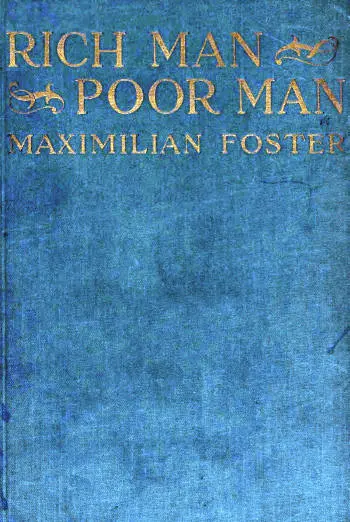
"Rich Man, Poor Man" by Maximilian Foster is a novel written in the early 20th century. The story explores themes of class, wealth, and personal connections, particularly focusing on the lives of Mr. Mapleson, a timid clerk in New York City, and Bab Wynne, a spirited young woman who is on the verge of discovering her true heritage. The interplay between these characters and their relationships will likely form a central part of the narrative as the plot unfolds. At the start of the novel, we meet Mr. Mapleson, an elderly clerk whose life appears mundane and lonely. On Christmas Eve, his character is established as he reflects on the loneliness and alienation he experiences, despite the joyful holiday spirit surrounding him. Meanwhile, the narrative shifts to Bab Wynne, who is depicted with a spirited demeanor that subtly suggests her yearning for a more exciting life, free from the confines of her boarding house existence. The initial chapters set the stage for a forthcoming transformation in their lives, hinting at the intertwining fates of the characters against the backdrop of societal expectations and personal dreams.
Introduction adapted from the source catalogue; source summaries may be automatically generated.
Free to read · English · 58,624 words · No account needed
MAKE TIME FOR A GOOD BOOK
On by default. Untick to stop anonymous reading totals. Each page counts after 10 seconds in view. How this works.
Anonymous counting is on unless you have switched it off.
It was after midnight; and at Mrs. Tilney's the household, at this hour usually plunged in slumber, had awakened to a hushed, subdued activity. Mr. Mapleson was dying.
It was about ten when Varick first had noted a change in him. For two hours Mr. Mapleson had lain among the pillows, his face passive, peaceful with a smile, and Varick had thought he slept. Then, as he looked up from the book he had brought to keep him company, he had seen Mr. Mapleson's eyelids flutter. His lips, too, moved as if he spoke.
"Anything I can get you?" asked Varick.
Mr. Mapleson did not appear to hear him. He seemed to be looking at something in the distance, and again his lips parted. Putting down his book, Varick bent over him.
"What is it, Mr. Mapleson?"
From a long way off came the little man's voice: "Keep step, John
Mapleson. Keep step!"
Varick was puzzled. He laid a hand on Mr. Mapy's shoulder, and the little man quivered as if he had been struck.
"Mr. Mapleson!" said Varick. "What is it?"
The slight figure on the bed stirred restlessly.
"Yes, that's me, John Mapleson, number 556, sir. Keeping step, ain't I? One, two! One, two!" Again he moved slightly.
Then Varick understood. In his dream, whatever it was, John Mapleson lived over again his life in prison. And Varick now realized, too, that he would not live it over very much longer. He gave the little man one more glance, then went hurrying down the stairs to Mrs. Tilney's door. The doctor had come immediately. One look at Mr. Mapleson told him the story, and in haste a nurse was summoned. Before midnight she was installed--a young, pleasant-faced girl, pretty in her crisp blue gingham dress and white cap and apron.
For two hours now Mrs. Tilney had been running up and down the stairs to Mr. Mapleson's door. She did not enter, however, until she had made sure the nurse had all she needed. Then she came in quietly and, with both hands resting on the foot piece of the little man's bed, Mrs. Tilney looked down at him. He was still unconscious. Varick, after a single glance at her, turned away.
"Good-by, John," said Mrs. Tilney and that was all. The words came from her like a croak. One had only to glance at the gaunt, unlovely face to read in it all that went with that farewell. Godspeed she gave Mr. Mapleson, and God, one can be very sure, heard her. Varick followed her into the hall.
"Just what did that woman say--the one that came to the telephone?" he
asked.
Your reading position is saved on this browser. Take it to another device with a library code. Reading pages adapt to text, rather than matching a printed edition.
BEHIND THE BOOK
This eBook is for the use of anyone anywhere in the United States and most other parts of the world at no cost and with almost no restrictions whatsoever. You may copy it, give it away or re-use it under the terms of the Project Gutenberg License included with this eBook or online at www.gutenberg.org. If you are not located in the United States, you will have to check the laws of the country where you are located before using this eBook. Read the source licence.
The original source file, including credits and licence, is retained by this library. Request an original-format copy at no charge. Please include the book title and Project Gutenberg identifier #46945.
KEEP YOUR CURIOSITY GOING
Coulson Kernahan

Maurice Baring
Frances Wright
Cécile Tormay

Frederic Jesup Stimson

W. H. P. (William Henry Pope) Jarvis