THE CLASSIC COLLECTION✦A dead man’s diaryCLASSIC FREE BOOKS
A dead man’s diary
Coulson Kernahan
THE CLASSIC COLLECTION · 1916
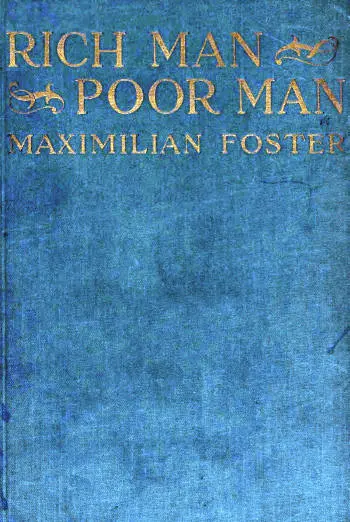
"Rich Man, Poor Man" by Maximilian Foster is a novel written in the early 20th century. The story explores themes of class, wealth, and personal connections, particularly focusing on the lives of Mr. Mapleson, a timid clerk in New York City, and Bab Wynne, a spirited young woman who is on the verge of discovering her true heritage. The interplay between these characters and their relationships will likely form a central part of the narrative as the plot unfolds. At the start of the novel, we meet Mr. Mapleson, an elderly clerk whose life appears mundane and lonely. On Christmas Eve, his character is established as he reflects on the loneliness and alienation he experiences, despite the joyful holiday spirit surrounding him. Meanwhile, the narrative shifts to Bab Wynne, who is depicted with a spirited demeanor that subtly suggests her yearning for a more exciting life, free from the confines of her boarding house existence. The initial chapters set the stage for a forthcoming transformation in their lives, hinting at the intertwining fates of the characters against the backdrop of societal expectations and personal dreams.
Introduction adapted from the source catalogue; source summaries may be automatically generated.
Free to read · English · 58,624 words · No account needed
MAKE TIME FOR A GOOD BOOK
On by default. Untick to stop anonymous reading totals. Each page counts after 10 seconds in view. How this works.
Anonymous counting is on unless you have switched it off.
Would he marry Barbara Wynne? That night with its train of abrupt, confusing happenings, all following swiftly, one hard on the heels of another, Varick ever afterward could remember only as the mind recalls the vague, inconstant images of a dream. The least of it all, though, was that veiled query put to him by Mr. Mapleson. However, he had still to answer it, even to himself, when the clang of the doorbell interrupted.
Outside in the vestibule stood two persons--a woman and a man. Their voices, as they waited, were audible through the glass; and Varick, once he heard them, listened curiously. Something in their tone was familiar, especially in the woman's tone; and though the footfalls of Lena, the waitress, already could be heard slipslopping on the stair, he did not wait. Instinctively he threw open the door.
It was as he'd surmised. The two outside were known to him, and for a moment he gazed, astonished. The lady--for manifestly in spite of her curious appearance she was that--was the first to break the silence.
"Bless me!" she said in a voice that boomed like a grenadier's. "If it
isn't Bayard Varick!"
Her escort seemed equally astonished. The gentleman, a middle-aged, medium-sized person with pale, myopic eyes, pale, drooping mustaches, and thin, colorless hair, gave vent to a grunt, then a sniff. The lady's buglelike tones, however, at once submerged this.
Her surprise at finding Varick there was not only startled, it was
scandalized, one saw.
"You don't mean you're living here?" she demanded. Afterward, having given her bonnet a devastating jab with one hand, she remarked eloquently: "My Lord!"
Varick in spite of himself had to smile. The world, or that part of the world at least which arrogates to itself that title, ever will recall with reverence--a regard, however, not unmixed with humor--that able, energetic figure, Miss Elvira Beeston. The chatelaine, the doyenne too, of that rich, powerful family, Miss Elvira enjoyed into the bargain a personality not to be overlooked. Briefly, it would have made her notable whatever her walk in life. But never mind that now. In years she was sixty--that or thereabouts; in figure she was short, not to mention dumpy. Bushy eyebrows, a square, craggy face, inquiring eyes and a salient, hawklike nose comprised other details of her appearance.
As the prefix suggests, Miss Elvira never had married. There were reasons, perhaps. Of these, however, the one advanced by the lady herself possibly was the most plausible. "Life," she was heard to observe, "has enough troubles as it is."
Your reading position is saved on this browser. Take it to another device with a library code. Reading pages adapt to text, rather than matching a printed edition.
BEHIND THE BOOK
This eBook is for the use of anyone anywhere in the United States and most other parts of the world at no cost and with almost no restrictions whatsoever. You may copy it, give it away or re-use it under the terms of the Project Gutenberg License included with this eBook or online at www.gutenberg.org. If you are not located in the United States, you will have to check the laws of the country where you are located before using this eBook. Read the source licence.
The original source file, including credits and licence, is retained by this library. Request an original-format copy at no charge. Please include the book title and Project Gutenberg identifier #46945.
KEEP YOUR CURIOSITY GOING
Coulson Kernahan

Maurice Baring
Frances Wright
Cécile Tormay

Frederic Jesup Stimson

W. H. P. (William Henry Pope) Jarvis