THE CLASSIC COLLECTION✦A dead man’s diaryCLASSIC FREE BOOKS
A dead man’s diary
Coulson Kernahan
THE CLASSIC COLLECTION · 1916
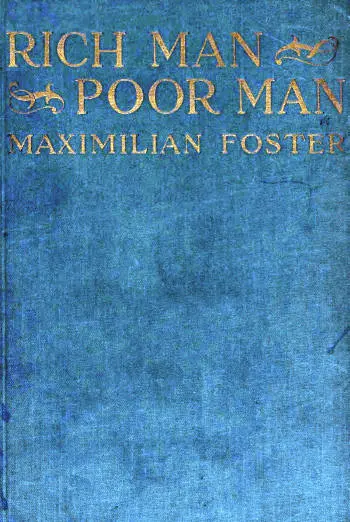
"Rich Man, Poor Man" by Maximilian Foster is a novel written in the early 20th century. The story explores themes of class, wealth, and personal connections, particularly focusing on the lives of Mr. Mapleson, a timid clerk in New York City, and Bab Wynne, a spirited young woman who is on the verge of discovering her true heritage. The interplay between these characters and their relationships will likely form a central part of the narrative as the plot unfolds. At the start of the novel, we meet Mr. Mapleson, an elderly clerk whose life appears mundane and lonely. On Christmas Eve, his character is established as he reflects on the loneliness and alienation he experiences, despite the joyful holiday spirit surrounding him. Meanwhile, the narrative shifts to Bab Wynne, who is depicted with a spirited demeanor that subtly suggests her yearning for a more exciting life, free from the confines of her boarding house existence. The initial chapters set the stage for a forthcoming transformation in their lives, hinting at the intertwining fates of the characters against the backdrop of societal expectations and personal dreams.
Introduction adapted from the source catalogue; source summaries may be automatically generated.
Free to read · English · 58,624 words · No account needed
MAKE TIME FOR A GOOD BOOK
On by default. Untick to stop anonymous reading totals. Each page counts after 10 seconds in view. How this works.
Anonymous counting is on unless you have switched it off.
Dinner at Mrs. Tilney's was at half-past six. At half-past seven the last of the guests would be served and Lena, the waitress, slipslopping wearily from pantry to dining-room, would begin clearing away for the night. The clatter of dishes precariously piled upon her tray was an intimation to those who lingered that they had better hurry.
On a Monday night, a week after his visit to the Blairs' summer place at Eastbourne, half-past seven was striking when Varick pushed back his chair from the table and arose. Only Miss Hultz, the Jessups, and Mr. Backus, the Wall Street gentleman, remained. The others, having finished, had sought either the parlor or Mrs. Tilney's front steps. Miss Hultz arose with Varick. She and Mr. Backus planned that evening to take in a moving-picture show near-by on Eighth Avenue.
The lady from Bimberg's wore a smartly cut polka-dotted voile that set off well her abundant charms. Delicately brushing the crumbs from her lap, she bestowed on Varick a flashing smile.
"I fancy we won't see much of you any more, Mr. V. Sorry to hear you're
leaving us."
Varick looked astonished.
"Why, yes," returned Miss Hultz, puzzled; "I heard you'd been promoted
at the bank."
Varick had indeed again been promoted, the bank having made him assistant cashier of its uptown branch; but, as he explained to Miss Hultz, that didn't mean he was leaving Mrs. Tilney's.
"Well, it'd mean it with me," she rejoined with conviction. "I ain't saying anything against Mrs. Tilney's, of course; only you know"--a sapient smile accompanied this--"socially, boarding ain't to my idea. Give me something select--an apartment hotel, say; or, if you'd be real swagger, Riverside Drive with your own bath and kitchenette. I always wanted to be a bachelor girl," Miss Hultz concluded.
Varick agreed with her. Nothing, he assured her, could be sweller. Miss Hultz, having gathered up her key, her handkerchief, her handbag and her evening newspaper, favored him with another flashing smile, then departed.
"The tray's ready, Mr. Varick," called Lena from the pantry door.
Varick thanked her, and was starting toward the pantry when Jessup, rising from his chair, touched him on the arm.
"How's the patient?" asked the bookkeeper. "Mapleson any better?"
Varick shook his head. Mr. Mapleson, he said, was still in bed. For a week now the little man had kept to his room. Either Lena or Mrs. Tilney carried up his meals during the day, and at night Varick volunteered. They none of them knew just what was wrong with Mr. Mapleson. He had refused to let a doctor see him.
Jessup frowned gravely.
"Any news?" he asked guardedly.
Your reading position is saved on this browser. Take it to another device with a library code. Reading pages adapt to text, rather than matching a printed edition.
BEHIND THE BOOK
This eBook is for the use of anyone anywhere in the United States and most other parts of the world at no cost and with almost no restrictions whatsoever. You may copy it, give it away or re-use it under the terms of the Project Gutenberg License included with this eBook or online at www.gutenberg.org. If you are not located in the United States, you will have to check the laws of the country where you are located before using this eBook. Read the source licence.
The original source file, including credits and licence, is retained by this library. Request an original-format copy at no charge. Please include the book title and Project Gutenberg identifier #46945.
KEEP YOUR CURIOSITY GOING
Coulson Kernahan

Maurice Baring
Frances Wright
Cécile Tormay

Frederic Jesup Stimson

W. H. P. (William Henry Pope) Jarvis